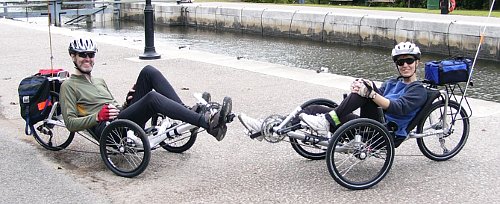
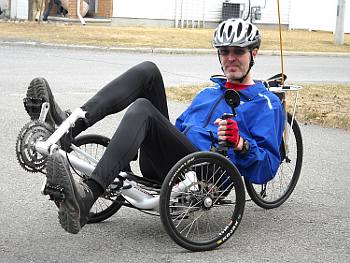
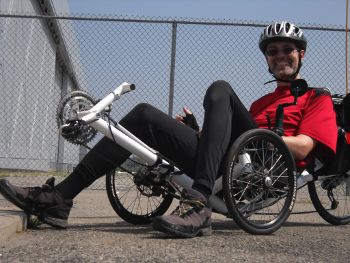
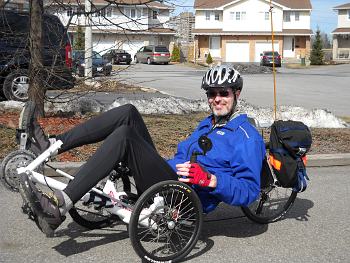
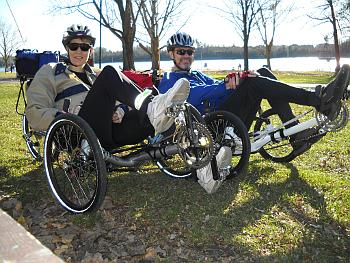
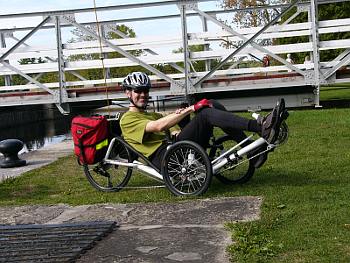
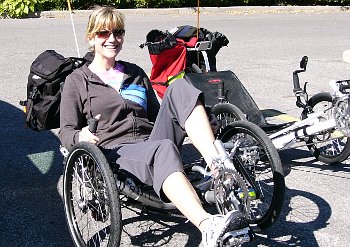
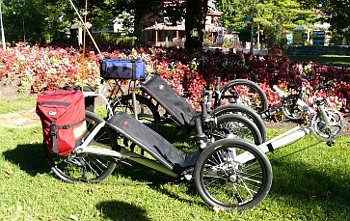
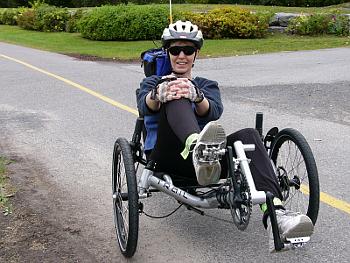
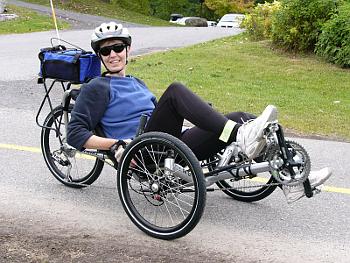
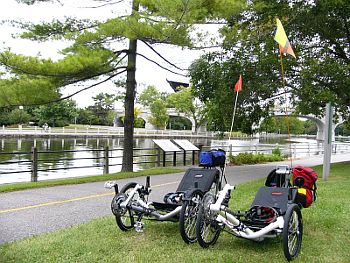
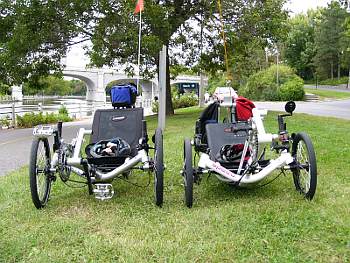
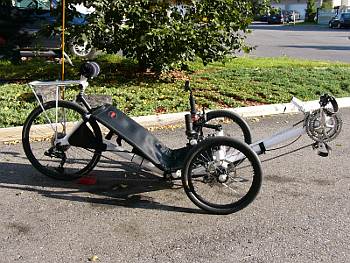
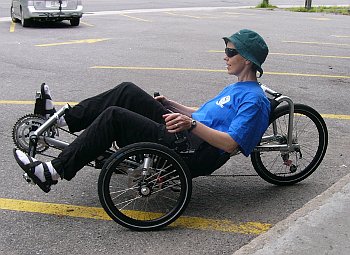
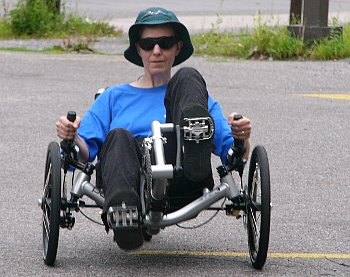
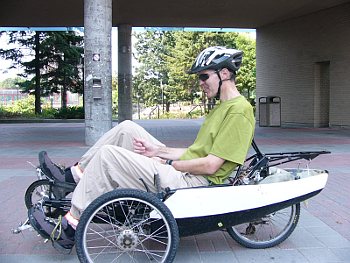
Adam on the Catrike Speed and Ruth on the Catrike Trail at the Rideau Canal Locks
Ruth and I both long owned mountain bikes, but it was really once we traded our old automobile for a pedal-powdered quadracycle that we became dedicated to cycling instead of driving.
As we got more into cycling and travelling everywhere under our own power, we appreciated the load-carrying capabilities of the quadracycle, but regulations and physical dimensions keep it off the city's bike path network and also prevent it from being electric powered in the future as an e-bike.
We have always been interested in other transportation solutions, but in the summer of Ruth really began to consider the advantages of a tricycle as a means of getting around. This lead her to order a Catrike Trail tadpole-style trike on , which was delivered on . On , while Ruth was waiting for hers to be delivered, Adam found a used model Catrike Speed for sale in the local area.
Since these vehicles are still relatively unusual in Ottawa, we thought we would keep a diary of our experiences here so others can find out what we learn as we go along. Ruth also has her own blog about Catriking.
Like most diaries, the most recent entries are at the top, so you will have to go to the bottom of the page to see the beginning of the story.
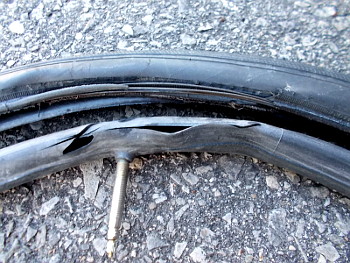
Schwalbe Stelvio tire and inner tube after the blow-out
It has been three years since I have written anything here, and because I am covering mostly maintenance issues here, that is a good thing!
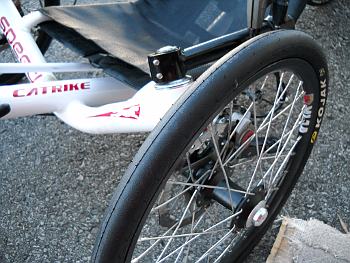
It was just a few weeks ago, on 14 May 2015, that I noticed that I had once again just about worn out a set of 16" Schwalbe KojaksETRTO standard ISO 5775 size 32-349 (16 x 1.125 in) tires on the trike front wheels. There was no scrubbing or anything, just after three years they were done, worn through. I was actually on a ride at the time and had to return home as one tire was starting to bulge!
I ordered a new set from my local bike shop, again and they came in pretty fast, in about two weeks. The new Kojaks are pretty much the same as the old ones, just with a new style of logo lettering that is bigger! More advertising, I guess. Today I installed them and the job went very easily, taking only about 15 minutes to complete. I inflated the tires and was ready to go again.
I decided to check the back tire pressure and that is where things went wrong. First the Presta valve stem broke in half, which wrote off the inner tube. That was no real problem, though, as I had two spare inner tubes!
So I changed the inner tube and inspected the rear tire, a Schwalbe Stelvio. Since this was OEM equipment on the 2006 model Catrike Speed, I suspect that it has been on the trike since new, but then the rear wheel is not subject to much wear, lacking steering and especially brakes.
I inspected the Stelvio tire, it looked fine, re-installed it and it appeared to seat fine. I carefully pumped up the tire and the bead held. I increased the pressure to about 110 psi (it is rated for 120 psi) and it looked good. Then the bead failed, tearing out the bead wire. I was holding in my hands as the bead was failing, but in under a second the inner tube exploded like a pistol going off. The photo above shows the damaged bead and the blown out tube.
I did have one more spare tube and a even a spare rear 20" tire, a Schwalbe Kojak that I had purchased a few years ago, especially to replace that Stelvio! So I was all set, or so I thought, but I couldn't get the new Kojak on the rim.
I didn't want to risk damaging the rim, the tube or the tire, so I decided to just take it all to my local bike shop and ask them to mount the tire instead. After checking it they determined that I had the wrong sized tire!
I had ordered the Kojak some time ago from my local bike shop as a replacement for the Stelvio. The mistake I made was going by the imperial size, as both tires are listed as having a 20 inch diameter, even though they are quite different sizes. It turns out the Kojak is an ETRTO 35-406 (20 x 1.35 in), while the Stelvio that actually did fit the rim was an ETRTO 28-451 (20 x 1.125 in). The Kojak was at one time OEM equipment on the Speed, but that must have been with a different rim, I guess. The solution was to order a Schwalbe Durano on 17 June 2015, which is an ETRTO 28-451 (20 x 1.125 in) tire. It arrived after five weeks, on 21 July 2015 and I picked it up the next morning, along with two spare tubes that I ordered. It looks good and it works well!
What happened to the ETRTO 35-406 (20 x 1.35 in) Kojak tire that I can't use? Since it was brand new my local bike shop initially said that they would give me a credit for it and resell it. Later they returned it to me and said that it was an unusual size and would be hard to sell. I now have it posted on Craigslist and Kijij.
My Catrike was out of service from 14 May until 29 July, 12 weeks, all waiting for tires to come in.
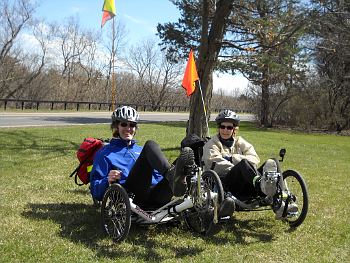
Adam with his Catrike Speed and Ruth with her Catrike Trail
The triking season actually started really early this year, on 21 March when we had a five day heat wave that sent temperatures into the 27°C range. Ruth set a 300 km goal for the season and we are well on our way in that endeavour. Ruth's Catriking blog will track that story over the summer.
To get the Catrikes on the road we just pumped up the tires and oiled the chains and we were off. Hopefully we will have some good weather this summer and that will allow Ruth to make her goal and for us to have some fun out cycling. You can never tell these years. Climate change is upon us and the weather can now be anything.
I was recently on the Catrike company website and discovered a few things. First of all they have cut the line down to only six models now, the Expedition, Pocket, Road, Trail, Villager and 700. Gone are the kid's Dash, the Musashi two-wheeler and, yes, my model the Speed. This probably makes sense as the 700 is really the new "speed" model and is almost identical, except with a 700 mm rear wheel in place of the Speed's 20 inch one. But it does mean that my Speed is now pretty much a collector's item.
The Speed was introduced in and discontinued in , an eight year production run. Mine is a model, built in the middle of the run. If you own a Speed, hang onto it!
It has been almost two years since I did a 100 km trip out to Carp Airport and back and this year I had a good reason to do a similar distance. The event was the Carleton Place Fly-in and Lunch Barbeque, a distance of almost exactly 100 km from home, round trip.
The day, , turned out to be perfect, with a daytime high of about 21°C, light winds and clear skies. Because the Carleton Place Aerodrome is west of Ottawa I would even have the sun behind me on the way out in the morning and then again on the way home in the afternoon. I had actually done this trip in on my old 12-speed Norco mountain bike and while it was possible to complete the trip, it took 5.5 hours of pedalling and left me pretty sore, too, in the back, wrists, neck and especially the butt. That is a long way on a mountain bike! As the distance is actually 99.4 km my average speed then would have been 18.1 km/h. This year I had hopes that the Catrike ride would be more comfortable and also a bit faster and both turned out to be the case.
It is worth noting that, travelling that far from home, I ensured that I had a wide selection of tools and parts. I could fix a broken chain or a flat tire and just about anything else that I might have encountered. None of the tools were needed, however, and the Speed performed flawlessly. Traffic was no issue, either as this route is just about all on-road bike lanes or rural highways that are lightly travelled. The bike lane on Hunt Club Road needed sweeping, as usual, as the bike lane had far too many car parts in it, trailer bolts, mufflers, catalytic converter shields, tail lights and such. Once home I called the city to let them know it required sweeping again. I am not sure why there are so many car parts all over the bike lane, I mean if bikes spewed parts all over the car lanes, then drivers would be irate.
People come to the fly-in to see and talk aircraft, not bikes, and so when I arrived I tucked the Speed away in a friend's hangar for the event, but it still got a number of questions from attendees who had seen it. I offered, but none of the mostly middle-aged crowd wanted to try sitting on it. "Looks comfortable." "It is, wanna try the seat out?" "Oh, no thanks, I'm afraid I'd never be able to get up again."
I left home at 0730 hours and arrived at the fly-in before 1000 even with a couple of stops enroute. After lunch and some aircraft photography I was on my way just after 1400 and back home at at 1640 hours. My pedalling time was 4.7 hours this time and my average speed was 21.1 km/h. More importantly the trip was much more enjoyable and comfortable. The Catrike is definitely the vehicle to use for these longer trips. By the time I got home my legs were tired, but nothing else hurt. The ride home was pleasant enough and didn't take any longer than the trip out had.
My new front tires came in a this past week and I got a chance to install them on Friday, just in time for Canada Day and the fly-in at Rockcliffe Airport. Ruth wanted to trike to that event so I had to make sure the tires were on and I was ready to go on time!
Removing the old 16" Schwalbe Kojaks and installing the new ones went smoothly, nothing like removing the old Greenspeeds, which were close to impossible to pry off. Once they were installed and inflated I carefully measured the toe-in and it was still perfect at 1/16".
So today we got out early and did the 50 km round trip via the pathway system, saw the Canada Day Fly-in At Rockcliffe and made it home all without incident and the new Kojaks performed well. I even hit 48 km/h on the big hill in Rockcliffe. Back home I checked the toe-in and it was still right on. I am going to check this regularly and make sure it stays that way, if only to save money on tires!
While we were checking the trikes over at home we removed Ruth's seat and reinstalled it in an attempt to get it to fit right. Being a model her Trail has the more modern seat design with the multiple pockets on the back. It has started to squirm on her and wants to rotate on the seat tubes. After a bit of wrestling with it, we got it back on a bit straighter, but it seems to have developed a "memory" and isn't happy being square on the seat frame. Ruth reports it isn't uncomfortable that way, however. This seems to be one advantage to the earlier and simpler seat design like I have on my model Speed, it shows no sign of wanting to move on the frame.
I decided yesterday to go ahead and change my chain. As I mentioned before it was five years old and had been through three owners, including me, so its history is a bit suspect.
With Ruth's help I removed the old chain, cleaned it and measured it. Twenty-four links came to 12.25", which is normally the sign of a stretched chain, but the new ones out of the box have the same measurement. Regardless the old chain has had one break already and I really didn't want to push my luck with it.
Removing the chain is easy, especially with someone to help. I put it in top gear, had Ruth take the the tension off the chain and just snapped one of the power links off. Then I pulled it through the chain-rings, sprockets, idler and guide tubes and got it free of the trike. After cleaning it we measured it at 153" plus the one powerlink to connect it, which seems to be pretty optimal for the Speed with the boom tube fully extended. In this case optimal means that the chain is not under tension when in the largest sprocket and largest chain-ring, that the derailleur still has some spring in it.
The new chain, or rather chains, since I bought three, are 114 links each. That gives them a nominal length of 171", so lots to do the job, with a few inches left over. Since 153" seems to be ideal, we connected the three chains and then measured it out to that length and used the chain tool to punch out the rivet to get the right length.
Installing the chain was as easy as threading it onto the chain-ring and then following the routing though the guide tubing, idler, sprockets and then through the derailleur, back though the guide tubing and up to the chain-ring again. As can be imagined this is rendered much easier with someone to feed you the chain as you guide it through and Ruth did that job admirably. I joined it with the powerlink and then we tested it out to make sure I had routed it right, which I hadn't. I had missed one guide on the front derailleur, so breaking the chain at the powerlink and rerouting it quickly fixed that.
Ruth held up the rear wheel while I ran it though all gears to make sure everything was smooth and correct, which it was this time. Then I lubed the chain and we were all done.
I also wanted to investigate the tire situation more closely. I started by carefully marking the front tire centre-lines with a grease pencil and then we did a careful check of the toe-in. As mentioned before I had carefully set the toe-in when I got the trike and have checked it a number of times since then. This older model has a tie rod that can only be adjusted by removing one bearing bolt and then screwing the bearing in or out to adjust the toe-in. There really isn't any way it can change over time. We checked it carefully and it was 1/4" out, with 5/16" toe in, easily enough to quickly write off a pair of tires. The odd thing is that if it was like that all along then the tires would have worn out a lot sooner and not taken a year and half.
We adjusted it back to the specification 1/16" toe in, but I have no idea how it changed. We checked the whole steering chain and there is no looseness and hardly any play in it. I am at a loss to explain it. All I could do it order some new tires. Since the tires didn't seem to be the problem I ordered another set of Schwalbe Kojaks as these seem to be the fastest tires available for this trike. Also the factory is using the Kojak on the front of the 2011 model Speed, with a Schwalbe Durano on the rear, so that is an endorsement of the tire.
You can be assured that I will be checking the toe-in even more often, from now on.
Ruth and I have actually been doing quite a bit of cycling this year so far, as least when it hasn't been raining. April and May were very wet, April even set records for rainfall. Today looked like a good morning, Ruth wasn't up for a ride, so I decided to go downtown and back on my own by Catrike Speed.
It rained last night, but not a lot. By dawn the streets were slowly drying out in the high humidity. The day was dull at first, with early summer fog hanging around, overcast and a little cool at 18°C, actually perfect for a ride. The weather forecast indicated a risk of showers this afternoon, which worked out well as I was planning to leave about 0830 and be back by 1030, long before it would get wet again.
I pumped up my tires to 110 psi and hit the road at about 0840. I passed along the fairly quiet urban streets, though Mooney's Bay Park and its bike trails and hit the start of the Colonel By Drive and the south end at 0902 hrs. The Colonel By is closed on Sundays in the summer from 0900-1300 for non-motorized recreational use. There were very few bikes on the road, but there was a running race on, with headquarters near Dow's Lake. The day was still grey and foggy, with even the odd spit of rain evident. I wasn't concerned as the Colonel By Drive has numerous bridges over it to shelter under, if the need really arises.
Proceeding further north I was keeping my speed up and was only passed by two cyclists on road racing bikes who were older than me! I passed all the rest of the traffic. I made it to the far north end at downtown in 36 minutes from home, covering the 14 km at an average of 23 km/h, which isn't too bad.
I took took a break, drank some water and chatted with the crew from KPMG who were supervising the barrier keeping the cars out, all in the shadow of the Dead Mackerel (the new Ottawa Convention Centre).
The run home was almost as fast, being a slight net up-hill. Still the Colonel By Drive was not very busy at all, with the exception of the road race going on. The skies were breaking up and there was a bit of sun and cumulus cloud quickly building. I was thinking with the temperature at 19°C, the dew point at 18°C and the lifted index so positive that there was a real risk of showers developing right out of the fog. Just past Mooney's Bay it was evident that there had been a pretty big rain shower just through, as the streets were puddled and the sewers gurgling. My Catrike Speed has no fenders, so if the road is wet it throws water everywhere, including from the rear wheel through the mesh seat. You get wet pretty fast.
I tried to stay out of the worst of the puddles, but it was obvious that as I went south that the rain had been heavier there. I tuned from McCarthy onto Hunt Club and headed down the hill to Airport Parkway in the bike lane. The lights were green at the bottom of the hill for once so I sailed though the intersection doing 45 km/h, with water spraying everywhere. The momentum carried me most of the way up the east side hill and then on home. It was a nice fast end to the run.
Back home the skies had cleared out nicely, although it looked like another shower could spring up any time. Parking the Speed in the driveway it was wet and dirty and so was I. It seemed like a good time to wash it and so got out the soap, sponge and hose. While I was at it I decided to wash my Norco Alpine mountain bike as well, as it was fairly dirty from its trip though the Greenbelt Pathway on Wednesday. Cleaned and dried, I oiled both chains, put the bikes away and went to change into some drier clothes.
I have a new chain for the Speed since I had a break on it last season and the chain is original and thus five years old. The cycle has a very long chain; I checked with the local Catrike dealer Les Bicyclettes de Hull and they confirmed that three SRAM chains joined together are the solution. These are available at any bike shop, so I picked them up at my local bike shop. It saved the long trip to Gatineau and it is always good to support your local bike shop if you want them to stick around. Now I just have to install the new chain. The question is do I wait a while and risk another break or do it now? I will probably tackle that soon as it adds confidence when away from home to know that you have a good chain on the trike.
The other issue that has recently come up is tires. I just put the new front tires, Schwalbe Kojaks, on in and already they are close to worn out. I don't know how many kilometres I have on them, but it can't be over 1500, tops. As soon as I noticed the wear I checked the toe-in, but it seems fine. Perhaps the problem is just that slicks wear out fast? It looks like time to shop around and see what my options are for replacements.
On Friday the day was warm enough to get our bikes out of the garage and get them tuned up for summer time! Even better we had had a big rainfall since the last city salt-spreading and that washed away the salt. Personally I don't get my bikes out until the salt is gone, the corrosion isn't worth it!
We checked everything over, pumped up the tires, lubed the chains, tightened up Ruth's Catrike Trail's wing mirror and that was just about all that needed doing. Ruth was keen to get her Trail out on the road and so she made the first Catriking trip of the season for us on Friday. After tuning up my old 1986 Norco Alpine mountain bike, I took that for a run, but didn't change into my tights to take my Catrike Speed out. Regular pants are not a good idea on a Catrike, especially on the quite recumbent Speed as everything falls out of your pockets and the wider pant cuffs end up in the chain ring. It's tights or nothing.
Ruth has already written up her ride on her blog, and you can tell that she is enthusiastic about the cycling season.
It was only today, on Sunday , that I had a chance to dig out the tights and take my Speed out for a run. I was waiting for the afternoon, for the day to warm up a bit, but then I checked the weather radar and noted that the threatened low pressure system was coming in fast and that I only had an hour or so until the rain started. That did leave me enough time though to do a short run around the neighbourhood for 7.5 km, without getting wet.
As Ruth noted on Friday, after winter it is great to be out Catriking, get out on the road and just go. The Speed, naturally, likes to go fast and so I ran it up to 30 km/h on some flat streets, did some fast corners and rediscovered the joys of riding it. It still wants to go fast and it still corners like it is on rails, the advantage of a very low, narrow design.
Ruth and I have already talked over some plans for the cycling season. She has set two goals, cycle camping and do a 100 km day. Both are fairly ambitious. I have already done a 100 km day trip and, while it is long, it is possible to do. Camping will be interesting. It should be easy enough with the trailer, but if we pack lightly it enough may even be possible without it. We shall see!
As long as the weather is not too wet this summer we should meet our goals, take some pictures and get some stories to write along the way.
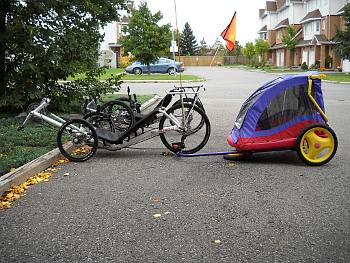
I recently picked up a bicycle trailer with the idea that we could use it for hauling freight using my bicycle and our trikes. I found the Little Tikes Cozy Cruiser on Kijiji at a very good price. It cost me $60, versus a new price of $230.
Picking up the trailer involved putting my bicycle on the front rack ("Rack & Roll") of an OC Transpo bus, getting off in Kanata and then biking ten km from there to furthest northwest reach of the city. The trailer I found had been well used by a young family, but was still in pretty good shape. After paying for the trailer I then towed it home another 45 km, which gave me a good opportunity to see how it towed.
The cruiser is obviously designed for hauling two children, but with its plastic hull, 44 lb (20 kg) empty weight and 100 lb (45 kg) capacity, it is also a useful freight carrier for moving groceries, computers or for camping with. On the ride home it towed very well, tracking straight, even with very little weight in it. It is also quite quiet on the asphalt, which is good. The Cruiser does add some drag and weight to the bike, but it is quite manageable, although I felt it back there, especially when going up hill. The wheels are plastic rims, 16" in diameter, with standard bike tubes and tires. Overall it is a nice design and very well thought out, it even folds flat for storage if needed. It has a retractable front wheel and handle, allowing it to be used as a push stroller, too.
On the ride home I determined that the Cruiser works well with my old mountain bike, so today, after having cleaned up the trailer, I wanted to see if it would attach to own Catrikes, with the thought of using it for camping. The short answer is "no". The Cruiser has a towing arm that ends in a rubber mounted joint and a special clamp that is designed to clamp onto the rear tubes of a standard bicycle. The Catrikes both have rear tubes that are too thick and also at the wrong angles to work with the clamp. This means that I have to get creative and will probably start with a troll though the bike shops to see if the clamp can be substituted with something else that will work better instead.
Overall the cruiser has lots of potential as a load-hauler and was cheap enough to make it worthwhile investigating ways of making it work with the trikes. I'll work on that and post more information when I make some progress.
Today is Sunday - one of our Sunday bike days here in Ottawa. Normally Ruth would be keen to head out on such a day, particularly as we had a cold front pass last night that swept away the heat and humidity and brought a cool and breezy morning. Unfortunately Ruth declared a "day-off" after a rather arduous hike yesterday.
I was determined to take advantage of the great weather and pored over the maps to pick a good route. I decided to try a distance and direction that we probably wouldn't do together and try that out. The Lucent-Alcatel Bike Days close a number of the NCC parkways here in Ottawa on summer Sundays and one we had hiked, but never biked, is the Rockcliffe Parkway, which is closed from the Canada Aviation and Space Museum all the way to Montreal Road from 0900-1300 Sundays. It is an 8 km stretch that runs within view of the Ottawa River in places and features forests of poplar, meadows and other attractions not often found in the city's built-up area. The reason we haven't biked it before is that both the start and end points are far away from our home near South Keys. The most logical way to get there is via the bike pathway that runs from Hog's Back through Vincent Massey Park, up through Rockcliffe Village, picking up the Rockcliffe Parkway to the aviation museum there. That makes it about 23 km just to get to the start of the 8 km road section and rendered the whole round trip 62 km.
The route to the start is the same as I have previously described, including the detour required along Heron Road and Riverside Drive to go around the closed section of the bike pathway network where bridge construction is going on. I left home at 0745, did the approach route and arrived at the Rockcliffe Parkway's barricades at 0904, just after it had been closed to motorized traffic.
That stretch of the Rockcliffe Parkway is amazingly smooth, the asphalt having been resurfaced just a few years ago. That makes it one of the nicest routes on which to Catrike in the whole city and actually worth the long trek just to have the opportunity to do so. The east-bound run was slightly up-hill overall, but with a slight tailwind. I saw speeds on the flatter portions of 30-35 km/hr with a bit of work, the smooth road making such speeds really pleasant. I arrived at the southeastern end of the route in just under 20 minutes. While taking a break for some water there I chatted with an in-line skater. He departed ahead of me, but I later caught him up and paced along with him and we talked about recumbent trikes, skating, teenagers and his latest challenge, osteoarthritis, which may shorten his skating years. He was enjoying the skating while he could and, despite the headwind on the west-bound run, he was making about 20 km/hr, which is a pretty fast skating pace. We parted at the western end of the route and, while he headed back the way we came, I started back for home.
My route back went quickly. The day didn't seem to be warming up much and the breeze was strengthening and cool, all of which added up to continuing great cycling weather. As I left the Rockcliffe area my route was south and so the northwest wind was more help than hindrance. I made a couple of brief stops and at one halt along the pathway near Billings Bridge I saw two trikes coming the other way down the pathway. This turned out to be a middle-aged couple from the Alta Vista area, who had seen us riding our Rhoades Car in the past. We chatted for a few minutes before they left to try the Rockcliffe Parkway themselves. They were riding an ICE Adventure and Catrike Pocket. The woman, who was of diminutive stature (4' 11"), found the small sized Pocket to be ideal after a long search for the right trike. They seemed quite pleased to have run into another trike on the pathway.
After bidding them farewell I had a smooth ride home, even smoother than usual since I was able to try out the newly resurfaced stretch of Hunt Club Road at Airport Parkway. The City of Ottawa did a great job on it and the uneven sewer grates and huge cracks are a thing of the past, greatly improving the route for cyclists. Now if only they had moved the curb and created a bike lane there, it would have been perfect. As a bonus I arrived home just in time for lunch as Ruth had made some pasta. I can't fault that, even if it was my turn to do dishes.
One last note, I owe some thanks to someone, but I don't know who. Part of my route to get to Mooney's Bay includes a bike and pedestrian pathway and tunnel under the railway tracks near Otterson. When I went through there outbound it was obvious that some nitwit had smashed a beer bottle in the middle of the pathway last night. I had stopped to brush the broken glass aside so as to at least make the pathway partly passable to bikes, but lacking the proper tools, could do no more. When I came back that same route the glass had been completely cleaned up. So "thank you" to whomever did that - it is greatly appreciated. As long as for each nitwit out there we have at least one person with a dustpan and brush, perhaps the world will be okay.
This year we have been getting out and enjoying the general lack of rain by using our Catrikes to go places. I have been leaving it to Ruth to write up most of these trips on her Catrike Blog, while I have been focusing more on technical issues here instead. The trouble is since the chain problem in May my Catrike has been performing flawlessly, other than one broken mirror, so there hasn't been much to write about.
Ruth's blog contains accounts of our 67 km trip to the Aylmer Yacht Club, two 40 km trips to Remic Rapids and our 80 trip to Kanata and back. The Catrikes make all of those trips easy and painless.
Today, with Ruth off to her Day of Mindfulness, I had the weather and the opportunity to do a solo trip. I chose to head off to Rockcliffe Airport and the Canada Aviation & Space Museum, partly to see what was happening out there, but mostly because we haven't been out that way this year yet.
My route was planned on roads to Mooney's Bay and then on the NCC pathway network. I ran into my first problem just north of Hog's Back Park - the pathway was closed and not just a bit closed, totally gated off. It seems to be part of the O-Train bridge work being done near Carleton University and the sign indicated that cyclists should find another route. They didn't offer any help, though. Fortunately I brought my city map and was able to locate the problem area and come up with a plan of some kind, although it involved backtracking and then cycling on Heron and Riverside Roads. This city has an insanely designed traffic system and so the corner of Heron and Riverside prohibits left turns northbound for no particular good reason. So I was forced to walk my bike across as a pedestrian and then pick up my track on Riverside. The big hill there gave me a chance to exceed 50 km/hr and the rough road gave me the chance to log some flying time under the bridge. I finally regained the bike pathway and continued my route just by Billings Bridge.
The rest of the route went fairly well, with only light traffic on the bike pathways for some odd reason. I departed the pathway at Dufferin and skirted Rideau Hall and cut though the quiet Rockcliffe Park neighbourhood. I made a bathroom stop at Rockcliffe Park, noting that it would be nice if the authorities had provided somewhere to lock up a bike there. In the end I locked it to a basement window bar on the pavilion building.
From the park the bike path continues east, getting narrower and rougher until it disappears at the top of the hill. I had brought along my camera with the intention of taking some video footage of the hill run. I must have remembered the hill as being higher and steeper than it really is, as it was quite disappointing for gaining speed on!
I did shoot quite a bit of video footage from there to the museum and at the museum and later turned it into a new video for You Tube. We now have eight of our own Catriking videos listed below in Catriking Resources.
The museum was fairly quiet with lots of construction under way building the new entrance and other facilities, although no actual work was being done today, being a Saturday. A few families were around and the Robinson R-44, de Havilland Beaver and WACO UPF-7 were all hopping rides for museum visitors, pretty much the only activity at the airport. The Rockcliffe Flying Club side of the airport looked very quiet with only one aircraft movement in the whole time I was there.
With cumulus clouds starting to pop up around 1100 hours and with showers in the forecast, I decided to get going back. My first stop was back at Rockcliffe Park after climbing the hill on the incredibly poor quality NCC bike path. The park features an ice cream concession stand run by the Boy Scouts and on such a warm day I couldn't pass up the opportunity to get a Tiger Tail cone. By the time I got going again the sky was looking darker.
The ride back was relatively quick and I was prepared for the transition to Riverside and Heron Roads this time to by-pass the construction. Because the turn at Heron and Riverside was a right turn I was even able to avoid walking my trike and could just merge onto Heron. In quick order I was back on the bike pathway, but the clouds were getting darker and more foreboding yet. It was after I turned onto McCarthy and started up the big hill that the first large raindrops started falling. About half way up the hill I decided I wouldn't even make it to the shopping mall at the top and moved the trike under some trees. The rain started coming down very hard and then the thunder arrived. Even under the trees the rain started making it to the ground. Finally after twenty minutes or so the deluge abated and, fairly well soaked anyway, I headed the last ten minutes ride home. There was still some lightning around and the road was quite puddled, with torrents running down the gutters and into the drains. The front wheels threw a lot of water into the air, but the disc brakes worked very well, a nice feature that calliper brakes can't match in wet conditions.
Back home the sun was starting to shine; I dried the trike off and put it away and then peeled off my wet cycling clothes and hung them up to dry. The trip totalled 48 km and was certainly the wettest ride I have had yet, although the Catrike Speed didn't seem to mind.
I am sure that we will do some more long trips and perhaps some more videos before the summer ends.
This week I noticed that my Catrike Speed needed a slight adjustment to its gears, since they were auto-shifting at times.
This was no problem, I just zeroed everything, re-rigged the gears and they worked fine. It was on the test run that things went badly. The gears were working just fine, but then suddenly, while 3.5 km from home, the chain broke and everything seized. A quick visual inspection revealed that a link pin had given way and the link had caught the chain protector plate and rotated it forward and everything had locked up.
Fortunately I carry a bunch of tools with me for this sort of problem, or at least almost for this sort of problem. I had rubber gloves to handle the chain and the tools to reset the chain protector, but no means to repair the chain. Lacking any other options I removed the chain, bagged it and then pushed the Catrike all the way home.
Once at home I changed into my coveralls and pulled the chain out to degrease it and carry out a visual inspection. Other than the broken link it looked fine. Lacking a link tool I couldn't do much so I called our local bike shop, to make use of their expertise. They suggested that I might need a new chain and that I should bring it and the gear cassette in for them to have a look at.
So this morning Ruth and I trekked up to the bike shop and let them have a look at the problem. They measured the chain and said that it was still serviceable. They figured that one pin had probably just given way and so they sold me a replacement speed link and a chain tool, which I will admit I needed anyway.
Once back home it was an easy job to remove the broken link, insert the speed link and put it all back together. With some degreasing, a wash and the chain lubricated, the Speed seems to be as good as new.
I am just glad the chain didn't break out on some rural highway somewhere, as I am not sure how I would have fixed that break-down.
The rear tire on my Catrike Speed is a Schwalbe Stelvio and starting late last season it developed a leak. The leak was insidious, at first it took a week or so to go from 100 psi to 20 psi. It was easy enough to just add a bit of air and keep riding.
As time went on the leak became worse. This spring I pumped it up and it went to 20 psi in about three days and then two. It never went actually flat, just lost most of the pressure and then seemed to stop leaking. I knew it wasn't a good sign.
So facing the inevitable I enlisted Ruth's's help and removed the back wheel. Then I got the tire off and removed the tube. The tube looked okay, although the tire didn't. It is holding together but someone at some point in time damaged the bead with something metal, probably a screwdriver.
So the next step was to try to locate the leak in the tube, so I added some air and dunked it in a sink full of water. The result was nothing - no bubbles at all. Sadly I wasn't surprised, as I suspected that a leak that slow that takes three days to deflate and only goes down to 20 psi is probably being caused by a faulty valve and not a hole in the tire. You can't make a hole that small.
No problem, I thought, as I have a spare tube, in fact it is a 20" X 1.125" Schwalbe tube. We struggled with that tube for a couple of hours without any luck. Its diameter is quite a bit smaller than the old tube I had and also smaller than the rim and as a result it has to be wrapped around the rim to be installed. At the valve there is no room between the tube and rim for the tire bead, it just doesn't fit, no matter what you do. We tried everything, including adding air, removing air, pushing the value up and trying to seat the tire - no go. I needed a different tube.
A trip to Wal-Mart showed that they have lots of 20" tubes but all for 1.75" and up, not for 1.125" tires. A check at the local bike shop turned up a 20" X 1.125" tube, but it was a Schwalbe, so that was out. Finally I tried another bike shop and they had a Kenda brand tube. As a bonus it was half the price of a Schwalbe tube.
I brought the Kenda home and we had it and the tire installed in about two minutes, with almost no effort at all. I took it out for a spin and it works great.
I am not sure what the moral of this story is, but it could be that Schwalbe tubes don't fit Schwalbe tires, but Kendas tubes do.
This past winter was a poor affair with little snow and darn little skiing as a result, too. Given that, we were both happy when spring seemed to come early, the last few weeks marked by temperatures above zero and what little snow and ice there is on the ground quickly disappearing.
In fact by the time this last weekend arrived there was more salt around than snow, the city having dumped tons of salt in thick drifts everywhere. I refuse to go out cycling when there is salt around as it ruins bikes very quickly and so this past Sunday was great boon as we had 18.6 mm of rain, which washed all the salt down the drains and into the river. Today was actually dry and warm, with a temperature of 13C and so Ruth was chomping at the bit to get out triking, as is evidenced by her diary entry.
So we pumped up our tires and, with a stiff east wind, we went for a 6 km run in the local area. The trikes performed well and seemed glad to get out of the barn for a run. The road gutters are full of gravel and so it will be nice once the city sees fit to send the sweepers around to clean things up. We did some speed runs and I managed to hit 39 km/hr with a bit of a tailwind and Ruth got to 34 km/h. Over the winter I had almost forgotten how much fun the Catrike is when you are going fast. It feels tight and responsive and just wants to go as fast as you can make it go.
I noticed on the way back that my Speed wouldn't shift its front sprocket into low range and so once home I determined that I had a loose return spring, due, unfortunately, to a broken tang on the derailleur. It can't be fixed and so I will have to go up to my local bike shop tomorrow and get a new derailleur for the trike. Otherwise it seems to have survived the winter intact.
Ruth is keen to get out training, not for speed, but for distance as she wants us to do some longer trips this year. After having survived my 109 km trip to Carp Airport I am happy to give it a try, as I know I can do those sorts of distances without much trouble. Last year's biggest challenge was the incessant rain. We will have to see how this summer pans out. Hopefully it will be drier, if this dry winter and early spring are any indication, although my concern is that this summer may turn out to be too dry, but we will see.
My new 16" X 1.25" Schwalbe Kojak tires finally arrived yesterday and so we hiked up Bank Street to my local bike shop to pick them up.
By the time we got home it was getting close to dark, so I opted to wait until the morning sunlight to install them. I got dressed up in my coveralls and set up all my tools in the driveway and set to work. I didn't get far. After almost an hour I had two broken tire irons and the old Greenspeed Scorchers were still on the rims, refusing to budge.
I decided to take the easy way out, pulled the wheels and brakes off and took the rims, with the old tires still on them and the new tires up to my local bike shop, where one of their keen young lads made short work of the problem and even sold me some new tire irons.
Back at home all that was required was to:
reinstall the front wheels
reinstall the brakes
adjust the brakes
inflate the tires to 90 psi
measure the tire circumference
reset the Filzer dZ2L Cycling Computer for the new diameter
check the toe-in once again
The new tires result in a slightly smaller circumference than the old tires. The Greenspeeds had a circumference of 1366 mm, which is a diameter of 434 mm (17.11 inches). The Kojaks have a 1283 mm circumference, which is a diameter of 408 mm (16.08 inches). The reduced tire diameter lowers the bottom bracket height to 16 3/4 (425 mm) from its previously measured 17 1/8 in (435 mm) with the Greenspeeds.
I checked the toe-in using the centreline seams on the tires and it was exactly right, 1/8" toe-in, which I suppose means that I got it right the last time I adjusted it.
Next, of course, was taking the Speed out for a test run before dark. I did a quick 5.4 km run around the neighbourhood in 15 minutes, averaging just under 22 km/h, despite all the stop signs!
It is hard to be precise, but my impression is that the Kojaks are a bit faster than the Greenspeed Scorchers, by perhaps 2 km/hr. That isn't really a surprise, given that the Kojaks are 1.25" wide against the fatter 1.5" Scorchers.
Of greater interest to me was checking to see if they would be more-bone jarring, as they are thinner in width and lower in height as well. My impression on our local roads is that they are about the same as the Greenspeeds for cushioning. So overall I am very happy with the Kojaks on the Speed.
Update -
Today Ruth and I went for a 15 km local ride, which gave me a better chance to try out the new Kojak tires. They actually performed very well. The cushioning is at least as good as the old tires and they do seem to be a bit faster. They corner like a dream, at any speed and, at least on the low-slung Speed, you hardly need to lean into the turns at all. Because they are a bit smaller in diameter and lower they even give more clearance between the steering levers and the tires, allowing more room for your hands or for adjusting the levers outwards. Overall I can recommend the 16" X 1.25" Schwalbe Kojaks for Catrikes, without any reservations.
Really nice days are generally rare in November in Ottawa, especially in the last few years as our previously cool and dry autumns have given way to wet days, courtesy of climate change. But today the forecast called for 12C and by mid afternoon it actually hit 16C. People were out in short-sleeved shirts, whereas the last few weeks have been strictly gloves and toques!
We decided to take advantage of the weather and go for a Catrike ride. I am still riding on nearly worn-out Greenspeed tires on the front wheels of my Speed, so I have been reluctant to go too far, for fear of getting stuck far from home with a blow-out. As a result we opted to pedal to Mooney's Bay and see how the beach looked. It seemed to be almost warm enough for a beach day, or at least for a picnic!
The car traffic on Hunt Club Road was surprisingly thick for a Sunday afternoon, although we did see a few bicycles out. On the plus side nobody seemed to be in a big hurry and the drivers were courteous.
Pausing at stops signs you could actually feel the warmth of the day from the clear skies and sunshine. The lack of wind made it seem even nicer yet. We arrived at Mooney's Bay quite quickly, with Ruth leading us both. There were a few people there playing tennis and even some kayakers, but no picnicers or swimmers! For some reason the parks administration takes all the picnic tables way in the winter, although the BBQ grills stay out. We found a fixed bench to stop at and admire the warmth and water, while snapping a few photographs.
Ruth didn't want to linger too long there so we soon retraced our route home, again without any problems at all. There has been a construction project on the south side of Hunt Club for some time that has previously left the bike lane full of debris or occasionally torn up, but that work seems to be all done now and the bike lane was quite usable.
Back home after completing the 12 km trip, we checked over the trikes, which, other than my rapidly-reaching-end-of-life tires, looked fine.
Good weather days are rare at this time of year, so we always try to make good use of them when they come up. Tomorrow promises to be warmer yet, so I know we won't spend it indoors.
It's been six months since I brought my Catrike Villager home from the dealer in Bentley, Alberta. With fair-weather riding drawing to a close and winter riding just around the corner, this seems a good time for a report.
The Villager is light – weighing just 32 pounds. That means I can carry it onto the elevator and through my apartment door. I still spend a lot of time admiring my new ride. The Villager's one-piece frame is beautifully made. The welds are beautiful and the components are all high-quality nicely finished pieces. I'm not sure why, but the aesthetic of the Villager seem French to me. In fact, the first thing I did when I got the Villager home was peel off the "Made in the USA" sticker. Why? Because whether it's
Harleys, Hummers, foreign policy or breast augmentation, "Made in the USA" is synonymous with "big, heavy and crude". The Villager, on the other hand, is small, light and refined. Credit for this must go to Catrike founder, designer and engineer Paulo Camasmie. To the best of my knowledge, Paulo was raised and educated in Brazil.
In the first month or so of riding the Villager, I had a couple of low-speed rollovers. The first was due to rider stupidity (I went looking for trouble and I found it). The second rollover involved a nasty bump and a sharp turn. I'm happy to say that I have not crashed since. Moving the grips up the bars (toward the kingpins) helped. When the grips were back near the end of the bars, there was just too much leverage. Moving the grips forward increased steering effort but also made smooth and subtle steering inputs much easier. The Catrike owner's manual recommends leaning into turns. Early on, I thought that only applied to "dare devil" situations, but now I lean into almost every turn. It's fun and it keeps both front tires on the pavement.
Speaking of tires, the Villager is fitted with Schwalbe's excellent Marathon Racer tire. My buddy Scott rides a Catrike Trail and we've logged a couple of 70 km days together. I can't imagine a better tire for riding on the road. The Marathon Racers are light, quiet and fast – and they're lined with Kevlar for a measure of puncture protection.
Scott on the Trail
In her September 16th post, Yay! Hooray! The Cats are Home!! Ruth mentioned that when riding her Catrike, bumps in the road made her eyeballs rattle. She added, "I felt every single little bump and dip." All Catrike frames are made of heat treated 6061-T6 aluminium alloy. Aluminium frames (especially one-piece frames) are light and strong but
also very stiff – hence the rattling eyeballs. Perhaps this explains why Schwalbe Big Apple (50-406) comfort tires are popular among Catrike riders. Greenspeed and TerraTrike build their frames from CroMoly steel. Steel offers a more forgiving ride, but adds about five pounds to the weight of a trike.
Sometimes I think I might prefer a CroMoly frame – for comfort's sake – but then I think about the times when pushing less weight is a genuine advantage. Abstract notions like "acceleration" and "top speed" become very real when I'm riding in traffic and the car driver behind me is getting impatient. A lighter trike is also preferable when riding into the wind or uphill. Of course, if I lost ten pounds....
After a month of two or riding the Villager, I started finding quite a number of loose spokes. I tightened them up as I found them, and didn't think much of it. Then I started experiencing front wheel shimmy. Where previously the front wheels would just shake off a bump, suddenly they began to shimmy. I sent an email to Mark Egeland at Catrike in Florida and he phoned me the next day! Mark assured me that if I needed upgraded bearings or bushings for the Villager, they would be sent free of charge. Eventually I found a Shimmy Checklist posted by Catrike boss Paulo Camasmie. Among the things that could cause or aggravate shimmy, Paulo listed under-inflated tires and loose spokes. I decided to check all my spokes. To my surprise, I found they were a total mess – everything from screaming tight to shoestring loose! This called for a truing
stand. I made an appointment with my local bike shop. They trued all three wheels for only $15.00. I've had no trouble with shimmy since.
I think the most telling thing I can say about the Villager is that it has extinguished my lust for Hase's Kettwiesel Ride delta trike. Despite its 7005 T6 Aluminium frame, the Kettwiesel Ride weighs 45.6 pounds – and you can't pile near as much camping gear on a delta as you can on a tadpole. To be fair, the Ride is weighed down somewhat by a limited-slip differential. The Kettwiesel Allround has an aluminium frame – and no differential – and it still weighs in at 39.4 pounds. Next year Scott and I are determined to ride 100km in a single day. I think I'd prefer to ride 100 km on a trike that weighs 32 pounds, not 45.6.
This is Jeff from Rebel Cycles in Waterloo, Ontario. With a studded tire on the rear wheel, Jeff rode his tadpole trike all winter. Read the whole story on the Bicycle Forest blog.
Unlike Adam and Ruth who have kept their mountain bikes and their Rhoades Car, I live with just one human powered vehicle. Tadpole trikes are at their best on long-distance road tours. Is there such a thing as a "general purpose" (all-surface, all-season) tadpole trike? Is the Villager that trike? It's too soon to tell.
After six months, here's what I know for sure. The Villager is a great grocery getter. Its 12.5-inch seat height and 5.5 inches of ground clearance are terrific in town where visibility and ease of use are more important than flat-out speed. I've tried the Catrike Trail – and I find the lower seat (9.25 inches) noticeably more difficult to get in and out of. That matters when I'm levering myself up and down several times while running errands.
I'm very happy with the Villager as an "out of town" trike. There are times when I'd like more top-speed gears, but during two 70 km highway loops, it was no big deal – certainly not enough to spoil the fun. The Villager is now available with the same 27-speed gearing used throughout the Catrike line-up. Nine-speed Villagers like mine can be easily upgraded.
Last week I bought some knobby tires for winter. The Villager seems kinda light in the tail for winter riding, but time will tell. This picture is my inspiration....
As I previously mentioned my trip to Carp Airport was successful, but left me with one of my front Greenspeed Scorcher slicks showing some fabric through the surface. That isn't good. I have no idea how long those have been on the trike, but the last owner said that it was the first owner who had installed them and not him. That tends to indicate that they were on the trike for over a year.
Also as mentioned when I got the Catrike Speed and checked the toe set on it I found it was way off, 7/16" toe out. The tires looked pretty scrubbed and that would be the reason why!
The only two questions I had at this point were whether to order new tires now or wait until spring and which tires to get.
The currently high Canadian dollar and some urging from Ruth that the season isn't quite over yet indicated that I should order some new tires sooner rather than later. Ruth made it clear that in the spring she wants to get out triking as soon as the weather is good enough and that she doesn't want to wait for me to get new tires then.
So that left the choice of tires. There aren't a lot of low-rolling resistance tires for 16" wheels around. The Schwalbe Stelvios that came with the model Catrike Speed are no longer available in that size. I decided to see what tires Catrike is using on the models and discovered that they are shipping with Schwalbe Kojaks (the "bald slick"). I found the exact tire on the Schwalbe North America website. It is a 16 X 1 1/4" tire designed to run at 70-115 psi and is a true slick, no tread.
So I took the easy way out and decided to order a pair from our local bike shop in south Ottawa. I should have them in one to two weeks.
In the meantime I have still been riding my Speed and just not going too far from home, plus carrying duct tape, just in case.
Update -
Yes, the tires should have been here by now, but a check with my local bike shop indicated that the distributor didn't have them in stock, they are back-ordered to the factory in Germany.
This isn't critical as the existing tires do have some wear left in them, although now much and the cycling season will be over very soon here, once the snow arrives. At this point I am confident I'll have my new tires by spring, anyway!
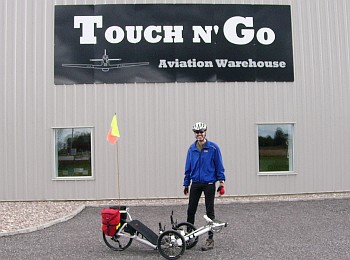
Adam and his Catrike Speed at the Touch 'n Go Aviation Warehouse, Carp Airport
I wanted to get in one longer trip on my Catrike Speed this year, now that I have it all tuned up and adjusted and also before the season ends, which may not be far in the future.
A new aviation supply shop, Touch 'n Go Aviation Warehouse opened up at Carp Airport on , but I was unable to be there for the grand opening as I was down with a head cold. My intention was to take pictures and do a story on the new business, so as my cold went away I started looking out for a good day to go out to Carp Airport.
We have had a lot of wet days recently, in fact the whole summer has been very wet except from mid-August until mid-September. The forecast didn't look good for most of this week, except Tuesday, which Environment Canada indicated would be rain-free, at least until the evening, with a high of 14C, which is a good temperature for cycling.
On Tuesday morning the weather still looked good. We had had rain the day before and the system moving in would bring more rain Tuesday night, but the daytime looked dry enough. I plotted a route that took me to Shirley's Bay on the Ottawa River via the NCC pathway network and on roads from there. I packed my lunch and lots of water, tools, inner tubes and other parts and set off at 0900 hours, just at the end of rush-hour. I knew the distance was about 50 km and so I hoped I would be able to make it there in about two hours.
Naturally things never work out quite as planned and it took me longer than anticipated to get there. The Catrike performed beautifully, but a number of things slowed me down, including deep puddles, leaves and debris on the NCC pathways, poor signage that required many stops to consult maps and some sub-optimal surfaces. Yes, I took one wrong turn and had to back track a kilometre once I figured out where I was. Most of the NCC pathways are smooth asphalt and are not in bad shape, but some were wash-board gravel or had potholes and frost heaves. It all added up to 2:55 to get there.
While at Carp Airport I got my story and photos, a new t-shirt and ate lunch. Then I headed home, completing the round trip in 5:41 of actual travel time. The final distance was 109.2 km for an average speed of 19.2 km/h.
Over all the trip was very pleasant, cool temperatures and light traffic on the route I chose. The drivers were all very accommodating and courteous and best of all, it didn't rain. The route was pretty muddy in places, with a fair amount of leaves and debris on the pathways and so by the time I got home everything needed a good bath: me, all my clothes, my panniers and the Catrike, too.
The trip proved that 100 km in a day is quite possible, but it will probably take longer than you think it will.
The Catrike is certainly comfortable for trips of this length. When I was done I was tired, but not too sore, although I had lost 3 lbs and not from dehydration, either.
In inspecting the Catrike after its washing, it seemed to have survived the trip without any problem, although it looks like I will need new front tires in the spring. The previous owner ran it with the toe-in set so far off (7/16" toe out), that is isn't surprising that the front tires are close to worn-out.
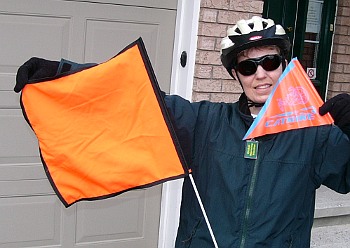
Ruth's new flag (left) and the standard Catrike flag
The past week has seen almost no cycling at all, due to a bad head cold that we both have come down with and, at the same time a week of almost solid rain. Still it wasn't a total loss as the week did give me the chance to address Ruth's flag issue.
All Catrikes come with a flag and a mast to mount the flag on. Having a flag is a good idea because Catrikes are pretty low and the flag certainly makes them more visible. My used Catrike came with a 40 X 40 cm flag that someone had made up from a safety vest, including retro-reflective bands on it. That flag seems to show up pretty well.
Ruth wan't happy with the stock Catrike flag that came with her new Trail. The flag is vinyl, pennant shaped and is 20 X 25 cm, which is fairly small. It also has the Catrike logo on it, which Ruth thought was excess advertising. She wanted a bigger and more visible flag, like the one I have.
We looked around for some material and, since it is September, found a nice blaze orange hunting vest at Wal-Mart for under $7. I took it apart and made a 40 X 40 cm flag from it, re-using the elastic edging material from the vest for a border and mounting sleeve. The new flag has 6.5 times the area of the old one. It works really well and Ruth likes it much better than the stock Catrike pennant.
Since this morning the rain actually wasn't beating down for about an hour, we decided to get our Catrikes out and give her new flag a try. I shot a video of the flag while Ruth rode her Trail. I think you will agree that it is quite visible! It started raining again right after that.
Ruth was out for a short ride on her Catrike Trail today. While stopped at a stop sign in the neighbourhood a car driver rolled down his window to let her know how visible the new flag is! It works!
Since I keep finding useful information on Catrikes on the internet I thought it would be worthwhile starting a list of what I have so far. I will add to this list as I find more. Also if any readers have any favourite links, please send them along.
Adam with his Catrike Speed at the Rideau Locks near Manotick
Today was another beautiful and rain-free day here in Ottawa. Ruth was tired out from our 56 km trip yesterday, so I decided to take my Catrike Speed out alone and see what kind average speed I could get out of it on a longer run.
I decided to head south to the Parks Canada Rideau Canal Locks just north of the village of Manotick. The route would take me down Albion Road, Leitrim Road, Bowesville Road and Rideau Road to get there. Those are all rural highways and mostly in reasonable shape, even if they lack paved shoulders. Rideau in particular was recently paved and is now very smooth. Bowesville and Rideau both have some gentle hills on them, both up and down, and, since I would follow the same route in both directions, would give a good idea of what kind of speeds I could expect on longer trips.
When I left at 1400 hrs the temperature was a very pleasant 22C, with a bit of cloud forming in the west from an approaching system, winds were relatively light, mostly south at about 10 km/h during the trip. The run down there went pretty well with just light car and truck traffic on the roads. The drivers were all very courteous and gave me lots of room. Many waved as they passed. I exceeded 40 km/h on some downhills, but spent more time on the up-hills doing 15 km/h or so.
I completed the 18.5 km to the park at the canal in 48 minutes, for an average speed of 23 km/h. Ruth and I had bicycled to this park on on a rare dry day at that time of year, for a picnic lunch. At that time the Parks Canada summer-student manually cranked canal locks were teeming with tourist boat traffic. This time, here in late September, when the weather has been consistently better, there was virtually no one there. Other than a few car tourists there was only some Parks Canada crews doing maintenance work on the buildings. I just stayed long enough for a short break and then headed back.
The trip back was equally uneventful, although there was much more traffic on Leitrim and Albion Roads. The sections of these roads I was on have no paved shoulders, and there was lots of oncoming traffic, but again all the drivers but one were very polite. At one point a few cars had to wait to pass me and one young woman honked a complaint, even though I was doing 35 km/h in a 50 zone. I think some people need to just get up five minutes earlier in the morning so they don't live their lives in such a state of stressed out impatience. Stress kills you know. The return trip took 52 minutes and averaged 21 km/h.
I made it home just about two hours after I left, including the breaks I took enroute. The round trip was 37 km, which took 1:40 for and average speed of 22 km/h. I must admit that I had hoped to turn in a slightly faster average, but at least I have a baseline measurement, now for future comparisons!
The great weather just keeps on hanging on here in late September and we keep taking advantage of it.
Even though the overnight temperature dropped to +5C on Saturday night the forecast said 22C for an expected daytime high and that was good enough for us to plan a trip. We arranged to meet our friend Jane, who has a new Trek upright bike that she wanted to take on a trip, too. The best solution was to meet her at her house north of where we live and then keep going north to the Ottawa River, before heading east to Rockcliffe Airport and beyond. We brought a picnic lunch and the day proved perfect for the planned excursion.
We left home at 0945 and the weather was just warming up from the overnight chill, jackets were required. By the time we covered the 15 km to Jane's house we were well warmed up. Ruth and Jane exchanged bikes for a try-out with Jane trying the Catrike Trail and Ruth taking a spin on the Trek 7200 hybrid. Jane enjoyed the Catrikes's comfort and Ruth was impressed with the smooth gear handing on the Trek. With that done we headed out for Rockcliffe.
Biking through Rockcliffe is always pleasant, the neighbourhoods of ambassadorial residences and other stately homes makes for quiet backstreets. I was glad I had tucked a city map into one of my panniers as we quickly hit a "road closed - construction" block and had to do some re-routing. Once we got past the poor-quality pathways that skirt Rockcliffe along the parkway and onto the proper NCC pathways things were smoother. Rockcliffe Airport was very busy with an airshow going on, courtesy of Vintage Wings, their open house and their visiting aircraft, including a Lancaster bomber. That all made for lots of tourists and lots of cyclists in the area.
At one point I stopped to take off my jacket and stuff it into a pannier and the two women got far ahead. I am still feeling out what my Catrike Speed is really capable of but I can say that I exceeded 40 km/h catching up to them without too much effort. This is a fast machine!
Of course it isn't all gravy riding a Catrike, there are drawbacks, too. Ruth and I had to do three "portages" and carry the trikes across curbs and traffic islands that lacked cut-down curbs. Jane could have easily hopped the curbs on her bike, but walked across instead and waited for us.
I also discovered how little ground clearance my Speed has. At one point, while leading the other two, I got far ahead and so I pulled off the asphalt pathway onto the grass and waited for them. We took a break and had some water and then I was elected to lead again, since I had the map. In pulling up onto the pathway I heard a scrape and immediately stopped, pulled the trike onto the grass and had a look. The chain protector plate had hit the pathway edge ridge and rotated backwards, which is what it is supposed to do, to protect the tubing and the chain. I pulled out a wrench and hex wrench and realigned it. I also checked over the frame tubing and determined that it hadn't been damaged, no harm done. Moral of the story - carry onto the pathway unless you are sure that it is almost dead level, 1 7/8" is not much clearance.
We did find a nice spot by the Ottawa River for our picnic lunch, sitting on some nice smooth rocks.
By the time we got home in the middle of the afternoon the temperature had reached the forecast 22C and we had covered 56 km, a very good day. Neither of us felt tired or sore, which is definitely one advantage of the Catrikes.
The weather has been just great here in mid-September this year - nothing like July at all!
We have been taking advantage of the warm temperatures and lack of rain to shake out our Catrikes, make adjustments and get used to riding them distances.
On Friday 18 September we did a 15 km local trip around our neighbourhood in the evening and today we went downtown on the Colonel By Drive NCC Pathway to meet Leitra Velomobile owner Jamil Shariff, a trip of about 30 km. The last time we had seen Jamil we had ridden our Rhoades Car downtown on the 16 August Sunday Bikeday on the Colonel By Drive, so it was nice to meet for coffee and hear what he has been up to recently. The route featured the first autumn leaves starting to turn red, and lots of still-blooming late summer flower beds, too.
The weather looks like it may turn showery later on this week, so now is the time to do these trips, while the weather allows! We have more trips planned for the next few days, too, including a longer one for next week.
Ruth considers this a challenge to get in lots of cycling before the snow falls.
Today was a day to take a break from all the cycling and clean up a few odds and ends on both Catrikes.
When we had arrived back home yesterday I installed Ruth's computer and made a small adjustment to her front derailleur so it would go into the highest sprocket, but there were a couple of other items that needed attention.
First on the list for today was looking at Ruth's right brake. It was making some noise on the way home and I did a quick field adjustment on it on a quiet street in Gatineau. Today I took it all apart to find out what the problem was and make sure it was truly fixed. Brakes are important because you have to be able to stop of course. If they are making noise then chances are they are wearing something out, usually a brake pad somewhere. That proved to be the case here. I totally removed the brake from the trike, checked the wheel and the disc, reinstalled the brake and then set it up from scratch. The problem turned out to be a maladjusted actuation cable. Once that was set the brakes worked fine and, best of all, made no noise.
Second was checking the toe-in on Ruth's new trike. I checked hers last night and just like on my trike when I got it hers looked like it was way off. In the daylight today we carefully measured it several times and confirmed it was set for 5/8" toe in instead of the specified 1/16". That is quite a lot off, 9/16" too much toe-in! Setting it on Ruth's model Catrike Trail was very easy, I just had to back off the tie rod jam nuts, rotate the rod backwards until the required 1/16" was achieved and tighten the jam nuts again. It took only a minute or two to do.
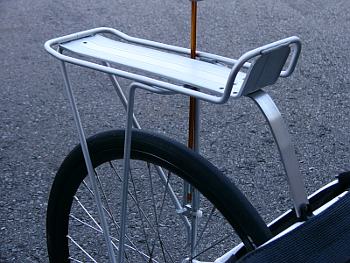
Last on my list today was fixing up the rear rack support on my Catrike Speed. I had previously tried tie-wrapping it to the headrest support, but on my trip to Gatineau yesterday one of the tie-wraps broke and I almost dumped my panniers! Obviously a better solution had to be found.
I find that the headrest is pretty useless, even if it can be adjusted to support the back of the head it transmits so much vibration that you keep your head off it anyway. Using it for a rack support is less than ideal as it has too much structure for that use, is hard to mate to the rack without using tie-wraps as the lateral bar on the rack meets the lateral tube on the headrest, and it just looks messy.
My solution was to remove the headrest structure entirely and make a new front support for the rack from a piece of 6061-T6 aluminium 1" X 1/8" bar stock that I had on hand. The material is appropriate as 6061-T6 is what the Catrike frame is made from! I just bent the bar and then cut it off to fit, drilled it and bolted it into place. As you can see in the photo above it looks very elegant, is light and strong and best of all, uses no tie-wraps to hold the rack in place.
That brings my list of Catrike odd jobs to an end for now. Ruth went out for a ride to test out her adjusted brake and by the time she got back I had my new rear rack support completed, so we both went out for a short 5 km ride in the late afternoon together. Now that is Catrike bliss!
Tuesday, September 15th saw us zipping out on foot to run a few grocery errands. As the day was windy and unseasonably cool, we wanted to get this task done and out of the way quickly. Not expecting a phone call from Les Bicyclettes De Hull, we were very pleasantly surprised to discover a phone message from François saying - yes - my trike was ready for pick-up and that all I had to do now was to come into the shop for a fitting.
I originally had plans to do other things but this wonderful piece of news changed all that. Now, I had to phone the bike shop, arrange a time to meet to do the final boom tube fitting and then get myself up there to retrieve my trike. One phone call later and we were set to meet up with François, adjust my trike to fit me and then take my new kitty home.
The plan was that Adam would ride his Catrike Speed up to Les Bicyclettes de Hull while I would take the two buses (I actually wound up taking 3 but that's another story) to get to the shop. I love these kinds of adventures - you know, planning, operating as a team to make it all come together...that sort of thing. Adam and I often have these little "urban adventures" and this one would be one of the better ones.
So, I would leave our house alone and catch a bus to downtown Ottawa at which point I would switch from OCTranspo to STO - the bus system that serves the Gatineau area. Since Les Bicyclettes de Hull is located a fair ways up Boulevard St. Joseph, the trip for me would take roughly one hour. Actually, it took precisely one hour and, whew, the weather remained really good though quite breezy as we had anticipated.
When I got to the shop, I saw what I was convinced was my trike sitting right there on the floor of the store itself, not squirreled away at the back of the place or otherwise hidden from public view. Long story short, it was, indeed, my trike, just waiting for me to come and pick it up.
Ruth on her Catrike Trail at Lac Leamy
Jeff, the salesperson who originally served us when we initially visited the shop on , arrived and he fitted me by adjusting the boom tube to match my leg length. This would mean that the chain would need some adjusting as well but, as François, the bicycle technician who assembled my Catrike, had arrived by that time, he took care of that. François showed me what he was doing, what tools he was using to remove the excess chain and how he put it all back together. Because he is so experienced and highly skilled, the chain adjusting took less than a minute, including all the questions I had for him.
I should mention here that when I phoned the shop and spoke with François, he mentioned that he would only be at the store until noon as this was his day off, but that he would very gladly come into the store when I got there to fit me properly with my trike. Although I thanked him profusely, there is no way I can ever thank him enough. Here is a young man, clearly dedicated to his profession, who came into the store on his day off just so he could accommodate me. I see this a lot with the current 18-28 year old crowd - polite, courteous and dedicated people who make it a point of working in a field that they truly enjoy.
By the time I was fitted Adam arrived and a short while afterwards we were off on our own. As it is 25 kilometres to our house, I had a good long ride to learn how my Catrike works and handles. It took me only a very short time to figure it all out. Before I could get my trike onto the vast expanse of bike trails that run near Les Bicyclettes de Hull, I had to carry it up a short but fairly steep hill to get to one of the streets, walk it along sidewalks, ride down a grassy knoll through a construction zone right by the Casino de Hull, before getting a chance to really ride it any real distance. That was the only tricky part of the trip home.
By the time we got through all those obstacles I was really itching to get on my trike and get zooming. We got through the casino construction zone and were both on our trikes and zooming away in short order.
Initial Impressions
Catrike Trail & Speed at the Rideau Canal
The Catrike took off like lightning but I was shifting gears in very short order, yes, even if I were going uphill.
The seat is very comfortable for me.
For me, the muscle groups used in riding a trike are pretty much the same as those I use on our quadracycle.
Bumpy roads and wooden bridges (which there were a few on our trek home) made my eyeballs rattle. I felt every single little bump and dip.
Despite warnings that the trike is painfully slow going uphill, I had little to no problems taking hills. There is one pretty good hill just the other side of the Rideau Canal in Ottawa which I took in the lowest gear I had. Yes, it was a workout but nothing too awful.
I found that I had to really be careful when at a stop on any hard surface, like asphalt. This trike really likes to roll away. On gravel or grass it will stay where I put it at a stop.
There are two clear plastic indicators to indicate which gear/sprocket combination I am in and those displays are pretty awful. I found them to be too low for an easy glance and the one on the right has some numbers that read right to left with others inverted and thus reading left to right. It's not anything more significant than an annoyance as I put myself in whatever gear suits the terrain and my energy levels.
The rack that I purchased with my trike is a very solid device which took my rack pack with extreme ease. I suspect it sits a little higher, too, so adding a couple of panniers should prove to be problem free.
This trike is extremely light, even for me. I had no problems at all picking it up and carrying it even if it meant having to readjust the mirror each time afterwards as I would always bump up against it while carrying my trike.
The journey home was, essentially, the reverse of how Adam got his trike to the store in the first place. Traffic was light in most places though, by the time we got to Hunt Club Road, was growing thicker with rush hour. Yet, neither of us had any problems merging with traffic if only because it wasn't really moving much.
By the time we got home, it was approaching 5:00 pm. The light was growing quite dim due partly to the increasing clouds and also to the fact that it's mid September when days grow short pretty quickly. We grabbed a fairly quick dinner and then took care of a few things with the trikes, including mounting the computer we had also bought a week or so ago, setting it up so that it would read correctly and then I give it a test run up and down our street - you know, the usual fiddly stuff new owners do.
So now, with the days growing cool but expected to remain dry, I can anticipate a good month or so of cycling weather left before the snow flies...or have I just jinxed myself?
While on my way to Les Bicyclettes De Hull to meet Ruth, who went there by bus to pick up her Catrike Trail, I encountered an interesting problem: front wheel shimmy. Shimmy can occur on just about any wheel system, but is most often seen on shopping carts, when one wheel vibrates quickly back and forth.
In this case while rolling on a slight downhill I took both hands of the controls and the front wheels started shimmying. Quickly grabbing the control handles again dampened out the shimmy immediately, but I quickly pulled over and checked out the front end.
My initial suspicion was that there must be something loose in the steering mechanism, so I pulled out my hex wenches and metric crescent wrenches and checked the tie rod. I had undone it the previous day to fix the toe-in and one bolt was not completely tight. Tightening it helped, but a quick test showed that the problem had not gone away entirely. I tried tightening the headsets, but that didn't fix it either.
After rendezvousing with Ruth at Les Bicyclettes De Hull I asked the Catrike technician, François, about it. He checked things over and suggested that the headsets were probably to blame. He suggested loosening the hand grip mounts and then tightening the headsets. One was tight, but the other one was quite loose. Tightening that with a hex wrench solved the problem and it hasn't recurred since.
Slowly I am learning the peculiarities of the Catrike. One thing is certain, if something isn't working right, fix it right away!
Update -
I had an e-mail from Lethbridge Catriker Gordon Koppang and he pointed out some additional things to check when encountering shimmy problems, from a list compiled by the Catrike designer Paulo Camasmie and posted on the Catrike forum.
Low tire pressure
Bumps on tires (poor mass distribution)
A very big or soft tire (The Big Apple will aggravate shimmy)
Wheel out of true, especially out of round and with loose spokes
Headsets bearings that are not pre-loaded. We suggest as per our manual, a pre-load of 70in-lb
Star nut not properly set inside the fork. 1-1/8 star nut will also fit in the fork and hold better
Excessive toe-in or lack of toe. For some riders 1/16" toe out might work better. (The Owner's Manual recommends toe-in of 1/16")
Keep at least one of the hands on the handlebars at all times
Those all sounds like good things to check on a regular inspection basis too!
Homemade sensor mount installed on the left-hand side
Ruth wanted to have a speedometer/odometer for her Catrike and so we picked up matching Filzer dZ2L Cycling Computers from MEC for both Catrikes.
The dZ2L is a nice little unit, very simple and easy to use with minimal features at a minimal price, Cdn$15.00. It doesn't do a lot, it gives instantaneous speed in km/h or mph and gives a running odometer, trip odometer and elapsed trip time and that is it. It comes with a magnetic pick-up for the spoke, a sensor and zip-ties for mounting. Naturally it is designed for mounting on the front wheel of conventional bikes and not recumbent tadpole trikes, so some adaptation is required.
The model Catrikes, like Ruth's (if it ever arrives) have a neat little sensor mounting bracket as standard equipment. This is bolted into a pre-drilled hole on the steering bracket, so all you have to do is basically zip-tie on the computer, set the wheel diameter and you are ready to roll.
Of course things are different on older catrikes, like my Speed. Apparently it didn't come with the sensor mounting bracket, although it does have the mounting hole in the steering arm. That it didn't come with a bracket isn't much of a surprise, back in Catrikes didn't even come with pedals! You had to come up with your own.
The curvy standard bracket is actually quite difficult to make and I didn't see the need to pay US$20 for a piece of stamped metal, so I had a poke through my box of aluminium scraps and found a mounting bracket from my old Lazair ultralight aircraft's wheelpants that would do the job. The bracket, made from 6061-T6 aluminium angle fit nicely, clearing the brake disc, even though it is made from straight angle. I just had to fit it, drill and cut it down a bit, file it, sand it and paint it and it was all ready. The longest part of the process was waiting for the paint to dry. I installed it using an AN-3 aircraft bolt and a lock-nut and it worked perfectly.
Filzer dZ2L Cycling Computer installed on the right-hand steering arm
Of course with the computer sensor installed, the next part was locating the display. That looked like it should be an easy choice as the Catrikes all come with a computer mount on the boom tube, right next to the front derailleur. The large numbers on the dZ2L would work well out there and allow me to see it clearly from the seat. Of course there was only one little problem - the cable that connects the sensor to the display pad is far too short to reach from the front wheel way out to the boom tube.
That all added up to finding a new home for the display.
The options on the Catrikes are very limited. The vehicle is very small and there isn't a lot of surplus space on it to mount anything, especially in front of the rider. I sat in the seat and cast around for a possible place where it could be mounted within cable range and that would allow the display to be read. Really the only choices were the steering arms, either left or right.
Mounting it on the left steering arm would leave lots of cable, so it was relatively easy to run the cable along the steering tie-rod to the right arm. The resulting location is not perfect, but it is workable and as a bonus it does leave the designed location for the computer free for a night-riding headlight.
Naturally once the computer was installed, I calibrated the wheel circumference and then took the Catrike out and did some speed runs around the neighbourhood to see how fast it actually is. I found that I could do 30 km/h on the flats without too much effort and hit 35 if I worked at it. That makes this considerably faster than my mountain bike and probably twice as fast as our Rhoades Car 4W2PCP quadracycle is. Not surprising really when you look at the Catrike.
The addition of the speedometer pretty much finishes up my intended fix-ups to my Catrike Speed. I washed it and moved the small wedge-pack that the previous owner left on it to the other side, just to rotate it so the zipper was at the top and not the bottom and now it is all ready to go.
The last couple of days I have been doing some small fix-ups and adjustments on my Catrike Speed. While I had the tape measure out to do the toe-in I thought I would also do some measurements check out how close to spec the trike is.
Some of the measurements given in the Owners Manual are nominal because they depend on how long the user has the boom that mounts the pedals pulled out. This obviously affects the overall length and the bottom bracket height, amongst other things.
I also thought it would be interesting to compare the Speed and the Trail. The two trikes are generally similar in many ways, but their frame geometry is different to give the altered seat angles. This makes the Speed lower, narrower, longer overall and lighter than the Trail. The Speed was obviously designed strictly to be fast on hard-surfaced roads, while the Trail is a more "all-around" trike.
The company blurb on the Trail says:
A Budget-Priced multi-purpose Catrike. Its stable geometry and friendly ergonomics make it a great trike for novices and veterans alike.
While the blurb on the Speed says:
A Performance Catrike loaded with fun. It can corner like its on rails and it is still capable of light touring and commuting.
I have spent the last couple of days getting familiar with my Catrike Speed, learning how it is put together and riding it. Yesterday I rode it 24 km round trip to a volunteer commitment I had and it did really well, turning in a speed that was about 8% faster than my mountain bike had done the same route previously.
At the end of the day yesterday I decided I should check out the toe-in on the front wheels. The Owners Manual is very clear that this is important as improper toe-in can lead to premature tire wear and poor handling. The toe in is supposed to be set at 1/16" toe-in to allow the minimal slop in the steering system to straighten out to zero under normal pedalling. The person who sold it to me assured me that the toe-in had been checked by Les Bicyclettes de Hull and that it was fine. Their technician later said he had never seen this Catrike before.
I did the measurement and it looked like it was way out. I vowed to re-read the Owners Manual, as I thought I must be measuring it incorrectly, it couldn't be that far out, could it?
So I re-read the manual. The manufacturer recommends measuring the toe-in with a steel tape measure at the front and back of the wheels and the manual describes how to do that very clearly. They also say:
We hear a lot of reports from the field of improperly set toe, with resulting excessive tire wear. Don't assume it's been done right! Check it yourself.
So I went back out to the garage and carefully checked the toe-in about ten times. The trike was definitely set up with 7/16" toe out!!! It was quite an adjustment to set it to exactly 1/16" toe in. For some reason my Speed has the older style tie-rod that has identical threading at both ends, meaning that one bearing rod end needs to be unbolted to make the adjustment. The total adjustment was four full turns.
After that was done I took the Speed out for a run and it seemed to accelerate more quickly and corner better, too.
Well, today, September 10th, marks three weeks since I ordered my Catrike Trail. Unable to wait for a call from Les Bicyclettes de Hull, I phoned them at 9:05 this morning. Sure enough, I was told that my trike is in! Whee!
Well it is "in", but the factory ships the trikes unassembled. However, the gentlemen who does the assembly and the precise fitting, François, is off in Montreal this weekend for the bike races and that means it won't be ready for me for at least a few more days. As François is away this weekend, I am busy on Monday and that François doesn't work Tuesdays or Wednesdays, I likely will not be able to go in for my "fitting" until next Thursday.
Yes.
Another week to wait.
Sigh.
But, at least it got here so I know I won't have to wait too much longer...
I had a little bit of inspiration this week that paid off surprisingly well.
When we went up to Les Bicyclettes de Hull on Ruth tried out the Catrike Pocket and really liked it. This lead her to order a Catrike Trail for delivery soon. The Pocket and the Trail are fairly similar, with the same seat angle. The main difference between the two models is that the Trail has 20 inch wheels all around, whereas the Pocket has 16 inch wheels in the front. Ruth really liked the seating position.
I also tried out the Pocket but found the seat pretty uncomfortable, with the lateral seat tubes contacting my hip bones. It is possible that the webbing material needed tightening, as "sling" seats are not comfortable unless they are tight. I had intended to check out Ruth's trike when it came in and see if the comfort was improved for me or not, before deciding whether to get one of my own, although as is quite evident from her earlier diary entry Ruth is very keen on me getting a Catrike, too.
This is where the inspiration came in. One night at bedtime it occurred to me that I should check around and see if there were any used Catrikes for sale in the area. So the next day I had a look through the on-line classifieds and found a model Catrike Speed for sale privately on Kijiji Ottawa. The trike was located over the river in Gatineau, actually in the far reaches of Aylmer. I got in contact with the seller via e-mail and arranged to come up and have a look at it that same evening.
While all the Catrike models are similar, the Speed has two main differences from the Trail. Like the Pocket it has 16 inch front wheels and a 20 inch rear wheel. Unlike both the Trail and the Pocket is has a 33° seat angle instead of the 45° seat of those models.
The manufacturer's marketing copy on the Speed says:
A Performance Catrike loaded with fun. It can corner like its on rails and it is still capable of light touring and commuting.
I am always sceptical of advertising, but wanted to have a look at it and especially to try out the seat and see if it was a bit more comfortable. After checking the bus routes to Aylmer and realising I might need up to four connections to get there, I decided to just ride my old mountain bike, as I could do almost the whole trip on NCC bike pathways. It turned out to be a two hour ride or about 40 km one way.
Once there and I had met the seller, I had a close look at the Speed. For three years old and two owners, it was in good shape. It had a few upgrades: an extended chain guard, bell, horn and wider tires installed along with a custom-made flag. The seller indicated that he had recently bought a new recumbent and added a tag-along trailer for his three-year old daughter. The Speed wouldn't pull the trailer and so with one bike too many, he decided to sell the Speed.
Next we went for a short ride around the neighbourhood. He came along on his new bike and it must have made quite a sight! The advertising blurb turned out to be accurate, the Speed does corner like it is on rails. It is also surprisingly fast, accelerating like a shot and sustaining pretty good cruising speeds. On down slopes it builds up speed fairly quickly. Best of all the seat was pretty comfortable.
I told him that I would take it and, since he had two other interested people who had called, I offered him what he was asking for it and he agreed. A new Speed is US$2350 or about Cdn$2535, or Cdn$2865 including taxes. I paid just over half of that, so I think that is a fair price! I had a happy cycle home on my old mountain bike in the dark from Gatineau.
The next problem was getting back out to Aylmer to pay for it, without using my bike. The seller indicated that he was going to be in Ottawa, near Tunney's Pasture the next day and, having a van, could bring it with him. So we met there, finished the deal and I rode it north through the government office complex at Tunney's to reach the NCC bike pathway on the Ottawa River, past Parliament Hill, down the Colonel By Drive pathway and on home.
The first couple of kilometres were pretty good as quickly I got the handling figured out. Once on the pathway at, what was then lunchtime, I had to deal with lots of joggers and pedestrians. That made for a fairly slow trip, but whenever there was a clear spot I put on some speed and passed a lot of bicycles! No doubt the Speed lives up to its name.
By the time I was at Hogs Back Falls I was finding the seat a bit uncomfortable. It wasn't the hipbone problem I had with the Pocket, it just felt like the webbing was too loose and was forming a cone-shape under me. I stopped, flipped the Catrike on its side and tightened all the web straps up. Some of them were quite loose, too! That made a big improvement and so I went tearing off home along the back streets.
The trike certainly climbs hills well. On one hill that is an effort on our quadracycle I was half way up it before I realised that I had reached the hill!
The next challenge was on Hunt Club Road. Noon-time traffic was thick, but I usually stick to the bike lane. This time construction had closed the side walk, the bike lane and one of the two car lanes. I decided to risk it, signalled and merged into the one car lane available. With the congestion, traffic was slow and I certainly wasn't holding any car drivers up, no one seemed to object to me being there. After the construction I headed for the bike lane, accelerating downhill and passing a few cars.
Once at home Ruth took my Speed for a run up and down the street and, even with the boom set far too long for her, she was definitely envious and showing signs of impatience that her Catrike Trail hasn't arrived yet.
A quick trip to MEC got me a rear rack so I can carry some panniers for cargo space. I also discovered that , with the 33° seat that you can't have keys and things in your pants pockets, because they fall out. The trike came with a small wedge-pack to store small items, but I figured that if I can't use my pockets that I might as well save the wear on my hiking pants and get some real biking tights. I found a perfect pair at Bushtukah.
So now I am all set and out triking in the great weather we are having. We just have to wait until Ruth's trike comes in, hopefully next week.
Ruth tries the Catrike Pocket at Bicyclettes de Hull
Although the day wasn't cold, it wasn't exactly summer-like either. The clouds seemed to constantly threaten to release its load of showery weather on us but managed to hold out throughout our trip to Les Bicyclettes de Hull.
Adam looked up the Catrike dealers and found Bicyclettes de Hull over the Ottawa River in the north part of Gatineau is our local dealer. We worked out which combination of OC Transpo and STO buses would get us there.
So, after a good breakfast, we headed out with the intention of getting to the shop on Boulevard St. Joseph by bus and then walking back over the river and catching a bus back home from downtown Ottawa. All in all, it would be about a 6 or 7 kilometre walk, enjoyable provided the weather held out.
We arrived at Les Bicyclettes de Hull in mid-morning. The model I was considering was the Trail. I wanted to try one out just to see how I would like it but there wasn't a Trail available. However, there was a Catrike Pocket which I could sample, so the salespeople took the lightweight trike down from where it was stored, hanging from the ceiling (that's how light it was) and let me sit in it. It fit very nicely but I also wanted to see how it would handle so we took it outside to the store's parking lot. With the first splattering of rain, it was a fairly quick zip around the lot but that still gave me a chance to assess the trike.
The Pocket was as tiny and zippy as the name implies, with a rear 20 inch wheel and front 16 inch wheels. I found the disc brakes were really quite sensitive but at least it would stop on a dime with precise control. I could also turn it on a dime and the Ackerman steering made turns smooth and not the least bit skittery. The steering was very intuitive, too. A left turn was done by nudging (and I do mean nudging) the left stick back and the right stick forward. The trick is to not use too much pressure on anything, whether steering, braking or turning. I felt snug in the Pocket, more as though the trike were wrapped around me. Pedalling was straightforward although the parking lot was too small for me to get much speed and run the gears through their range. What I really liked was that the gear shifters were of the twist grip variety just like my bicycle, as opposed to our quadracycle, which has lever type shifters.
Ruth on the Catrike Pocket at Bicyclettes de Hull
In short, I was sold, and, so, after bringing the Catrike Pocket back into the store, we decided to order a Catrike Trail for me. Sure, the Pocket was lovely but the Trail, with its 20 inch wheels all-around, will suit me better. The Trail comes in two factory colours, silver or yellow but, I opted for silver. Besides, I would only be plastering my trike with reflective tape anyway so why would I care about colour?
We also decided to add a rear rack to my trike as, once again, I really like self-sufficiency. I already have a rack on my bike and I always attach my rack pack to it so why would this be any different?
It's about here where I should talk briefly about why buy a trike, when I have a bike and we have a quadracycle.
With my MS I have no idea when, or even if, I would ever be in a wheelchair. That prospect hangs over my head like the Pocket trike did in the shop. In Ontario, the current e-bike regulations allow for the addition of an electric motor to a two or three-wheeled bike, but not a four-wheeled one. Since I need to remain as physically active as possible, it is a relief to know that I can add a motor to my trike and have it as a power assist so that I can still pedal with a little help.
The trike should be in in early September, stay tuned as I will definitely write more and include pictures and perhaps even a movie of it in motion. I still have to go in for a "fitting" as the boom tube will have to be adjusted for my leg length and the chain length will have to be sorted out but that shouldn't take too long to do.
I fully expect Adam to order his Catrike Trail - or else!
I have always been a fan of self-sufficiency. When Adam and I head out for the day on our bikes or quadracycle, I always like to make sure we've packed enough provisions to take care of ourselves for however long we're away. It's fun.
With our quadracycle, it's easy to pack a lot of things - a picnic lunch, a couple of books or magazines, our camera, binoculars, maps and probably enough tools and spare parts to construct another quadracycle. Travelling along the open roads affords us a view of the city and surrounding areas we wouldn't ordinarily see from, say, a car. Part of what I see, though, is that lacy web of bicycle paths our quadracycle is prohibited from using whether legally or from a practical point of view. Sure, we could just use our bikes but my balance isn't always good enough, thanks to the sheer unpredictability of my MS.
That leaves me in somewhat of a conundrum: do I choose between being limited to roads or do I take my chances on not falling down while on my bike? What if where we want to go is inaccessible by quadracycle? While it usually doesn't happen too quickly to me (whew!) sometimes my MS acts up at the most inopportune moments. I have nightmares about being at exactly the furthest point from my house when, suddenly, the world starts flipping or spinning around. If I were on the quadracycle, that wouldn't be too much of a hassle. However, it's a different story on a bicycle...how to resolve this dilemma? How can I maintain safety, self-sufficiency, physical exercise and have the freedom to travel both the open roads and the bike paths? It took a happy chance for me to find the answer.
On Sunday, , Adam and I had a happy meeting with Jamil Shariff. He rode up to meet with us on his Leitra Velomobile, a tadpole trike (two wheels in the front), with provisions for a fibreglass fairing, although in deference to the warm weather he left the fairing at home that day. I got a chance to try his Leitra and fell instantly in love with the whole trike concept.
To be sure, I did not covet Jamil's trike nor was I interested in getting a Leitra per se. However, I was more than smitten with the sleek lines, the zippy feel, the potential for carrying things (there's that self-sufficiency I like again) and, of course, the ease of driving it.