by: Richard Taylor, © copyright 1998, 2024
|
Chasing the Perfect Eclipse
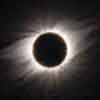
Picture by: Richard Taylor, © copyright 1998, 2024 |
|
In February of this year (1998), my family and I joined the flocks of sun-worshiping snow-birds flying south for the Caribbean solar eclipse. Like thousands of others, we combined a fabulous cruise amongst the islands with an even more fabulous day watching the eclipse.
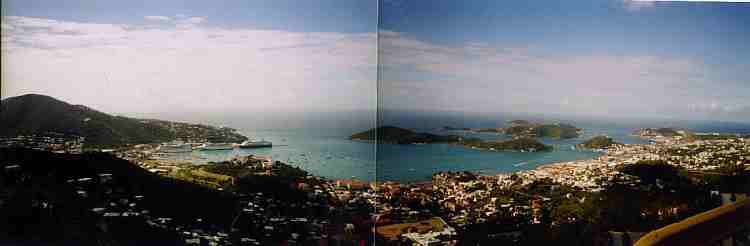
This was my second solar eclipse, and I wanted to make use of the telephoto lenses and faster films that I didn't have the first time to capture a personal souvenir of the event. For the record, I was using two cameras: One was a Minolta with a 135 mm f/2.8 telephoto mounted on a small tripod using Kodak Royal Gold 1000 print film, the other was a Pentax with a 200 mm f/4 telephoto mounted on a clamp attached to the ship's railing using Kodak Elite II 400 slide film. I used a cable release and manually adjusted the shutter speeds from about 1/500 sec to about 1/8 sec - I say "about" since I didn't pay much attention to the exact settings during the excitement of the event. I just kept changing the speed and snapping pictures. I also spent some of the time simply staring at the sky "making funny noises" as my daughter later described me.
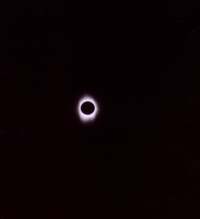
Back home again, still glowing with sunburn and joy, I had my pictures developed and eagerly flipped through the prints and slides. My first impression was YES! they definitely showed the various parts of the corona from inner to outer with the different exposures. But looking more closely, I felt a bit of disappointment - the REAL eclipse I had seen was so much better than the photos! I remember seeing a pitch black circle of the moon, surrounded by pearly streamers bursting out in all directions, set in a deep blue sky and with two brilliant planets playing escort. None of my pictures showed all of that. Some of them showed long streamers and planets, but those ones didn't show any detail near the middle and the moon's disk was all blurred at the edges. Others showed some of the detail near the middle, but the streamers and planets were missing. None of them showed the blue of the sky, nor the incredible detail of the entire corona. Our eyes are truly remarkable devices!
 |
 |
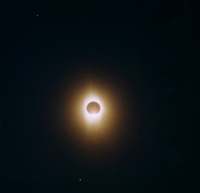 |
My first attempt combined two of the best prints, one long exposure and one short, and used a standard de-blurring filter to bring out some of the detail. The result was better than any of the individual prints, but it still looked too blurry and didn't have the full range of the coronal streamers.
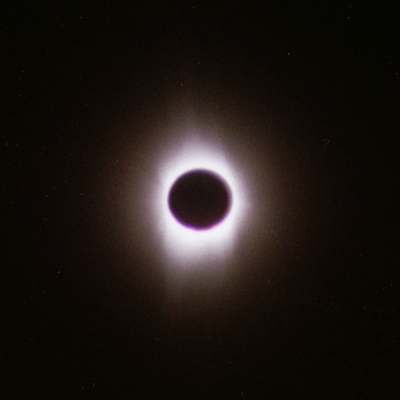
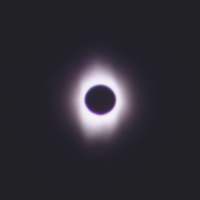
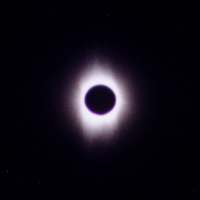
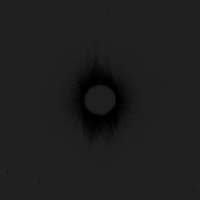
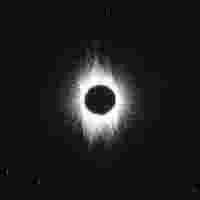
Time to try the complicated process. The Sky and Telescope article suggested using a radial blurring process to turn an eclipse image into a kind of radial density filter for the original image. Eclipse photographers would like to have a good radial density filter because the sun's corona has such an enormous range of brightness that no film can capture it all. If you had a filter that was dark in the middle and light at the edges, you might be able to photograph a wider extent of the corona. The computer can partially reconstruct this effect by calculating the difference between a radially blurred image and the original. This may sound complicated, but it was even worse than that - first I had to exactly center each image on the center of the sun, and before I calculated the difference, I had to change the brightness scale of the blurred image so that negative differences wouldn't go off the scale. The result was a pale negative image - but boy, did it show detail!
| Blurred
|
 |
Original
|
 |
Difference
|
Inverted and stretched
|
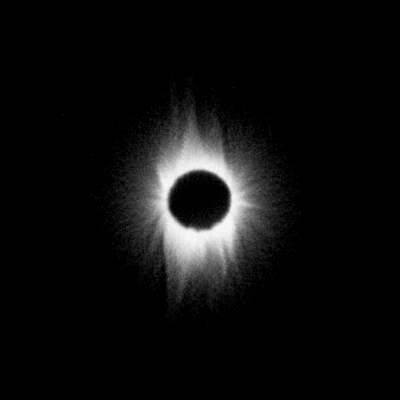
Comparing my prints and slides, I thought my slides were better quality. The 200 mm lens gave a bigger image and the ISO 400 film speed had finer grain. So I sent the slides back to the photo shop to have prints made. When I saw the results, I was disappointed again. The printing process just couldn't keep all the detail I could see on the slide. Nevertheless, I tried the scanning and processing again (groans from the family - "when are you going to be finished with the computer??!!"). The overall result was fairly similar to the processed image from the ISO 1000 prints.
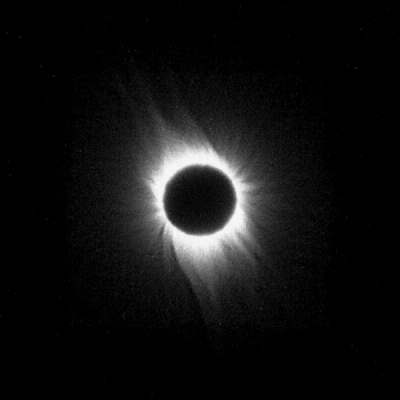
By this time, I was getting frustrated by my inability to capture the raw material I could see on the slides. Time to get professional help (I think my family agreed, but they meant a different kind of professional). I took the slides to BGM Imaging and a few days later a Photo CD was in my eager hands. Of course, that was the evening when EVERYONE had a desperate need for the computer. And when I finally did get a turn, my first try at viewing one of the 18 megabyte high resolution images resulted in a crazy "out of memory" failure that resulted in a bright red screen.
Eventually the memory problems were solved (a workaround involving importing the images into Corel Draw, then cutting and pasting just the corona image into PhotoPaint), and I began the slow process of centering, blurring and subtracting. The VERY slow process. The images were of such high resolution, each blurring step took about 10 minutes of processing time. Since I wanted to get a colour image, I was also repeating each process three times for each image (separating the red, green and blue channels). Twenty one images later, I had a glorious colour picture that finally matched the kind of detail, extent and colour I remembered.
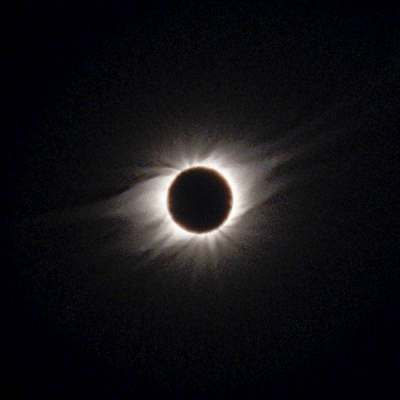
But the sky should be dark blue, the moon should be pure black and the planets should be visible. My picture still wasn't right. Time for a bit of artistic licence. One of my prints (but none of my slides) showed the eclipse and the two planets close by (Mercury and Jupiter). I could cut and paste the processed image from the slides into the place of the eclipsed sun of the print, but I had to rotate it a bit to compensate for the different orientations of the two cameras. The picture of the planets didn't show them as being brilliant points of light as I remembered, so I artificially boosted their local contrast. Then, for the final artistic touches, I carefully filled the background with a deep blue, and replaced the fuzzy grey moon with a perfect black circle.
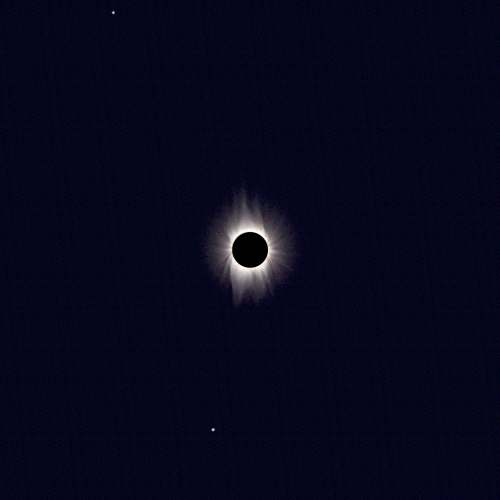
At last, the perfect picture! Or is it??? Having stared at so many different versions of my photographs, and compared them with so many others available on the Internet, my memory of the real thing is fading into memories of pictures. Have I really produced an image of reality? I've certainly lost any claim to scientific accuracy. The best I can claim is that this picture reminds me of the beautiful, spine-tingling experience I had on February 26th.
This page last modified: 2024-05-08 |