Tuesday March 16
I am waiting in the warm observation lounge of the Shiraz Airport. My 1240h flight has been delayed due to snow in Tehran. This is one delay I did not anticipate.
Maintaining this journal is beginning to take on a life of its own. I don’t know what will become of it. It will only move beyond the personal once it is transcribed from my unreadable long hand. My experiences have been so full since arriving in Iran, that it has been difficult to be current with my writing. Last night I put down point form notes of my previous three days in Esfahan and Shiraz. Presented with an “ocean” of time sitting in this airport I will endeavour to transform the notes.
My experience in Iran is transformed and enriched with Masoud, my friend, guide, and interpreter extraordinaire. Not only does he explain the details of what I observe, such as the coupon line-ups for food rations, he spends hours in discussion with me nightly, explaining the revolution, the intricacies of daily life, the yearnings of the young people and so much more.
Monday March 22, Village Trip
We hit the road by 0715h, pick up Faraj, and head south on a six lane divided highway toward Qom. The air is a thick choking soup. Most cars on the road (usually Paykans) are filled with families, six to a car. Many hitchhikers are on the side of the road, offering to pay a negotiated sum for a ride.
Sitting in the front seat of the car, with a three-hour drive in front of me, this is my first opportunity to record in my journal as life speeds by.
We keep up with the traffic, speeding down the highway. In a short distance we pass a roll over accident, and then a vehicle on fire, its owner desperately trying to douse the flames. A child is pulled back from running onto the highway. Cars refuse to pick a lane; instead they seem to try to be in all lanes at once. Fortunately there are no transport trucks on the road, as this is Narooz, the Iranian New Year, a two-week holiday period. The only other vehicles are buses, which vary from brand new yellow Volvos to ancient Fiats and old rounded Mercedes 302s. Families are picnicking on the side of the dusty road.
Approaching Qom, we pass a large salt lake on the left. The pavement is rough. It is a cloudless day, yet a brown haze is entrenched across the basin. I find my body in a state of heightened alert, as a vehicle suddenly appears within a couple of inches of our car on my side, temporarly creating a fourth lane of traffic.
I can see snow capped peaks in the distance.
Faraj is feeding us oranges from the back seat. The traffic remains thick with vehicles dodging and weaving. We are passing the city of Qom on the ring road. So many of the factories are ringed with high fences topped with barbed wire. Often there are also armed guards stationed in turrets high above the fences. Open fires create ugly visible pollution. Dump trucks rumble along the paved shoulder while we speed by at 130 kph. I view the occasional patch of green, or a tree, surrounded by vast areas of sand and rock.
Traffic speeds up and slows down in a random fashion. You can never assume anything about what the other driver will do. A car wanders into our lane, and then slows down. A bus straddles two lanes. A pick up truck wanders into the fast lane for a slow pass without warning. Dozens of sheep are visible on the side of the unfenced highway. We are heading west out of Qom, into the higher elevations. We pass a roadside pomegranate stand. The stacks of fruit present a remarkable deep red colour.
 We
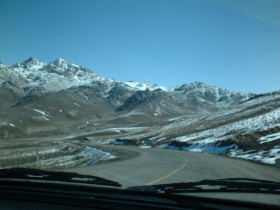
are now within 25 kms of Tafresh and climbing higher. The snow of the mountain
appears to be travelling down to greet us. The road winds its way up, the
twists and turns becoming tighter as we climb. The soil is often imbued
with a green hue akin to the colour of a tarnished copper rooftop. We have
reached the summit of our climb, and are now descending into Tafresh. Before
entering the town, however, we are stopped at a police checkpoint. One
officer with a holstered pistol motions us to the side of the road. He inspects
the trunk and the back seat. Although I have my passport ready, I am not
asked to produce it.
We
are now within 25 kms of Tafresh and climbing higher. The snow of the mountain
appears to be travelling down to greet us. The road winds its way up, the
twists and turns becoming tighter as we climb. The soil is often imbued
with a green hue akin to the colour of a tarnished copper rooftop. We have
reached the summit of our climb, and are now descending into Tafresh. Before
entering the town, however, we are stopped at a police checkpoint. One
officer with a holstered pistol motions us to the side of the road. He inspects
the trunk and the back seat. Although I have my passport ready, I am not
asked to produce it.
We enter Tafresh, a tired, dirty, broken town. What I see are so many crumbling walls, piles of rubble, and broken pavement. Most women here but not all, wear the traditional chador.
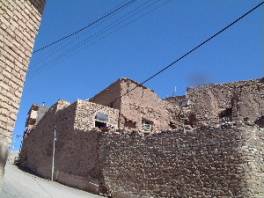
Leaving Tafresh, we head east into the mountains, climbing up a twisting road. A cluster of modern houses appears on the left. They have been built by the sons of former villagers who have returned from Tehran after making their fortune. The paved road we are travelling on was constructed in the past ten years through the combined efforts of the villagers and the government. The former donkey trail can be seen below. This road traverses difficult terrain. There are frequent signs of minor rockslides. After a long climb we descend briefly and enter the village of Naghoosan. Suddenly the car is brought to a halt with Masoud exclaiming, “There is my aunt!” Brief kisses, then we drive on for a hundred meters, and turn left down a narrowing stone wall sided alley, past a donkey, until the car can physically go no further.
 I
do not know what to expect in the village itself, although I have heard much
about it. The previous week some members of Masoud’s family had joked about
whether or not I should be “allowed” to go to the village, perhaps fearing
that I may find it too overwhelmingly rustic. Ultimately, nothing could
be farther from the truth, as I was soon to discover. Most of the structures
in this village, as in most of rural Iran that I have seen, are constructed
out of yellow sand coloured brick or spread compound. This is just like
so many of us in the west see on our television screens whenever Middle East
villages are shown. Up close, though, touching it, I feel how weathered
and impermanent it is.
I
do not know what to expect in the village itself, although I have heard much
about it. The previous week some members of Masoud’s family had joked about
whether or not I should be “allowed” to go to the village, perhaps fearing
that I may find it too overwhelmingly rustic. Ultimately, nothing could
be farther from the truth, as I was soon to discover. Most of the structures
in this village, as in most of rural Iran that I have seen, are constructed
out of yellow sand coloured brick or spread compound. This is just like
so many of us in the west see on our television screens whenever Middle East
villages are shown. Up close, though, touching it, I feel how weathered
and impermanent it is.
 As
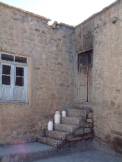
we enter the home of Masoud’s relatives, I am immediately impressed with
the well cared for feel of the property. Yes, it is rustic. No material
from Home Depot was used to construct this home. Farm animals are heard
just behind the back wall of the main living quarters. But everything is
cared for. Everything is in its place, and there seems to be a place for
everything. This walled property is roughly twenty by thirty meters. Three
buildings; a cookhouse, living quarters and a barn cover about 60% of this
area. Different from most other structures in this village, they are built
with stone and partially covered with whitewashed stucco.
As
we enter the home of Masoud’s relatives, I am immediately impressed with
the well cared for feel of the property. Yes, it is rustic. No material
from Home Depot was used to construct this home. Farm animals are heard
just behind the back wall of the main living quarters. But everything is
cared for. Everything is in its place, and there seems to be a place for
everything. This walled property is roughly twenty by thirty meters. Three
buildings; a cookhouse, living quarters and a barn cover about 60% of this
area. Different from most other structures in this village, they are built
with stone and partially covered with whitewashed stucco.
 I
am soon introduced to several family members who are visiting during Narooz. Included
are several young women between fifteen and thirty years of age. I am greeted
by many warm, yet shy smiles. I remember the instructions given by Masoud
before coming to Iran not to extend my hand to a woman, - to shake a woman’s
hand only when it is offered. None is offered. Included in these introductions
is Masoud’s Uncle, who immediately welcomes me in the traditional fashion
with kisses on alternate cheeks three times. It is the first time I have
felt the rasping of such grizzled whiskers against my face since hugging
my grandfather goodnight as a child. This greeting feels very warm, open
and accepting.
I
am soon introduced to several family members who are visiting during Narooz. Included
are several young women between fifteen and thirty years of age. I am greeted
by many warm, yet shy smiles. I remember the instructions given by Masoud
before coming to Iran not to extend my hand to a woman, - to shake a woman’s
hand only when it is offered. None is offered. Included in these introductions
is Masoud’s Uncle, who immediately welcomes me in the traditional fashion
with kisses on alternate cheeks three times. It is the first time I have
felt the rasping of such grizzled whiskers against my face since hugging
my grandfather goodnight as a child. This greeting feels very warm, open
and accepting.
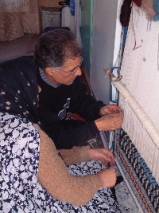
Soon we are offered tea, nuts and fruit as a snack, sitting on the floor with our feet under a table heated with a basin filled with hot coals. Also in this room is a partially completed rug on a loom. Masoud spends a few minutes with his Aunt working on it. Next we go into the cookhouse, a stone building with an open wood fire and nothing but a smoke hole in the roof to act as a chimney. A single bare light bulb illuminate the otherwise soot blackened space. In the middle of the room is a hole filled with hot coals for baking bread. Chicken kebabs are being prepared on the floor.
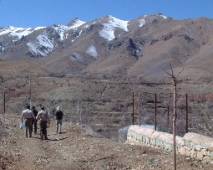
It is now time to go for a hike around the town. First we head off toward the mountains, and through some of the backfields. The air is clear and fresh, not a cloud in the sky. Vegetation is sparse. Only the men go on this walk, as the women are busy preparing the meal. It is a time for stories, and for meeting old friends, as this is the village where Masoud spent his summers as a child, visiting his grand parents. Masoud shows me where they use to live, now unfortunately a crumbling ruin.
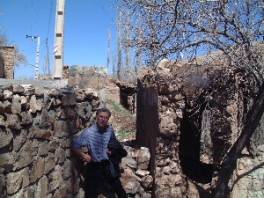
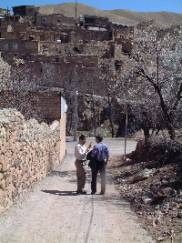
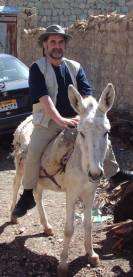
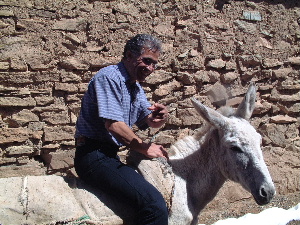
We wind back through the village, where it is decided that I need to experience a special kind of transport, this time on a donkey. No trip to an Iranian village is complete without one! Both Masoud and I take turns coaxing the trusty steed along.
 The
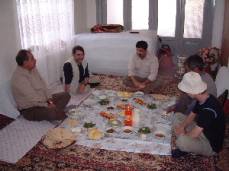
highlight of the day, however, is yet to come. I am speaking of the meal. A
traditional feast served on the floor, with chicken kebabs, fresh bread,
saffron rice many fine salads, and fresh yoghurt.
The
highlight of the day, however, is yet to come. I am speaking of the meal. A
traditional feast served on the floor, with chicken kebabs, fresh bread,
saffron rice many fine salads, and fresh yoghurt.
No one that I meet in this village speaks English, yet everyone communicates warmth and acceptance as they greet me. As we prepare to leave I shake my head in disbelieve as Masoud explains that his Aunt is concerned that the meal is too simple. I ask him to convey that it is one of the most enjoyable, and certainly memorable meals I have ever had.
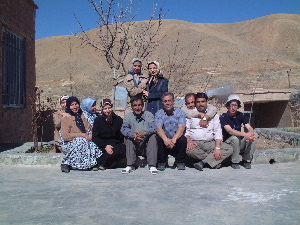 In
preparing to go, I ask if we may have a group picture. Everyone gathers,
some more shyly than others.
In
preparing to go, I ask if we may have a group picture. Everyone gathers,
some more shyly than others.
 As
we begin the return journey the air is clear. Unfortunately this condition
does not last. In less than an hour, the thin brown line visible on the
horizon grows ever larger. As we approach the city of Saveh, we are enveloped
in this brown smudge. The reasons are obvious as we enter the city. Large
factories are frothing black soot and old diesel buses are doing the same. Open
fires can be seen on the side of the highway. North of Saveh we turn left
to drive a few kilometres to a modern six-lane highway.
As
we begin the return journey the air is clear. Unfortunately this condition
does not last. In less than an hour, the thin brown line visible on the
horizon grows ever larger. As we approach the city of Saveh, we are enveloped
in this brown smudge. The reasons are obvious as we enter the city. Large
factories are frothing black soot and old diesel buses are doing the same. Open
fires can be seen on the side of the highway. North of Saveh we turn left
to drive a few kilometres to a modern six-lane highway.
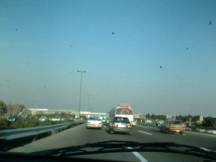
Cars continue to drift from lane to lane for no apparent reason. The barren landscape flashes by. A concrete tall wall separates opposing traffic. Tumbleweed, and other debris are resting against it. The highway is unfenced, yet sheep can be seen once again grazing in the distance. Snow capped peaks are barely visible to the north through the smog. I can feel the coarseness of the air as I breathe.
Just sparse tufts of vegetation appear to be all that holds soil (if it can be called that) in place. I am thankful that it is not windy. As we pass the “70 kms to Tehran” sign the traffic is very light, yet vehicles continue to struggle with the concept of maintaining a constant lane and speed, including at times the one I am in. The visible demarcation of smog rests just above the highest peak of the distant mountains.
Thick black smoke is rising from an open fire on the side of the road. A large tractor tire is in flames. This thick feather wafts upward, uncaring, and uncared for. We descend a barren valley and view Parand City to the left. There is no vegetation visible as we climb up the other side of the valley. I wonder what holds everything together. There is a reddish hue to the terrain. As we pass the “10 kms to Tehran” sign the beautiful mountains that I know to be there are totally shrouded from view by smog.
Tuesday, March 23. A trip to the Caspian Sea.
Our trip to the Caspian Sea was hastily arranged after Masoud received a phone call from his old friend Javod, whom he had been trying to contact for several weeks. Although previously a resident of Tehran for many years, unbeknownst to Masoud, he had recently moved back to Chaloos on the seacoast. The reasons for this move would become apparent later.
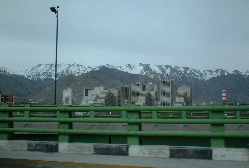
We pull away at 0718h, another crystal clear, beautiful day. It is 7 degrees Celsius. Two traffic police officers stand at a corner. These traffic officers seem to appear everywhere, but through my western eyes, don’t control anything. On this early morning during Narooz, we are on the four lane controlled access Niayish Highway. We continually pass buildings in various stages of construction.
The original plan was for five of us to take this journey, but Ahmed is sick and Maryam, Ali’s fiancée, has decided it would be unwise if she came. If stopped at a police checkpoint she is concerned about being challenged as an unmarried woman travelling with men with whom she is not related as defined by the Islamic Republic of Iran.
As the sun rises higher the dirty brown smudge of the Tehran air becomes more visible. By 0800h we have pulled off the main highway at Karaj. Before continuing, we stop for an oil change where David Beckham (or his card board cut out) sells his Castrol brand of service. The business owner cheerfully and briskly serves us, and in less than ten minutes our trip continues. If only I could count on this service from Canadian Tire.
This is regarded by many as the most beautiful
of the highways to take you north to the Caspian Sea. We approach a large
traffic circle where dozens of people stand, looking for a ride. As we push
into the mountains small dilapidated square box residences seem to crawl
up the slopes with us. We enter the first of a series of tunnels, signifying
our departure from Karaj. This is a mountainous winding route. We follow
a stream up the valley. Sheer cliffs 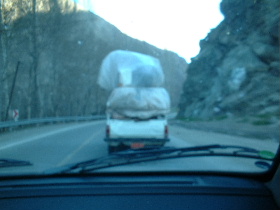 loom
on either side. The road is busy, yet impatient drivers insist on attempting
to pass. Overloaded vehicles crawling up the hill further reduces traffic
speed while increasing everyone’s frustration level. Stone walls protect
many of the roadside properties. Most of these walls are covered in painted
advertising.
loom
on either side. The road is busy, yet impatient drivers insist on attempting
to pass. Overloaded vehicles crawling up the hill further reduces traffic
speed while increasing everyone’s frustration level. Stone walls protect
many of the roadside properties. Most of these walls are covered in painted
advertising.
Garbage often litters the side of road and a dog is seen picking through it. An endless snake of vehicles proceeds up the mountain.
Cars continue to pass on corners as we wind our way up the hill. The police are maintaining a strong presence on this section of the road, and are actually pulling some wayward drivers over. A cruiser screams past us, hopefully in pursuit of a particularly offensive driver whom I witnessed force several vehicles off the road as he charged up the hill in his 30 year old Oldsmobile.
From the valley I look up and note at least four major switchbacks in the road as it makes its way up the mountain. The rock faces are sheer. It is a very long way to the bottom as I glance out of my window. It is the first time I have experienced my fear of heights from a car. I have never noticed so much tension in my body on a road trip as I am experiencing at this moment. With the treacherous road and the outrageous driving habits I feel every muscle flexing. I note the almost constant grip I have had on the “holy shit” handle above the passenger door.
The tunnels are lit, but the interior rock face is jagged, as they have not been lined with concrete. We have passed a large dam, and the headwater is to our left.
Families pull off on the side of the road, often cooking breakfast on an open-air fire. There is much evidence of recent rockslides. The headwater from the dam is now reduced to a fast flowing stream a few metres wide.
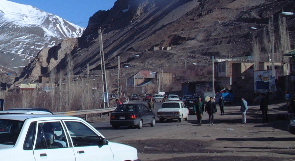 We
pull into Gadchscar for a toilet break. The shaded ground is frozen, but
mud is beginning to appear where the sun is shining. A police checkpoint
is twenty metres ahead of where we stop. I observe them as they randomly
motion oncoming traffic to pull over. We climb back into our vehicle and
pull into traffic, but as soon as we approach the checkpoint we are ordered
to the side of the road for inspection. The officer at the driver’s door
demands my passport, while another officer opens my door. A brief discussion
in Farsi ensues. It was later explained to me that the officer in temporary
possession of my passport began to insist that I needed a permit to travel
on this particular road. Masoud was able to deftly dissuade him of this
opinion by pointing out that since I had a visa for Iran, and the road was
in Iran, that I had all the permission I required. We continued on our journey.
We
pull into Gadchscar for a toilet break. The shaded ground is frozen, but
mud is beginning to appear where the sun is shining. A police checkpoint
is twenty metres ahead of where we stop. I observe them as they randomly
motion oncoming traffic to pull over. We climb back into our vehicle and
pull into traffic, but as soon as we approach the checkpoint we are ordered
to the side of the road for inspection. The officer at the driver’s door
demands my passport, while another officer opens my door. A brief discussion
in Farsi ensues. It was later explained to me that the officer in temporary
possession of my passport began to insist that I needed a permit to travel
on this particular road. Masoud was able to deftly dissuade him of this
opinion by pointing out that since I had a visa for Iran, and the road was
in Iran, that I had all the permission I required. We continued on our journey.
As we head to higher elevations snow banks are appearing, and looming larger. Travel is slow, barely exceeding 40 kph, as we follow two diesel belching Mercedes 0302 buses. Snow sheds are in place to protect from avalanche. We have travelled through the Kandovan tunnel to enter a completely snow covered environment.
This changes quickly though, as our elevation drops, and we head down to the Caspian Sea. Our first accident of the morning, with one vehicle nose first into a ditch and rock face, slows traffic temporarily.
We are now driving down a steep gorge, not much wider than the road itself. We enter Sizeh Bizesh. Roadside services selling souvenirs and various foodstuffs hug the cliff. Fresh meat hangs in the windows of several stores while a smoky haze hangs over the entire valley.
We have been on the road a few minutes short of 3 hours and have come 150 kms. Small rocks litter the road. We descend the mountain only meters behind a fully loaded pick up truck. Masoud constantly peers for an opportunity to pass. More than once he has attempted to respond to my concerns about this dangerous road. He is confident in his knowledge of this road and his skills. He even offers to turn back, probably noting a greying of my complexion with every twist and turn. I tell him that I won’t give up this experience that easily. Just then a car without headlights passes our line of vehicles through an unlit tunnel.
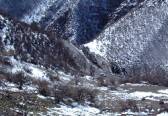 The
trip through the gorge north from our tea break to Marzan Abad is relentless. It
is the most dramatic highway I have ever experienced. The switchbacks are
countless. Large rock faces hang over us. At times I feel that if I were
permitted to stand in the middle of the road I could touch the gorge on either
side.
The
trip through the gorge north from our tea break to Marzan Abad is relentless. It
is the most dramatic highway I have ever experienced. The switchbacks are
countless. Large rock faces hang over us. At times I feel that if I were
permitted to stand in the middle of the road I could touch the gorge on either
side.
For the second day of travel I am observing the world from the front passenger seat. Yesterday Faraj sat in the back. Today it is Ali occupying that spot. Perhaps out of a need to care for both the driver and the foreign visitor, both of them seem compelled to feed us. There is a steady stream of peeled apples and oranges, nuts and the occasional zucchini. Although well intentioned, it magnifies my apprehension as I travel this road and watch Masoud expertly thread our car through the available space while removing excess orange seeds, apple cores, pistachio shells and zucchini stems from his hand.
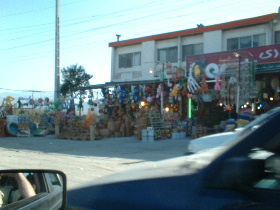 Another
component of driving in Iran is that you are constantly being pleaded with
by roadside vendors to buy their wares. People stand by the side of the
road waving oranges, bananas, bottles of refreshment, and anything else they
think they may entice you with. They are just as pervasive on this mountain
road as they are on an expressway. They are not so much the danger, as are
the purchasers, as they are prone to sudden stops, or driving at you from
the opposite side of the road to negotiate for the bargain they have eyed.
Another
component of driving in Iran is that you are constantly being pleaded with
by roadside vendors to buy their wares. People stand by the side of the
road waving oranges, bananas, bottles of refreshment, and anything else they
think they may entice you with. They are just as pervasive on this mountain
road as they are on an expressway. They are not so much the danger, as are
the purchasers, as they are prone to sudden stops, or driving at you from
the opposite side of the road to negotiate for the bargain they have eyed.
If you are stopped in traffic, perhaps at a highway tollbooth or police checkpoint, they will descend to sell flowers, pillows, or food. From young children to the elderly, they all have something to sell.
Traffic chaos greets us as we descend the mountain and approach our destination. Several disorganized lanes converge to traverse a single lane bridge. After this bottleneck we are soon driving in excess of 100 km/h. Both sides of the road however are littered with debris and piles of rotting garbage. Many buildings are in disrepair.
After driving less than an hour along the coast we pull into a hotel/fast food parking lot to meet Javod. Masoud introduces him as a poet and his best friend. After a brief conversation Ali hops in Javod’s car and Masoud and I follow them down a series of twisted broken alleyways. Eventually we are driving down a wide boulevard that takes us to the Caspian Sea. It is the first time I see cows wandering about in a built up area. At this apparent dead end we turn left down a very rocky trail. This leads us to a rope gate and a wire-fenced property with more than a hundred meters of frontage on the seacoast. Within this compound, surrounded by newly planted trees is a two room newly constructed bungalow.
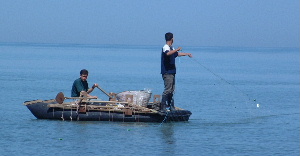
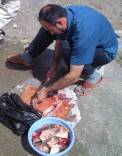 Several
middle-aged men greet us. One of them is preparing freshly caught white
fish on a concrete slab next to the house for our lunch. We have a tour
of the property, taking time to skip stones into the sea and watch as fishermen
tend to their nets.
Several
middle-aged men greet us. One of them is preparing freshly caught white
fish on a concrete slab next to the house for our lunch. We have a tour
of the property, taking time to skip stones into the sea and watch as fishermen
tend to their nets.
It is now time to move inside for tea and conversation. Javod opens a briefcase and pulls out a few sheaves of paper. He then begins to recite what I know to be poetry. Though I do not understand a word of the meaning, I feel the lyricism, flow and rhythm of his poetry as he speaks. Several men sit, entranced by his words.
His story is a tortured one, literally and figuratively. An engineer by profession, he is no longer permitted to practice his profession because of government restriction. Previously residing in Tehran, he was politically active and involved in student demonstrations at Tehran University last summer. As a result, he was arrested, questioned, beaten and tortured for his views. Well over six feet in height, his body is well proportioned. Signs of grey are appearing through his full head of dark hair. His face, though beginning to show the creases of middle age, displays a warmth and tenderness that I would thought uncharacteristic of someone who had suffered a state sponsored beating. But then, it is probably his openness that provoked the beating in the first place.
Apparently, this was the reason for his sudden move back to the coast. Wanting to reduce his profile to those who may be interested in his political activism, he has chosen to return, with his young family, to the community he grew up in.
How representative his story is of the tragedy of Iran. So rich with culture, emotion and expression, yet their citizens live in fear of their own government. So many people are afraid that they may speak the wrong words in the wrong place, allowing them to be overheard by someone who will betray them.
It is mid afternoon before we are sitting down for our lunch of fresh white fish, rice, yoghurt and bread. I can tell that Masoud wishes we had more time to enjoy an extended leisurely visit with his old friend. There are many stories that will have to be told on another day. We do linger, though, spending time visiting a family farm where kiwis, oranges and bananas grow.
As enjoyable as this is, our departure is now delayed to late afternoon, and we are several hours away from Tehran. After poignant goodbyes, we once again join the traffic of the coast, proceeding east on a jammed holiday route. Cows continue to be a concern, wandering aimlessly along the side of the road. Occasionally they graze on piles of discarded garbage.
Thursday, March 25
Looking down on the vastness that is Iran, I ponder what will allow it to be free and expressive of its beauty. So rich, yet so sad, physically choking on its own effluent, emotionally it is being strangled by fear. Fear pervades so many decisions made by the people of Iran that we in the west take for granted. Fear of speaking openly; fear that satellite dish may be taken, in other words, fear of speaking, and listening.
The Islamic Republic of Iran is afraid of information. As with any totalitarian state it must impose its view through fear and intimidation. I realize that only now, as I fly away from Iran over European airspace that I feel free to openly discuss, even with myself, the large contingent of various security forces that are ever present throughout the Republic. From the fighter jets that greet you on the tarmac of Meherabad Airport to the police officers stationed at 50-meter intervals up both sides of Vali Asr Street surrounding a park during the Narooz celebration, the imposition of government security is pervasive.
Three times in two weeks we were stopped at police checkpoints. Our vehicle was searched and identification checked. I saw countless military police and special forces patrols every day that I travelled. On several occasions I witnessed security forces patrolling the streets or guarding a building armed with fully automatic weapons.
I am now flying over Germany, soon to descend into Amsterdam. I look down on the neatly cared for rural landscape, the well-organized cities, and the traffic flowing on the autobahn. Less than sixty years ago this country was devastated by war, its infrastructure destroyed and its people despairing at the site of the ruins that lay around them. How could they rebuild? How could they make life worth living again? Since, then, they did that, and much more. They have many modern day problems, but they have developed a country that is a respected world leader.
Germany was able to move from a totalitarian, repressive, militaristic society. I believe Iran can as well. The Iranian society is as rich and its culture as strong as anything German society has laid claim to. It is my hope that Iran can move on the path of becoming a more open, free and pluralistic society. All the people of Iran deserve it.