London Notes
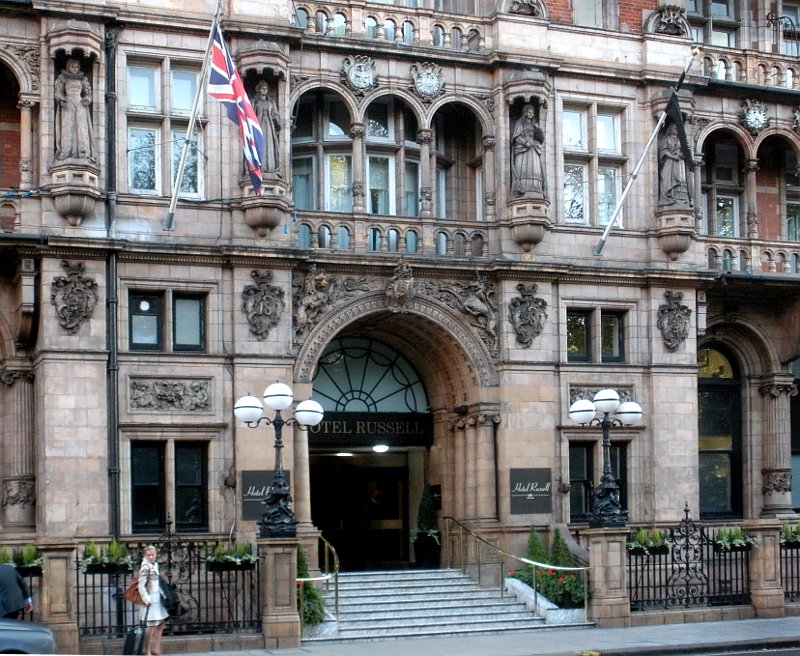
Hotel Russell, Russell Square, Bloomsbury, London
Doors, doors, doors.
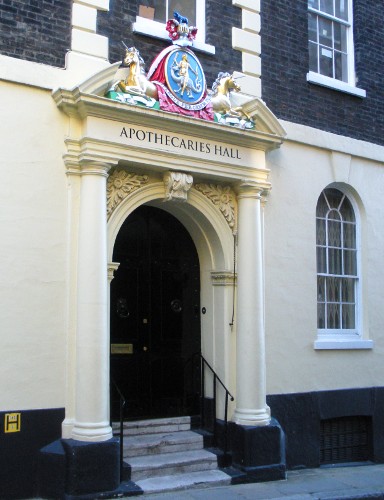
The Worshipful Society of Apothecaries of London, Black Friars Lane.
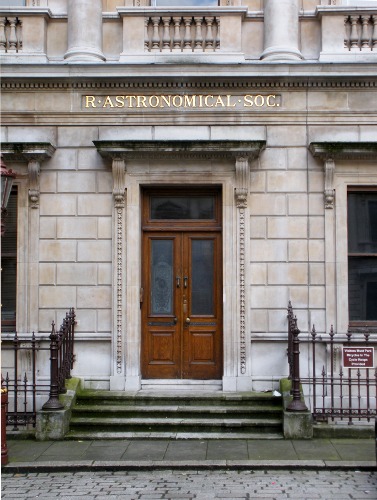
Royal Astronomical Society (RAS), Burlington House, London
Some have a quiet, classical dignity, some are a bit showy, all are a joy to look at. These aren't the products of some CAD (computer assisted design) program. These doors are more than just a segment of some corporate-branded consumer-traffic control system. And that may be a large part of their appeal to us: They look and feel handmade. They contribute to an environment that we experience as having been made by and for human beings. There are just as many of the "other" kind of door in London as there are in any modern city but as tourists unconstrained by daily necessity we could choose to avoid them.
These little (and sometimes not-so-little) works of art are a small part of what made walking around London such a fascinating experience. Boredom was never an option. Exhaustion, on the other hand, became a daily certainty as we were drawn on and on by the possibility of what we might find just around the next corner.
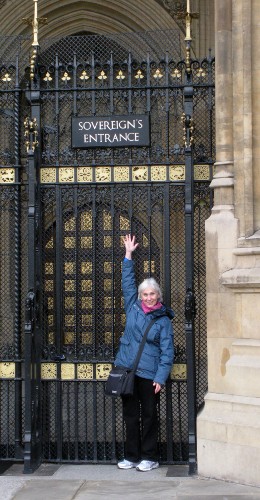
She Who Must Be Obeyed at the other Queen's entrance, Parliament, London
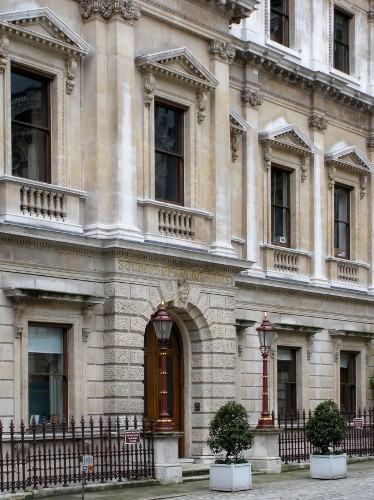
Society of Antiquaries, Burlington House, London
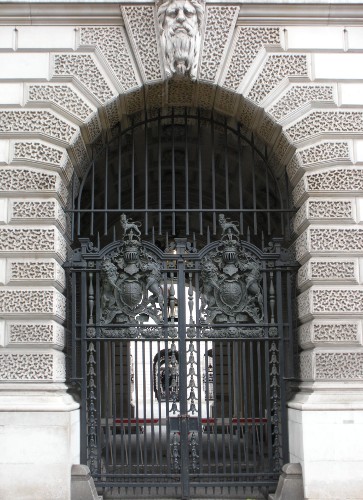
Gate, HM Revenue and Customs, Great George Street, London
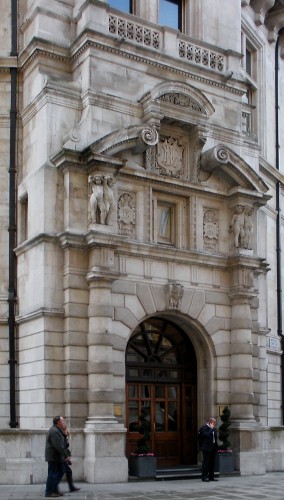
An entrance to the National Liberal Club, junction of Whitehall Place & Whitehall Court, London
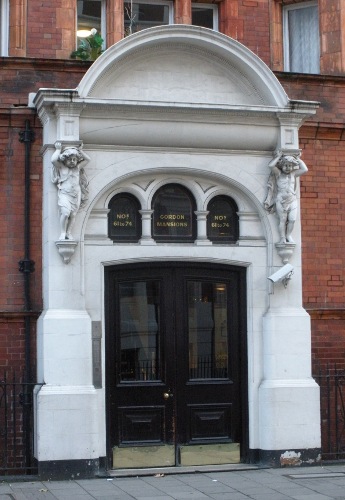
Gordon Mansions, Torrington Place, London
Hotel Russell facade
The Russell Hotel was designed by Charles Fitzroy Doll, an architect who specialised in the designing of hotels. His inspiration for this building was the Chateau de Madrid built in the Bois de Boulogne near Paris in the sixteenth century. An interesting note is that he re-used the design of the dining room of the Hotel Russell for his design of the dining room on the Titanic.
The four life-size terracotta sculptures of British Queens, busts of four Prime Ministers, and assorted cherubs, on the facade of the hotel were produced by the sculptor Henry Charles Fehr.
Apothecaries Hall
Apothecaries Hall has stood on this site since the original building, the guesthouse of the Dominican Priory of the Black Friars, was acquired in 1632. The original Hall was destroyed by the Great Fire and rebuilt in 1672. In 1704 the Society won the right to prescribe and dispense medicines which subsequently led to the evolution of the apothecary into today's General Practitioner.
For a glimpse of the fascinating history of their evolution from members of the Guild of Pepperers (c.1180) to their present position:
The Worshipful Society of Apothecaries of London
http://www.apothecaries.org/society/our-history/
Worshipful Society of Apothecaries (wikipedia)
https://en.wikipedia.org/wiki/Worshipful_Society_of_Apothecaries
Royal Astronomical Society
"The 'Astronomical Society of London' was conceived on 12 January 1820 when 14 gentlemen sat down to dinner at the Freemason's Tavern, in Lincoln's Inn Fields, London."
-quoted from "A brief history of the RAS"
http://www.ras.org.uk/about-the-ras/a-brief-history
It's worth drawing attention to the RAS' page about its location, Burlington House, which is also the home of The Linnean Society of London, The Society of Antiquaries (see below), The Royal Society of Chemistry, The Geological Society of London, and The Royal Academy of Arts:
Burlington House
https://www.ras.org.uk/about-the-ras/burlington-house
Society of Antiquaries
"The encouragement, advancement and furtherance of the study and knowledge of the antiquities and history of this and other countries’".
The Society of Antiquaries of London, by Royal Charter, 1751.
The Society led a somewhat peripatetic life until 1874:
The Bear Tavern in the Strand (1707), the Young Devil Tavern (1708), the Mitre Tavern in Fleet Street (1717), rooms in Gray's Inn (1725), back to the Mitre (1729), the former Robin's Coffee House in Chancery Lane (1753), Somerset House (granted by George III, 1780), and, finally, to Burlington House (see RAS above) in December 1874.
Society of Antiquaries
http://www.sal.org.uk/
Society of Antiquaries of London (wikipedia)
https://en.wikipedia.org/wiki/Society_of_Antiquaries_of_London
The National Liberal Club
Founded in 1882 ...the club remains completely independent but, as the name implies, continues to be closely identified with the historic Liberal traditions and Liberals worldwide."
-quoted from the club's website: http://www.nlc.org.uk/nlc.htm
"...the house that is now erected on the Thames Embankment is one of the finest and most complete establishments in London"
-from "Joseph Hatton's Club-Land (1890) on the National Liberal Club",
The Victorian Web http://www.victorianweb.org/art/architecture/clubs/10.html
A review of the National Liberal Club from Yelp:
http://www.yelp.com/biz/national-liberal-club-london
Gordon Mansions
If you think you might want to live here, be prepared to put out £1,000,000 and up for a flat (said to be spacious by today's standards) according to Zoopla property search.
http://www.zoopla.co.uk/home-values/london/torrington-place-wc1e/?pn=4
NOTE: All websites listed on this page were last accessed 2013-01-02.