A column of observation, discovery and opinion. When you are retired,
you can research almost anything you find interesting,
and take as long as you like doing it.
If you have JavaScript enabled, set your prefered font size button and font face: Arial, Times, Verdana
Amazon Kindle wireless e-reader
Amazon launches wireless book reader, press release, November 19, 2007
NEW YORK - Amazon.com , the world's largest Web retailer, said Monday it will begin selling an electronic book reader with wireless access, the latest attempt to build consumer interest in portable reading devices. Although the market for e-books is limited, and competing devices have yet to catch on, one analyst said Amazon's book reader could eventually evolve into one that is able to capture all of the company's many offerings. The battery-operated Amazon Kindle will sell for $399 (U.S.) and let users download books, newspapers and blogs over a wireless connection. It can carry about 200 books downloaded from Amazon.com at about $10 each for new releases. Wireless access, based on the cellphone broadband technology EVDO, is built into the 10-ounce, thin white device. Downloading content does not require a computer and takes less than a minute for a full-length book, the company said.
For further details, see Kindle: Amazon's New Wireless Reading Device
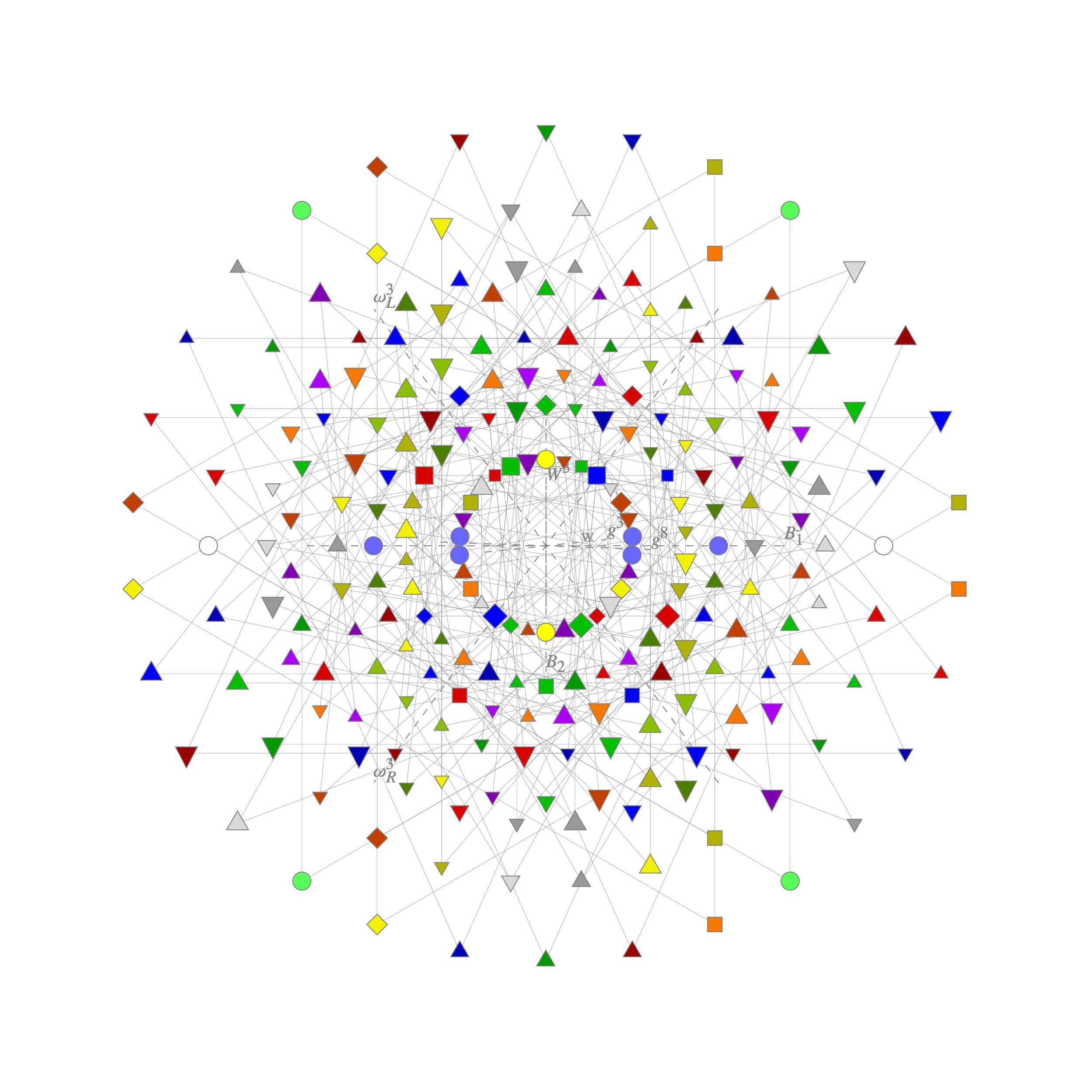
Lisi's E8 ToE (Theory of Everything)
2007 has been a busy year for Quantum Gravity Theory and for Garrett Lisi in particular.
Elizabeth A. Thomson,Math research team maps E8, MIT, 2007-03-18.
Roger Highfield, Is this the fabric of the universe?, Telegraph.co.uk, 2007-03-19, Roger Highfield describes a heroic mathematical enterprise that could lay bare the fundamentals of the cosmos
"The E8 calculation was part of an ambitious project known as the Atlas of Lie Groups and Representations. Mathematicians mapped the inner workings of one of the most complicated structures ever studied: the object known as the exceptional Lie group E8. This achievement is significant both as an advance in basic knowledge and because of the many connections between E8 and other areas, including string theory and geometry. The representations of E8 and a precise description of the relations between them, are all encoded in a matrix with 205,263,363,600 entries. This data occupies 60 GB, more than the human genome which occupies less than 1 GB. Mathematicians are known for their solitary work style, but the assault on E8 was part of a large project bringing together 18 mathematicians from the U.S. and Europe for an intensive four-year collaboration."
The ILQG Seminars are interesting in that they take place every week on Tuesday at 9am (US, CT), via a telephone conference call. Slides of the talks are posted in advance on their web site. The talks are recorded and the audio is posted on the web site (.wav, .aif and .mp3 formats). Groups that take part include PennState, Perimeter Institute (Canada), Marseille (Carlo Rovelli et al), AEI-Potsdam, Utrecht, UNAM-Mexico, FUW-Poland, CSIC-Madrid, UDELAR, Uruguay, UWO-Canada, UNB-Canada, Umass Dartmouth, Hamilton College, LSU. Previous presenters to the ILQG Seminar include:
Garrett Lisi (2007-11-13), Dan Christensen (UWO, 2007-10-30), Jonathon Engle (Marseille, 2007-09-18), Laurent Friedel (Perimeter Institute, 2007-05-15), Lee Smolin (Perimeter Institute, 2007-04-03), Krill Krasnov (Perimeter Institute, 2007-03-20), Michele Arzano (Perimeter Institute, 2007-03-13), Abhay Ashtekar (PennState 2007-02-27), Bianca Dittrich (Perimeter Institute, 2006-11-28), Simone Speziale (Perimeter Institute, 2006-10-03), Carlo Rovelli (CPT Marseille, 2006-09-26), Abhay Ashtekar (PennState 2006-09-19).
In his published paper of 2007-11-06, Lisi concludes:
"There are a remarkable number of "coincidences" that work exactly right to allow all known fields to be unified as parts of one connection. The factors of ½ and ¼ multiplying the spin connection and frame-Higgs result in the correct expressions for the gravitational Riemann curvature and the covariant Dirac derivative in curved spacetime. The fermions fit together perfectly in chiral representations under graviweak so(7,1), and the frame-Higgs has all the correct interactions. This frame-Higgs naturally gets a Ф4 potential and produces a positive cosmological constant. Finally, and most impressively, the fit of all fields of the standard model and gravity to E8 is very tight. The structure of E8 determines exactly the spinor multiplet structure of the known fermions.
"There are also aspects of this theory that are poorly understood. The relationship between fermion generations and triality is suggested by the structure of E8 but is not perfectly clear -- a better description may follow from an improved understanding of the new ω + xФ fields and their relation to ω + cФ. This relationship may also shed light on how and why nature has chosen a non-compact form, E IX, of E8. Currently, the symmetry breaking and action for the theory are chosen by hand to match the standard model -- this needs a mathematical justification.
"Quantum E8 theory follows the methods of quantum field theory and loop quantum gravity -- though the details await future work. One enticing possibility is that the gravitational and cosmological constants run from large values at an ultraviolet fixed point to the tiny values we encounter at low energies.[19, 20] At the foundational level, a quantum description of the standard model in E8 may be compatible with a spin foam description in terms of braided ribbon networks [21] through the identification of the corresponding finite groups. And there is a more speculative possibility: if the universe is described by an exceptional mathematical structure, this suggests quantum E8 theory may relate to an exceptional Kac-Moody algebra.[22]
"The theory proposed in this paper represents a comprehensive unification program, describing all fields of the standard model and gravity as parts of a uniquely beautiful mathematical structure. The principal bundle connection and its curvature describe how the E8 manifold twists and turns over spacetime, reproducing all known fields and dynamics through pure geometry. Some aspects of this theory are not yet completely understood, and until they are it should be treated with appropriate skepticism. However, the current match to the standard model and gravity is very good. Future work will either strengthen the correlation to known physics and produce successful predictions for the LHC [Large Hadron Collider], or the theory will encounter a fatal contradiction with nature. The lack of extraneous structures and free parameters ensures testable predictions, so it will either succeed or fail spectacularly. If E8 theory is fully successful as a theory of everything, our universe is an exceptionally beautiful shape."
Lisi found that all the particle types in the universe can be mapped onto a geometric structure known as an E8 Lie Group, a sort of three-dimensional Periodic Table of sub-atomic particles. Strong and weak atomic forces can be calculated from this model - these agree with their values in nature. There are 20 blank spaces on the model for particles not yet discovered. I am intrigued by Lisi's description of the inter-particle (strong and weak) forces: "all interactions and dynamics described by its curvature." Was not Einstein's theory of gravitational force being based on curvature of space? Is Lisi talking about a similar effect?
Unlike the various String theories, the E8 ToE only involve 3 dimensions of space and one of time. All the fundamental particles result from different facets of the strange symmetries of E8. Lisi found a way to place the various elementary particles and forces on E8's 248 points. All the elementary particles appear to belong to families, but this arises naturally from the geometry of E8. So far, all the interactions predicted by the complex geometrical relationships inside E8 match with observations in the real world.
E8 was originally formulated between the years of 1888 and 1890 (as early as 1879 according to some sources) by Wilhelm Killing. He invented Lie algebras independently of Sophus Lie around 1880. E8 was not analized in detail until the project known as the Atlas of Lie Groups and Representations. completed its calculation on 2007-03-19.
Blogs and Forums have been abuz with comments and questions ever since Lisi published his paper on 2007-11-06. One of the best forums is that of
Peter Woit, Not Even Wrong, with 84 responses including Garrett Lisi answering everyone's questions.
Physics Forums include
Marcus, An Exceptionally Simple Theory of Everything, 2007-11-06
Gang of four--Lisi, Loll, Reuter, Rovelli--make trouble for stringery, 2007-11-10
Live Journal posts include
ispy, Surfer-Physicist Offers A New Way To Explain Everything, 2007-11-17
pozorvlak, An exceptionally simple theory of everything, 2007-11-17
Some other posts include
bi-ker-shi, Breakthrough on the theory of everything, is Garrett Lisi another Einstein?, 2007-11-17
Rahul Siddharthan, Why am I surrounded by idiots?, E's flat, ah's flat too , Horizontal thoughts, 2007-11-17.
Chris Lee, Upon further review, surfer's new Theory of Everything severely deficient, ArsTechnica, 2007-11-17
Thanks to Morris and Joc who brought this interesting new ToE to my attention.
Sources
Garrett Lisi has a Personal Wiki Notebook Deferential Geometry, a CV, and a web page
A video of the various rotations and Representations of the E8 model may be found at Deferential Geometry, or YouTune,
Wilhelm Killing, Wikipedia
Wilhelm Killing, Die Zusammensetzung der stetigen, endlichen Transformationsgruppen, Mathematische Annalen,
Volume 31, Number 2 June, 1888, Pages 252-290 doi:10.1007/BF01211904;
Volume 33, Number 1 March, 1888, Pages 1-48 doi:10.1007/BF01444109;
Volume 34, Number 1 March, 1889, Pages 57-122 doi:10.1007/BF01446792,
Volume 36, Number 2 June, 1890,Pages 161-189 doi:10.1007/BF01207837
Zeeya Merali, Is mathematical pattern the theory of everything?, NewScientist.com news service, 2007-11-15.
An Exceptionally Simple Theory of Everything, Wikipedia
A Theoretically Simple Exception of Everything, BackReAction by Bee, 2007-11-06
Roger Collier, Just maybe, this surfer knows everything there is to know about physics, Citizen, 2007-11-15.
Roger Highfield, Science Editor, Surfer dude stuns physicists with theory of everything, Telegraph.co.uk, 2007-11-14,
For years, Rouse's Point, NY, and Lacolle, QC, neighbouring towns on the Canadian-US border, have helped each other with fire equipment in the event of a fire that one of them could not handle on their own. On Sunday, as the Anchorage Inn in Rouse's Point was burning to the ground, the Lacolle fire department were held up at the US border by overzealous border guards, following the post-911 regulations, because the Canadian firemen did not carry ID in the fire gear they were wearing.
Sources
Ingrid Peritz, U.S. border delay kept fire crew from blaze, Globe and Mail, November 15, 2007; and Print edn.
Fire crew rushing to U.S. blaze stopped at border, CTV News, updated Wed. Nov. 14 2007 (10:32 PM ET).
Elevator button labelling and floor numbering have long been confusing. Firstly there is the confusion as to which is the 1st floor. Then there is confusion as to the meaning of abbreviations such as G (Ground or garage), R-C (Rez de Chaussée), L (Lobby), LL (Lower Lobby), M (Mezzanine), B (Basement), LG (Lower Ground, where basement is considered inappropriate), S-S (sous-sol), P (Parking or Pool), especially in a multi-lingual environment. Sometimes the "ground floor" is not at street level.
Elevator manufacturers have long used the symbol * to indicate the floor that leads to the building exit. But several conventions exist as to the numbering of Storeys (UK and Canada) or Stories (US). The two main ones are the cardinal system used in Europe and Quebec, and the ordinal one used frequently in the rest of Canada, and in the US. The cardinal system measures the distance in floors from the ground. The ordinal system identifies a position in a sequence of floors.*
In the cardinal system, the first floor is above the ground floor. In the ordinal system, the first floor is the ground floor. In English speaking areas, G is usually used to indicate the ground floor if 1 is above it, or appended to the "1" if that is the ground floor, to minimise confusion. In a bilingual environment, do you use G/RC next to the 1 for the ground floor, and B/SS for the floor below?
The Bruyère Centre in Ottawa has an interesting bilingual elevator button labelling and floor numbering system:
2
1
*
-1
I saw Esref Armagan, the blind painter, in part of a documentary The Superhuman and Quest this evening on the Discovery TV channel. His skills were amazing, painting things he had never seen. When painting in oils or acrylics, he paints with his fingers, so that he can feel where previously applied paint is located. Likewise when drawing with pencil, he feels with his finger tips, where the previous lines have been drawn. The documentary showed an example of his painting - a seascape!
"Esref Armagan, of Ankara, Turkey, is a 53-year-old blind painter. Blind since birth, Armagan is a gifted visual artist who can draw and paint in three dimensions; drawing comparisons to Renaissance architect Filippo Brunelleschi, the first artist to master three point perspective. Armagan paints houses, boats, birds and butterflies, even though he's never actually seen any of these things. He paints with lively colours and has even learned to draw in perspective, yet his brain has never detected hue, light or shadow. Over the years, Armagan developed his own methods for creating his artwork and no one has taught him or described what techniques to use. He started with pencil and paper, and by 18 he was painting with his fingers, first on paper, then on canvas with oils. Nowadays, he works primarily with fast-drying acrylics. After displaying his work at more than 20 exhibitions in Turkey, Holland, the Czech Republic and China, Armagan's disarmingly realistic work and his abilities have revolutionized our knowledge of how much congenitally blind people can understand about the layout of space. Dr. John Kennedy, a psychologist and Director of Life Sciences at the University of Toronto, researches the psychology of perception and cognition in both sighted and blind people. He put Armagan through a battery of tests in which he successfully drew a series of solid objects, including a cube, in three-point perspective. Further tests, at Harvard University's Neuroscience laboratory, tested Armagan while drawing and revealed that as he drew his visual cortex wasn't lying dormant - it had been recruited by his other senses and lit up as though he was seeing. For the ultimate challenge, Dr. Kennedy takes Armagan to Italy to recreate Brunelleschi's perspective masterpiece - the Baptistery in Florence." *
"The third competition of the DARPA Grand Challenge, known as the "Urban Challenge", took place on November 3, 2007 at the site of the now-closed George Air Force Base (currently used as Southern California Logistics Airport), in Victorville, California.
"The $2 million winner was Tartan Racing, a collaborative effort by Carnegie Mellon University and General Motors Corporation, with their vehicle "Boss", a Chevy Tahoe. The second place finisher earning the $1 million prize was the Stanford Racing Team with their entry "Junior", a 2006 Volkswagen Passat. Coming in third place was team Victor Tango from Virginia Tech winning the $500,000 prize with their 2005 Ford Escape hybrid, "Odin". MIT placed 4th, with Cornell and University of Pennsylvania also completing the course.
"The course involved a 96 km (60-mile) urban area course, to be completed in less than 6 hours. Rules included obeying all traffic regulations while negotiating with other traffic and obstacles and merging into traffic. While the 2004 and 2005 events were more physically challenging for the vehicles, the robots operated in isolation and did not encounter other vehicles on the course. The Urban Challenge required designers to build vehicles able to obey all traffic laws while they detect and avoid other robots on the course. This is a particular challenge for vehicle software, as vehicles must make "intelligent" decisions in real time based on the actions of other vehicles. Other than previous autonomous vehicle efforts that focused on structured situations such as highway driving with little interaction between the vehicles, this competition operated in a more cluttered urban environment and required the cars to perform sophisticated interactions with each other, such as maintaining precedence at a 4-way stop intersection." *
See also the previous Grand Challenge
In his interview on the Current today, Deibert spoke of ways to circumvent Internet censoring in countries like China, where they use IP censoring, and keyword filtering on Yahoo, Google and Wikipedia. He referred to Psiphon and to Everyone's Guide to Bypassing Internet Censorship for Citizens Worldwide. He spends his days monitoring these conflicts, and trying to encourage more open civic politics on the web. He's the Director of The Citizen Lab at The Munk Centre for International Studies at The University of Toronto." *
"In China, the government controls access to Internet content and online publishing by a combination of technical filtering methods and extensive regulations and guidelines. The technical filtering is implemented primarily at the national backbone level, with requests for information filtered for both banned Internet Protocol (IP) addresses and keywords. Although sometimes inconsistent, China's centralized system of content filtering ensures uniform blocking of access throughout the country to human rights, opposition political movements, Taiwanese and Tibetan independence, international news, and other websites. There is very little transparency about Internet filtering, and no public accountability process."
Psiphon was developed by Citizen Lab (Deibert is its director). Its latest release is v1.6 (2007-03-09). OS: Cross-platform; Genre: Censorship circumvention; License: GNU General Public License; available from Citizen Lab
From Wikipedia:
Psiphon is a web proxy designed to help Internet users affected by Internet censorship securely bypass content-filtering systems setup by governments such as China, Iran, North Korea, Thailand, Saudi Arabia, United Arab Emirates and o thers. Psiphon was developed by the Citizen Lab at the University of Toronto, building upon previous generations of web proxy software systems, such as the "SafeWeb" and "Anonymizer" systems.
Psiphon's recommended use is among private, trusted relationships that span censored and uncensored locations (such as those that exist among friends and family members, for example) rather than as an open public proxy. Traffic between clients and servers in the Psiphon system is encrypted using the https protocol.
History and functionality
Psiphon is an internet proxy, described as "... a censorship circumvention solution
that allows users to access blocked sites in countries where the Internet is censored."
The psiphon software "...turns a regular home computer into a personal, encrypted
server capable of retrieving and displaying web pages anywhere." Psiphon was
originally implemented in Python, but has been re-designed and re-written in C++,
and designed as a cross-platform (Windows and Linux versions are currently available),
user friendly proxy server tool which uses a https protocol to transfer data. With
a user name and password, people in countries that use Internet content filtering
can send encrypted requests for information to a trusted computer located in another
country and receive encrypted information in return. As https protocol is widely used
for secure communication over the Internet (from web mail to Internet banking),
no government can block https traffic without further restricting its citizens'
ability to use the web, something that has not dissuaded these governments'
Internet censorship efforts thus far.
Everyone's Guide to Bypassing Internet Censorship for Citizens Worldwide, A CIVISEC PROJECT, The Citizen Lab, The University of Toronto, September, 2007 [31pp]; available from CitizenLab or from Nart Villeneuve. This paper lists
Web-based circumvention systems such as
Proxify, StupidCensorship, CGIProxy, Psiphon, Peacefire/Circumventor,
Tunneling Software, Free:
Tunneling Software, Pay:
Application Tunneling Software: Free
Application Tunneling Software: Pay
Anonymous Communications Systems
My bank has recently been improving the access security of its online banking service. One interesting feature is that as well as storing my answers to a number of security questions, it is also storing the IP address of where I normally access my account from. If I access the account from another location, it asks me some or all these security questions.
My handheld computer changed its clock back today, thinking that Daylight Saving Time had ended, not knowing about the recent law changing the DST ending day to the 1st Sunday in November. This computer is off-line, so that it gets no updates from Microsoft. I assume that Microsoft's Tuesday updates changed the DST algorithm on my desktop XP system which is online. *
As my eyesight began to fade more rapidly last week (cataracts ripening), my greatest difficulty is with trying to read my computer screen. After years of enjoying a 1280x1024 high resolution setting, I have had to change this to 1024x768.
Please excuse spelling mistakes in the future, that I do not see.
When "Sudden Infant Death Syndrome" was first so named, the cause was not known, and it generally was considered to be an accidental death that occurred randomly. There was often the suspicion that the child had been murdered by its mother. When more than one such death occurred in a family, the courts decided the guilt based on the mathematics of chance:
Morer recently, a study of the genealogy of families where SIDS occurred, showed a higher than normal frequency of SIDS in other family members of previous generations, indicting that there is a genetic component to the cause of SIDS.
On Sunday 2007-10-21, TV Ontario showed a film, Cherished, based on a real life case, where the mother lost three successive babies to SIDS, and was given two life sentences for their murder. The jury listened to two experts on the subject, with conflicting opinions, and believed the prosecution expert. Eventually she was released after an appeal brought forward better evidence on the genetic cause theory.
In the real life case, the result of the appeal caused a change in British law. Now if there are two opposing opinions from equally credible experts, then the defendant cannot be sent to jail.
Leon Martineau of Farm Point, QC (near Wakefield), saw and photographed a white ( albino) crow earlier this month. These are extremely rare (1 in 30,000). He was interviewed this morning on CBC's Ottawa Morning, when he described seeing and photographing it.. Pictures were promised on the program's web sight later that day, but did not appear until 10 days later, see.
I witnessed an alarming incident this morning, when a large 18-wheeler tried to negotiate itself round a single-lane roundabout [traffic circle], tetering at an angle of about 30 degrees to the vertical, as its wheels on one side had to mount the central circular walk-way.
It appeared to be travelling from the rear gate to the front entrance of the Governor- General's residence (in Ottawa), and it therefore had to travel down Princess Ave (a side road), along a short section of the Rockcliffe Parkway, and then along Rideau Gate.. In doing so, it had to go round two of the new roundabouts being installed in that area. Trucks are not allowed on the Parkway, but there seemed to be no other route for the vehicle to get from the back to the front of Rideau Hall.
Roundabouts have long been used in Europe to replace traffic lights at intersections on main or arterial roads. You see them in parts of Massachussetts. But you rarely see them in Canada. They now seem to be being introduced in Canada on an experimental basis. The Rockcliffe Parkway is intended for cars only, so although the roundabout diameter is large, there is only one lane around it. Roundabouts are being built on the new "des Allumettières Blvd" (formerly Hwy 148 and St Laurent Blvd), in the section west of St Joseph, as it goes through an old residential section of Hull. This is a main arterial road intended for truck traffic. Although the roundabout diameters are not large, due to limited available space, they do have two lanes in the circular section.
There has always been confusion about the rules for a roundabout, as to who yields to who, whether the traffic going round has priority over those entering the roundabout, or the other way round. This is especially true when the roundabout is on a major road, at the intersecction of a minor road. In Ottawa and Gatineau, they seem to have decided that traffic on the roundabout has priority over traffic entering the roundabout. If this were not so, the traffic would soon jam up. This rule is consistent with the "yield to traffic on your left" rule at road forks, or at highway entrance ramps.
Roundabouts have been much studied, to see if they really improve traffic flow, when compared to the traffic light intersection that they replace. On some very busy intersections in Europe, traffic gets so snarled up, that they have to control the flow of traffic into the roundabout with traffic lights, which defeats the purpose of the roundabout.
Computerization of Medical Charts
At my doctor's office, they are trying to computerize everyone's medical charts, and to enter data, via a wireless networked tablet computer, directly to a digital chart ( database?). This is supposed to make it easy to transfer your chart to another location, to a new doctor, or just for a doctor at another location to access your chart.
My GP says the transfer of all the current written-on-paper charts to digital form will be a huge task.
They are also trying to computerize the patient registration process once again (a previous attempt to do this failed miserably). The new program is better than the last time they tried this. There are still some questions where non-of-the above apply.
They ask for your email address , which I like, and ask if you want to be notified of appointments by email.
When you have successfully registered, they ask you to sit down and wait to be called. They do not confirm that your appointment is at the time and with the doctor that you had booked with. They do not confirm that your doctor made it in to work today - sometimes she is
i) ill at home
ii) car broken or stuck in snow etc.
ii) on holiday,
iv) away on business.
This year the city is celebrating the 150th anniversary of the choice of Ottawa, by Queen Victoria in 1857, as the capital of Canada - then only two provinces: Canada West and Canada East (formerly Upper and Lower Canada).
The National Capital Commission (NCC) are publishing some interesting historical facts and pictures about the "city" at that time - see the outdoor display at 33 Scott Rd, Chelsea, and indoors at the Capital Info Centre, 90 Wellington street, Ottawa , and on their web site www.1857.gc.ca.
I find particularly interesting two of the pictures:
The former is
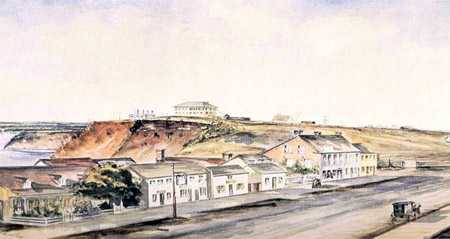
a detail from a watercolour by C. Sedley, titled Wellington Street near Bank Street, Ottawa, painted in 1853. The painting shows Wellington Street to have sidwalks and a wide roadway, even then. "Sedley's watercolour was painted from a room in Mr. Doran's hotel along Wellington street. The buildings shown on the Hill, were the Military Barracks, occupied by "A" Company of the Royal Canadian Rifle Regiment, commanded by Major Clements." *
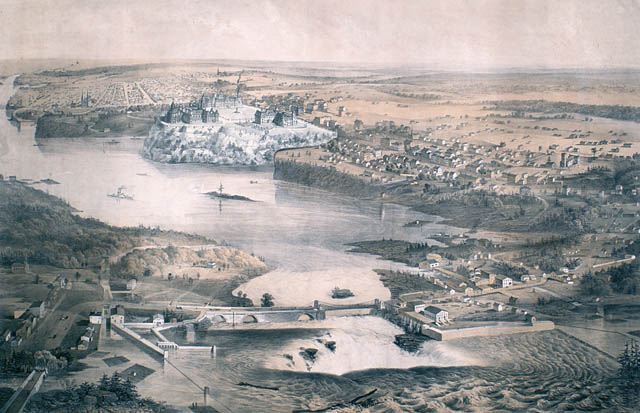
The latter, titled City of Ottawa, Canada West, shows a single bridge over the Chaudière Falls on the Ottawa River (Sappers Bridge, which burned down during the Great Hull Fire in 1900), and a lightly populated Ottawa. Bytown had officially become Ottawa, and was named the Capital of the Province of Canada (formerly Upper and Lower Canada) by Queen Victoria two years earlier in 1857. The river had been known as the Ottawa long before the city was so named.
"Architects Stent & Laver had moved to Ottawa in 1858 with the hope that Ottawa would be named the seat of the new Government and that business would be brisk as the city expanded. As a novel form of publicity for themselves, Stent & Laver had published a bird's-eye view of the city which went on sale in the spring of 1859. In September 1959, tenders were called for the construction of the Parliament Buildings and just two months later the enterprising young architects won the competition to design the East and West Blocks. (Fuller & Jones received the commission for the Centre Block). The first sod was turned in December that same year. After they won the competition for the designs of the East and West Blocks, they made a separate lithograph which depicted the still-to-be-built Parliament buildings. It was a clever move on their parts as it was great advertising for their firm." *
The first of these two lithographs:
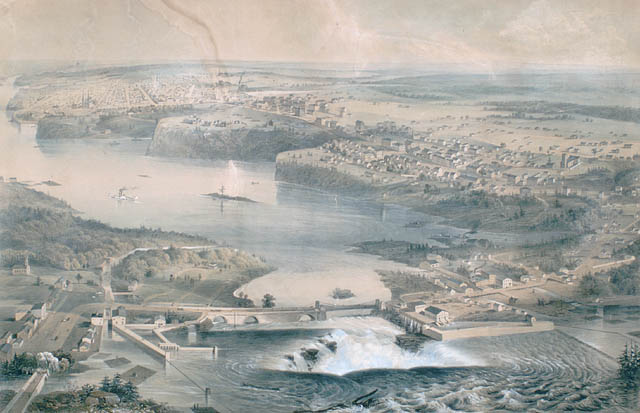
The second of these lithographs, also published in 1859:
I can still read 8 pt font size on the printed page, and I used to be able to read 10 pt comfortably on a web page - I guess the text size of a web page on screen depends on the user's monitor resolution setting - but as I get older and my eyes get weaker, I am starting to wish that web font sizes were larger. This wish may be true of many viewers.
Most web browsers, including IE7, already have two methods to make the text bigger:
Why would I propose a third method?
The first technique is not always implemented as well as might be desired. For example on IE7 when used with Windows XP:
The second method
as is done on this web page.
For this reason, I am experimenting, here, with buttons at the start, which call a function and pass the button's value when you click on it. This function
function ChangeFontSize(size)
{
document.body.style.fontSize = size + "pt"
}
modifies the value of the font-size attribute of the body element directly.
This is a very clean, simple and elegant method, using the DOM features of CSS, and the object oriented character of JavaScript, that does not involve the use of alternate style sheets etc. These buttons are labelled with the font point size in that font-size. They control the font in terms of point size rather than pixel size, so that the results should be independant of montor resolution settings.
For more details on this technique, see my web page on this topic
Sources
Dynamically change text size on a page, CuteSITE Builder, 2005-11-20
Mark "Tarquin" Wilton-Jones, JavaScript tutorial - DOM nodes and tree, 2007-10-06
New Rules - At the Ontario Election held today, there were some interesting new rules:
Election Results - "The Liberals, who have governed since 2003, won 71 of 107 districts, according to Elections Ontario results. The ruling party won 42 percent of the popular vote, down from 46 percent in 2003." * Thus they won 66% of the seats with only 43% of the popular vote.
Election Stats - "The percentage of eligible voters casting ballots in Wednesday's Ontario election hit an all-time low despite changes introduced in an effort to boost turnout. Only 52.6 per cent of eligible voters cast a ballot, or 4.4 million of 8.4 million possible voters, according to numbers released by Elections Ontario at 6:30 a.m. ET Thursday, when 99.8 per cent of polls had been counted.**
"The turnout was worse than a previous record low of 54.7 per cent set in 1923. It also fell below the 2003 voter turnout of 56.9 per cent.
"Legislation introduced by the previous Liberal government since the 2003 election to boost declining turnout in recent elections did not seem to have the desired effect. Those changes included:
However, there was a significant gain in voting at advance polls. Elections Ontario reported that 451,949 electors voted at the advance polls this year, up from 356,396 in 2003."
The interview in today's CBC Radio progam The Current with water expert Robert Sandford, about the water shortage in Alberta, caught my interest. CBC TV/Radio ran a series on this topic back in October 2006. *
In the latter series, under the heading Our Water, they said:
'Alberta holds only 2.2 per cent of Canada's fresh water, and the entire province is thirsty. A booming oil patch, parched farmers' fields, and a growing number of homes and businesses - everyone wants a sip. At the same time, Alberta's mountains have seen less snowfall over the last two decades and glaciers are shrinking. Both feed the rivers that are Alberta's main source of water for drinking and irrigation. Last year [2005], former premier Peter Lougheed called on Albertans to treasure water. "I believe that water is more important than oil," he said.'
A provincial report called Water for Life released in 2003 notes that some watersheds have already reached the limit of available water. The remaining ones will also be tapped out as Alberta's population and economy grow.
Check out the Water for Life report - see if it was provincial or UN, and whether Sandford wrote it.
In today's interview (2007-10-09) on The Current, Robert Sandford was introduced as the
"Chair of the United Nations Water For Life Initiative in Canada. He's a natural historian and has
written or edited 20 books on the Canadian West, including his new book, Water, Weather and the Mountain West." *
He said that in Southern Alberta
Soon the Southern Alberta plains will become desert.
In 1885, the Bow River basin had a populatioin of 5000. Today it has 1.4 M people. 100 years ago, Southern Alberta farmers were given an irrigation license to use 70% of the mean flow of the South Saskatchewan River. Towns further downstream only got what was left.
He said there is this myth that Canada has 20% of the world's fresh water. In fact it only has 6.5% of the world's renewable fresh water - the hydrologikcal cycle. The important point is that the rest, the non-renewable water in our lakes and glaciers, cannot be replaced. When it is all gone, and it is disappearing fast with global warmng, increased use (especially in Alberta) by our expanding populations, and by diversions and exports to the USA.
A small increase in the annual average temperature would cause all the water stored in our glaciers and lakes to disappear.
In order to satisfy the food demands of Alberta in the near future, using present farming methods:
In 2025, Alberta farmers will need an extra 2,000 cu km of water per year for irrigation. This increase is 20 times the flow of the Nile.
In 2050, Alberta farmers will need an extra 3,800 cu km of water per year for irrigation. This amount is equal to all the fresh water in the whole world.
Egyptions were managing their water supply as long ago as 4241 BC. The politicians planning the exports and the "re-plumbing of North America" do not seem to know or realize the difference between the non-renewable and the renewable water resources. The law which allows Albertan farmers the right to use half the water in southern Alberta rivers for irrigation,.has to change, or the same will happen to us as did happen in Egypt 3000 years ago, when they diverted the Nile to farming.
Presently timber and oil are plentiful in the west of Canada. When these run out, water will be the most valuable commodity, as it is today in dryer and desertifed regions of the world.
Sandford said 5 things have to happen to avoid disaster:
The climate is changing. We used to have extreme weather events on average about every 30 years. Today these events occur about every 3 years. With less than 1 degree C average temperature rise, Vancouver and Victoria now have flood disruptions that last for weeks. The fire season gets longer every year.
Water should be managed not on a regional, provincial or national basis, but by a single authority for the whole of a watershed basin, even if this region crosses provincial or national boundaries.
Water is a forest product - it is the trees that attract the rain. The resulting rain water is more valuable than the wood in the forest.
Check out:
Robert William Sandford, Water, Weather and the Mountain West, ISBN: 978-1-894765-93-0, 208pp, $19.95, softcover, Heritage, Rocky Mountain Books: 2007
Robert Sandford, History, Public Policy & New Vision of the Mountain West, ASAC 2006 Conference, Banff, June 2006
provincial report called Water for Life released in 2003
Blueprint Alberta: H2O, Our Water, CBC TV, Radio and CBC.ca brought Albertans an in-depth look at the province's water from Oct. 9 to Oct. 27, 2006
The Best of Blueprint Alberta: H2O, Episode 1, podcast, 2006-10-14
The Best of Blueprint Alberta: H2O, Episode 2, podcast, 2006-10-21
The Best of Blueprint Alberta: H2O, Episode 3, podcast, 2006-10-28.
The very successful linear Bar Code system, read with a laser and photo-sensor, comes in dozens of different forms. The most standard, the UPC Code, has several limitations:
The UPC has only numerals, with no letters or other characters.
It contains only 12 decimal digits (excluding the guard bars).
It cannot easily be scanned by the public.
The first barcode was developed in 1948 by three graduate students at the Drexel Institute of Technology. To extend the number of characters, stacked bar codes were tried. Later, 2-dimensional "square dot" codes were introduced, such as the Aztec Code which was invented by Andrew Longacre, Jr. of Welch Allyn in 1995. The Aztec Code symbol ranges in size from
15x15 modules square, which encodes 13 numeric or 12 alphabetic characters, to
151x151 modules square, which encodes 3832 numeric or 3067 alphabetic characters or 1914 bytes of data
2-D codes are read by digital cameras, so that they can be read, but not necessarily decoded, by the general public.
RFID technology is another approach used to extend the amount of data stored and available to the reader. Data is stored on a chip and is read with an RF signal that is re-radiated by the chip-computer-antenna back to the reader. The amount of data that can be stored on modern flash memory chips can be large. Range is very short, at most a few feet. This technology is quite complex, preventing the general public from reading the data, which is one of RFID's features when used in a credit card. Presumably this security feature is only short-term, until hackers build RFID readers.
In Japan, a 2-D approach, known as QR Code, has recently really teken off. The reader is a digital camera in a cell phone. The range is enormous. QR codes can be read from a mile away, if the target is big enough.
"The QR Code is widely used in Japanese everyday life, and works well for the Japanese K-tai world. Users love the K-tai Web browser. But to type a URL could pose a big problem. You need to hit, on average, 2.5 key strokes for a single ASCII character with your left/right thumb. No K-tai user wants to type a long and tedious URL this way. *
"The QR (Quick Response) Code is a matrix two-dimensional printable code, originally developed by an automobile component manufacturer, Denso of Tokyo in 1994 (ie predates the Aztec Code). The specification is open, in that the Denso patent right is not exercised. The Japanese standard for QR Codes, JIS X 0510, was released in January of 1999, and a corresponding ISO International Standard, ISO/IEC 18004, was approved in June of 2000. "QR code" is trademarked by Denso Wave.
"When an Internet merchant wants to entice new customers into visiting its K-tai shopping site, it encodes its URL string into QR Code and prints it everywhere, poster, flyer, magazine, sticker... A K-tai user simply "clicks" this QR Code with his K-tai camera. The decoding software kicks in and delivers the decoded URL to the K-tai browser. It jumps to the Web site directly."
QR Code modules have no size restriction. They can be as small as the dot in an "i" like a Cold War microdot (this would require a high-res microscopic camera) or you can expand it to an enormous size, visible and decodable from kilometers away. Some of the real estate developers do exactly that. They hang a gigantic QR Code poster on the wall of a building they are constructing. You see these QR Code modules on the side of a blimp, on a burger wrapper, or on a business card so that you can enter your contacts' coordinates directly into your hand-held or cell-phone address book.
You even see QR modules on a cabbage label, or a packet of rice. The code links to a mobile website detailing origin, soil composition, organic fertilizer content percentage (as opposed to chemical), use of pesticides and herbicides and even the name of the farm it was grown on.
Two applications where this technology could be put to good use in North America come to mind. The first is on small medicine bottles, where the amount of information (contents, doseage, warnings) far exceeds the avalable space on the bottle. Likewise food manufacturers are being required to include on the package detailed descriptions of the contents, the percentage of fats, transfats etc.
 The picture shown here is a QR module representing the words "Wikipedia Main Page". Click on the picture to enlarge it. Note
the reference squares (position detection patterns) in 3 of the 4 corners of the module. This compares with the Aztec Code
which only has a single reference in the middle. Whereas classic barcodes can carry only numerals, QR Codes can store
any character, alphanumeric, data or Kanji; with the following maximum number of characters or bytes:
The picture shown here is a QR module representing the words "Wikipedia Main Page". Click on the picture to enlarge it. Note
the reference squares (position detection patterns) in 3 of the 4 corners of the module. This compares with the Aztec Code
which only has a single reference in the middle. Whereas classic barcodes can carry only numerals, QR Codes can store
any character, alphanumeric, data or Kanji; with the following maximum number of characters or bytes:
QR codes use Reed-Solomon error correction, with correction levels L (7%), M (15%), Q (25%) or H (30% of code words restored).
Sources:
Mobile Ojisan (Matsushita Shuji), QR Code smudges Japanese daily life, CNet Asia, blogs, 2007-06-11
Gail Nakada, Japanese Use Cell Phone QR Bar Code Readers to Check Food Safety, Wireless Watch, Japan.
QR Codes On Rice, JumpMobile, August 29, 2007
QR Code, Wikipedia.
Michael Keferl, QR codes, CBC Radio One program "Spark"
In Japan, mobile phones have become ubiquitous. In Japanese, mobile phones are called keitai denwa, literally "portable telephones," and are often known simply as keitai (or K-tai).
K-tais have many more features than Blackberries. You down-load your music directly to your K-tai - you do not need a desktop computer to get the music from the Internet, then a cable to download it from your desktop to your iPod to play it. According to RIAJ (Recording Industry Association of Japan, the trade org of canned muzak) statistics, the 2006 Internet music download in Japan amounted to 53.4 billion yen (455 million US$). More than 90 percent of this huge amount was downloaded by and played on K-tais. Less than 10 percent went to iPods, silicon Walkmans and the like. As of February 2007, the number of music downloads to K-tais has surpassed 100 million songs.
The Japanese K-tai terminal has been swallowing up hundreds of otherewise incompatible features into its small body. Still, the K-tai has managed to shrink its size smaller and smaller. K-tais can write in English or Japanese. They have the capability to use very large character sets totalling more than one thousand characters including all of the Latin alphabet, hiragana, katakana, kanji and special characters such as arrows and musical notes.
Features found in K-tai's recently (last 3 years) include:
Most phones can be connected to the Internet through services such as i-mode. Japan was the first to launch 3G services on a large scale. In recent years, some cellular phones even have the capability of being used for money transactions such as debit or credit cards and can be swiped through most checkout lines to buy everything from mascara to jet planes, as more and more companies offer catalogs for cell phones. These functionalities include:
Sources:
Japanese mobile phone culture, Wikipedia.
Mobile Ojisan (Matsushita Shuji), Muzak? Your K-tai terminal is enough for that, CNet Asia, blogs, 2007-03-04.
Glenn Gould (1932-1982) plays again - Live!
Today, at the Museum of Civilization in the Cascades Salon, an unusual performance as part of the Glenn Gould: The Sounds of Genius celebrations, a "re-presentation" of Gould’s 1955 Columbia recording of Bach’s Goldberg Variations, live, with the pianist’s own fingering, pedalling and original interpretation on a Yamaha Disklavier Pro concert grand piano, presented by Zenph Recording Studios
Zenph® are able to take audio recordings (from any source: LPs, tapes, 78s, CDs, even cylinders) and convert them back into the precise, nuanced keystrokes and pedal motions that would have been used to create them. This is done in a new format which can be played back with phenomenal reality on corresponding high-resolution computer-controlled grand pianos, in this case the Yamaha Disklavier Pro. Zenph Studios first debuted this same re-performance of Bach’s Goldberg Variations, to standing ovations in the CBC’s famed Glenn Gould Studio in Toronto on September 25, 2006, which would have been Glenn Gould’s 74th birthday.
Olympic Torch Route over Everest
I was surprised to hear today that the Chinese plan to take the Olympic Torch over the summit of Mount Everest, on its way to the games in Beijing. An earlier map, does not include the climb up Everest in the route.
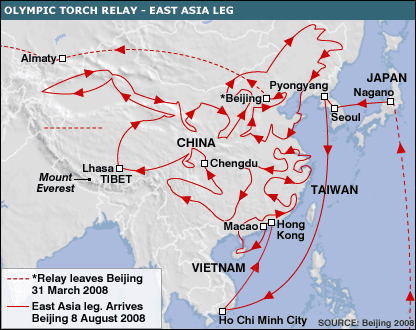
The BBC reported 26 April 2007
“Officials unveiled the new Olympic torch, a red and silver design shaped like a Chinese scroll. The 72cm (28-inch) high torch is designed to withstand wind and rain, and is also eco-friendly, officials said.”
The flame will actually go to the summit twice as there will be a televised rehearsal in 2007 before the actual torch relay in 2008. "The torch will be designed in order to burn at such a high altitude," said Beijing Olympics official Liu Jingmin.
MountEverest.net reported:
“The Chinese government plans to take the Olympic Flame up and across Mount Everest as a stage on the Olympic Torch Relay to Beijing, an event of major symbolic importance starting by March, 2008. Beforehand, a huge team is performing trial run of the torch up the mountain this spring. Climbers on the spot have reported on the expedition members adding up to 250 (figures are not clear), and to keep armed guards watching around its fenced-up BC. The Chinese have also installed antennas in order to provide with cell-phone connection coverage on most part of the mountain.
“Originally, the Beijing Olympic Committee said the climbing team would take the torch up the mountain from the southern slope in Nepal before descending to the North into Tibet. Later reports in Chinese media state the team could start instead from Tibet. According to other teams' reports, 17 members would have reached the summit on may 9. Up to now though, there is no news on the Chinese summiteers actually proceeding.”
The Mountain Company Summer 2007 Newsletter reports that this trial run did take place on 2007-05-09.
“This year has been another bumper crop for the Everest climbing season, as of today there has been 500 summits (and also 5 deaths). The season started off on April 30th. The huge Chinese team was up next, This was a trial run for taking the Olympic torch to the summit next year. On May 9th, 17 climbers from their team stood on the summit and apparently also successfully lit the torch!”
Note that the torch was not carried alight during the climb, as is traditional for most Olympic Torch Relays.
I accidentally discovered the Mozilla Developer Center wiki this morning, while searching for Ajax, and so learned that there are more wikis than Wikipedia.
"A wiki is a medium which can be edited by anyone with access to it, and provides an easy method for linking from one page to another. Wikis are typically collaborative websites, though there are now also single-user offline implementations. Ward Cunningham, developer of the first wiki, originally described it as "the simplest online database that could possibly work". One of the best-known wikis is Wikipedia. *
WikiWikiWeb was the first site to be called a wiki. The first ever wiki site was created for the Portland Pattern Repository in 1995. That site now hosts tens of thousands of pages." Ward Cunningham started developing WikiWikiWeb in 1994, and installed it on c2.com on March 25, 1995. It was named by Cunningham, who remembered a Honolulu International Airport counter employee telling him to take the so-called "Wiki Wiki" shuttle bus that runs between the airport's terminals. According to Cunningham, "I chose wiki-wiki as an alliterative substitute for 'quick' and thereby avoided naming this stuff quick-web." [3][4] Wiki Wiki is a reduplication of wiki, a Hawaiian-language word for fast. The word "wiki" is a shorter form of wiki wiki .
Cunningham was in part inspired by Apple's HyperCard. Apple had designed a system allowing users to create virtual "card stacks" supporting links among the various cards. Cunningham developed Vannevar Bush's ideas by allowing users to "comment on and change one another's text".[2] [5]. In the early 2000s, wikis were increasingly adopted in enterprise as collaborative software. Common uses included project communication, intranets, and documentation, initially for technical users. Today some companies use wikis as their only collaborative software and as a replacement for static intranets There may be greater use of wikis behind firewalls than on the public Internet.
On March 15, 2007, wiki entered the Oxford English Dictionary Online.
Critics of open-source wiki systems argue that these systems could be easily tampered with; while proponents argue that the community of users can catch malicious content and correct it.[2] Lars Aronsson, a data systems specialist, summarizes the controversy as follows:
"Most people, when they first learn about the wiki concept, assume that a website that can be edited by anybody would soon be rendered useless by destructive input. It sounds like offering free spray cans next to a grey concrete wall. The only likely outcome would be ugly graffiti and simple tagging, and many artistic efforts would not be long lived. Still, it seems to work very well.[7]."
The Wiki.org site * says:
"Wiki is a piece of server software that allows users to freely create and edit Web page content using any Web browser.
Wiki supports hyperlinks and has a simple text syntax for creating new pages and crosslinks between internal pages on
the fly.
Wiki is unusual among group communication mechanisms in that it allows the organization of contributions to be edited
in addition to the content itself.
Like many simple concepts, "open editing" has some profound and subtle effects on Wiki usage. Allowing everyday users
to create and edit any page in a Web site is exciting in that it encourages democratic use of the Web and promotes
content composition by nontechnical users.
Wiki.com allows you to search thousands of wikis, start a free wiki, and compare wiki software.
Other examples of wikis include:
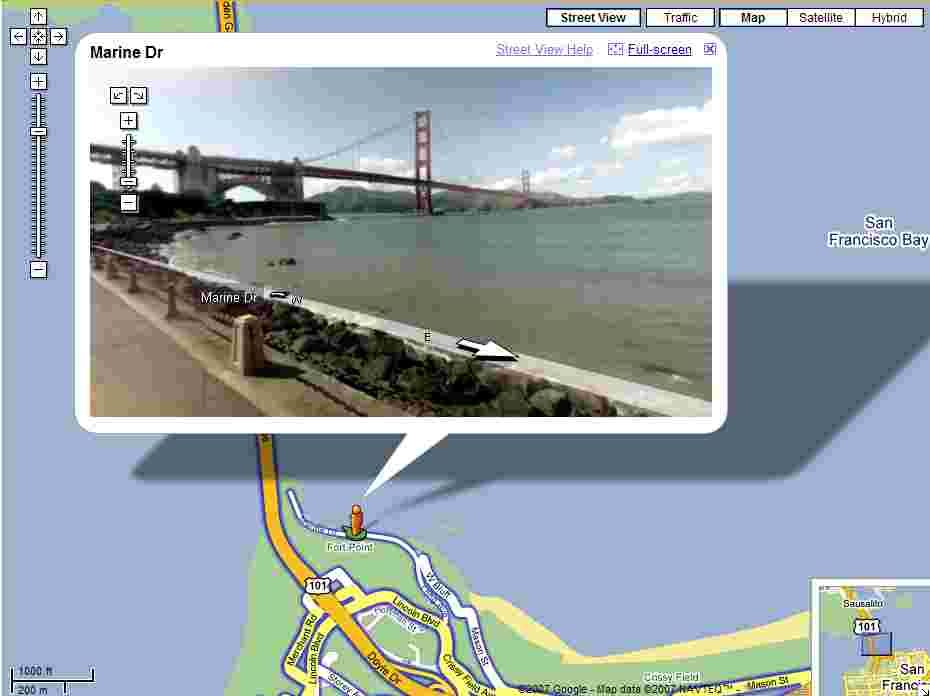
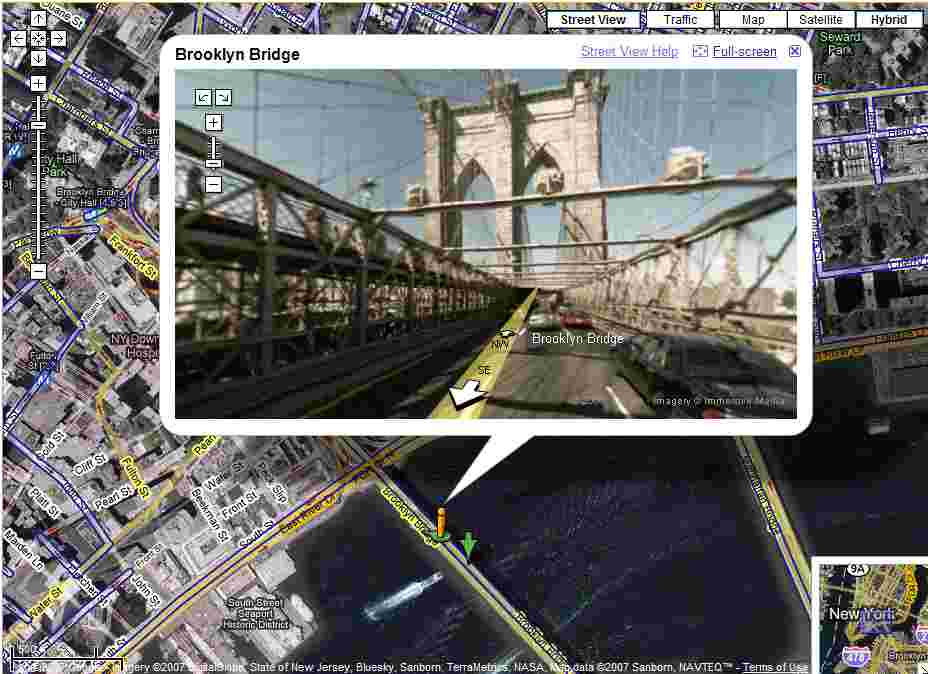
Chris Taylor mentioned Google Street View at the OPCUG* meeting tonight, see
Google Maps adds street-level panoramas, pcpro.co.uk, 30th May 2007
Amazon.com"s A9 Internet search engine went live on April 14, 2004. It’s BlockView mapping feature was introduced in early 2005 showing street-level views in roughly two dozen major US cities, but was discontinued on September 29, 2006, see.
Maps.Google currently shows street-level imagery for the following areas:
For example, see
San Francisco’s Golden Gate Bridge, and New York’s Brooklyn Bridge
Ontario Electoral Reform Referendum, 2007
For the first time in my memory, we are voting on 2007-10-10 on whether to reform our electoral system, in Ontario at least. Hopefully, this will lead to Federal Electoral Reform. If the alternative electoral system gets adopted, I will be interested to see if the need for strategic voting - voting against the party you fear - will be less necessary.
In June 2004, the Law Commision of Canada (formerly llc.gc.ca) wrote an excellent report titled “Voting Counts: Electoral Reform for Canada”. Unfortunately the Law Commission of Canada was abandoned by the Conservative government on 2006-09-25, when its funding was eliminated *
“Over the past nine years, the Commission engaged Canadians in the process of law reform through the forging of productive networks among academic and other communities while consulting the public through various innovative means.”
Fortunately the Citizens’ Assembly on Electoral Reform has this report on its web site.
This Assembly recommends that Ontario adopt a “Mixed Member Proportional system, specifically designed to meet the unique needs of Ontario.” Each voter gets two votes on their ballot - one for a party and a second one for a local candidate, and it is this system that is one of the options in the Ontario electoral reform referendum, see Sources below. The referendum question wording will be:
“Which electoral system should Ontario use to elect members to the provincial legislature?
The existing electoral system (First-Past-the-Post)
The alternative electoral system proposed by the Citizens’ Assembly (Mixed Member Proportional)”
The proponents of the "unfair" First-past-the-Post system, which tends to suppress smaller parties, say that this reduces the number of parties holding seats, and makes for a more stable system of government. They argue that a fully proportional voting system, where the number of seats a party gets is proportional to the popular vote it gets country wide, has caused minority governments with dozens of parties in parliament in those countries where it has been tried. such as Italy and Israel. Today, Italy has adopted a mixed system after prolonged debate in 1995.
The Citizens’ Assembly has therefore proposed a mixed system, which hopefully will have a measure of the advantages of both systems. Where majoritarian systems emphasize governability, proportional systems focus on the inclusion of minority voices.
The proposed changes to the system are: *
"Currently, Ontario elects Members of Provincial Parliament (MPPs) using the single member plurality, or first past the post, system. In this system, each voter gives one vote to a candidate in an electoral district; the candidate with the most votes wins and is charged with representing all voters in the electoral district. In most cases, the party with the highest number of elected candidates is asked to form a government.
"The Ontario Citizens' Assembly on Electoral Reform has proposed a mixed member proportional representation system. In this system, a voter casts two votes - one for a candidate (or 'local member') and one for a political party. The local member is elected in a first-past-the-post style election and represents the electoral district, while the political party vote determines, in conjunction with the number of elected local members belonging to each party, how many list members a party receives. A list member is a candidate on an ordered list that a party issues before the election; if the MMP formula determines that a party can have more seats than it won locally, it receives a "top up" number of list seats. Under this new system, the Legislature would have 129 seats: 90 local members (70% of the Legislature) and 39 list members (30% of the Legislature).
"In the proposed system, list members are assigned using the a Largest remainder method based on the Hare quota. The number of seats is determined by figuring out the "quota" (the number of votes divided by the number of seats) for each seat, and distributing all seats proportionally (including local winners) based on this quota. Fractional seats are given to the parties in rank order of the fractional amounts - bigger fractions first, until all seats are assigned. For cases (expected to be rare) where a party receives more local seats than its share of the party vote, resulting in "overhang seats", in order to distribute seats proportionally to the remaining parties, the Hare formula is reapplied using the total number of seats in the legislature minus the seats won by parties with one or more overhangs.[1]
"After local and list members are assigned, a political party's overall share of seats will roughly equal its share of the party vote, thus the results are proportional. The conventions as to which party is asked to form a government would remain unchanged."
"A proportional representation system was devised in the late 19th century, by Victor D'Hondt of Belgium. Victor Considérant, a utopian socialist, also devised the system in an 1892 book. After some Swiss cantons (beginning with Ticino in 1890), Belgium was the first country to adopt list-PR for the 1900 elections to its national parliament. Similar systems were implemented in many European countries during or after World War I. Single Transferable Vote was first used in Denmark in 1857, making STV the oldest PR system, but the system used there never really spread. STV was re-invented (apparently independently) in Britain, but the British parliament rejected it. It was, however, then used in Tasmania in 1907, and has spread from there. STV has been used in the Republic of Ireland since 1919." *
Today the following countries world-wide, use the proportional electoral system: Algeria, Angola, Austria, Argentina, Belgium, Bolivia, Brazil, Bulgaria, Burkina Faso, Burundi, Cambodia, Cape Verde, Chile, Colombia, Costa Rica, Cyprus, Czech Republic, Denmark, Dominican Republic, Equatorial Guinea, Estonia, Finland, Germany, Guinea-Bissau, Guyana, Hungary, Iceland, Indonesia, Ireland, Israel, Italy, Latvia, Lesotho, Liberia, Liechtenstein, Luxembourg, Malta, Mexico, Moldova, Namibia, Netherlands, Netherlands Antilles, New Caledonia, Nicaragua, Norway, Paraguay, Peru, Poland, Portugal, Romania, San Marino, Sao Tome and Principe, Slovakia, Slovenia, South Africa, Spain, Sri Lanka, Suriname, Sweden, Switzerland, Suriname, Turkey, Uruguay, Venezuela, Wallis and Futuna. This includes most countries in Europe, with the exception of the UK.
Sources:
Ontario electoral reform referendum, 2007, Wikipedia
Citizens' Assembly on Electoral Reform (Ontario), Wikipedia
Proportional representation, Wikipedia.
Voting Counts: Electoral Reform for Canada, full report, Law Commission of Canada, June 2004, formerly
One Ballot, Two Votes, A NEW WAY TO VOTE IN ONTARIO. Recommendation of the Ontario Citizens’ Assembly on Electoral Reform, May 15, 2007.
Democracy at Work: The Assembly’s Decision “In Their Own Words”, Citizens’ Assembly on Electoral Reform, a video message to all Ontarians.(33MB, wmv format),
Citizens Assembly on Electoral Reform
Project for Global Democracy and Human Rights, World Policy Institute.
Democracy: Electoral Systems, World Policy Institute.
Electoral Systems of the World, method of election of unicameral legislature or lower house of bicameral legislature, World Policy Institute.
Pippa Norris (Harvard University), Choosing Electoral Systems: Proportional, Majoritarian and Mixed Systems, for "Contrasting Political Institutions" special issue of the International Political Science Review Vol 18(3), July 1997: 297-312.
Richard Kimber, Elections and Electoral Systems Around the World, Political Science Resources last nodified: 2007-08-25, Political Science Resources, Keele University, Keele, Staffordshire, UK
Referendum Ontario, 2007, Elections Ontario
Confirmed Supporters of Proportional Representation in Canada, compiled by Canadians for Proportional Representation,
Brian O'Neal, Electoral Systems, Library of Parliament, Political and Social Affairs Division, Parliamentary Research Branch, May 1993,
Andrew Heard (Associate Professor, Political Science Dept, Simon Fraser University), Reform of the Electoral System, January 23, 2006
Update 2007-10-11:
At the actual referendum on 2007-10-10, the voters of Ontario rejected the MMP proposal - 36.85% for MMP, 63.15% for the existing system (First-past-the-Post). Only five ridings, all of them in Toronto, showed a majority supporting MMP. The MMP proposal required 60 per cent support to become the new electoral system. As well, it had to win a majority in 64 ridings.
A panel discussion on the results was broadcast the following day (2007-10-11) on CBC's The Current. The panel consisted of
Listen to the podcast.
Corel WordPerfect HTML Generator
The first draft for this blog was written in Pocket Word on my handheld Journada. When it came time to convert the file to HTML — it was too long (18,000 words) to code entirely by hand, I had available to me several easy options *:
MS Word HTML generator,
Outlook Express HTML generator
Open Office HTML generator, and
Corel WordPerfect (v12) HTML generator.
MS Word has two HTML generators: a) the extremely complex, but Word compatible version, and b) the simpler "Filtered" (less compatible) version. Both produce code with a complex style structure and a superfluity of unnecessary <span> tags. I sometimes use the latter when I am in a hurry and don't care about clean HTML.
Outlook Express generates usable simple unsophisticated HTML, which I often use for short web pages.
Open Office writes better HTML code. There is no style sheet in the Head section. All style is inline which makes it easy to understand, but very repetitive. All dimensions in inches are converted to cm, so that 0.2in become 0.51cm.
The Corel WordPerfect (v12) HTML generator writes comparatively clean code with a simple clear style sheet in the Head. However, there are still unnecessary nested <span> tag pairs in the Body, which I prefer to edit out. The indenting dimension remains in inches.This generator has taught me much in the past about writing HTML code; for example, the method I use to produce Side-Notes*. with main text flowing round the note.
Most HTML generators use <p> tag pairs to separate paragraphs. By default, the browser adds a line space when it sees a <p> pair. To avoid this unwanted line space, I usually use <div> pairs instead of <p> pairs. The Corel generator has taught me that this unwanted line space between paras can be avoided by the code:
<style>
p
{
margin-top: 0px;
margin-bottom: 1px
}
</style>
This addition allows me to leave all the <p> tags generated by the HTML generator, without converting them to <div> tags.
In the past I placed the whole document within a Table, with attribute "width=95%", to produce a 2.5% white border around the text. This is rather crude. A preferable method is to use the "margin-left:" and "margin-right:" styles for the whole Body instead of a table, but this does not work well if the text itself contains multiple different margin widths (used as indents). These inline margin styles over-ride the margin width in the Head style sheet. The Corel HTML generator showed me a better method, using the "padding-left: 3%;" "padding-right: 3%;" styles for the whole Body. This was originally used in Tables. This method is used on this web page.
I received a long distance phone call from India this evening. He was trying to sell me the Primus Long Distance Telephone Plan. The line was bad, we both could not hear each other very well, even though our voices were raised. I asked him if he was using Voice-over-IP (VoIP). He did not know what that was, but agreed that the call was coming to me over the Internet. At the end of the conversation, he even agreed that the poor quality of this connection was a good argument for not subscribing to Primus VoIP.
Three Documentaries on Bin Laden
Three excellent documentaries on Osama Bin Laden have aired recently. I refer to:
Tonight, just 3 days before the 6th anniversary of 9/11, CBC Newsworld re-broadcast their damning two hour documentary The Secret History of 9/11. written and directed by award-winning senior CBC Correspondent Terence McKenna. This was first aired on the CBC on 2006-09-12, to mark the fifth anniversary of the September 11, 2001 terrorist attacks.
"This extraordinary tale of intrigue and espionage begins with the first attack on the World Trade Center in 1993. The Secret History of 9/11 provides a look at the long, secret war waged against al-Qaeda from the White House, the CIA and the FBI, and examines the key intelligence failures that allowed the 9/11 plot to happen. It includes interviews with a number of key people including Richard Clarke (Chief of Counterterrorism at the White House) Mike Scheuer (the head of the CIA Bin Laden Unit), Gary Schroen (the CIA field agent who was trying to capture or kill Osama Bin Laden throughout the 1990s), members of the 9/11 Commission including Chairman Thomas Kean and Vice-Chairman Lee H. Hamilton and Marc Sasseville, the U.S. Fighter Pilot who was prepared to fly his unarmed F-16 into a hijacked aircraft.
"Watch a riveting minute-by-minute account of what was going on behind the scenes on 9/11. There was confusion in air traffic control, a failure to promptly notify the military about hijacked planes, and a breakdown in communications around the President. George W. Bush was reduced to trying to contact Washington on a borrowed cell phone. The presidential order to shoot down any further hijacked airliners never reached the fighter pilots who could have carried out the order."
For the 15 page transcript of the film, see
The Secret History of 9/11, CBC.
For the complete 1 hr 30 min. video, see
The Secret History Of 9/11, Oct 17, 2006, Video.Google
Sources include:
The Secret History of 9/11/, CBC
The Secret History of 9/11/, Wikipedia.
Michael Moore's documentary on 9/11 was also broadcast on CBC Newsworld this weekend. Moore's film includes much on GW Bush's connection with the Bin Laden family, and their financing of his oil company in Texas, but the quality and extent of Moore's research does not compare with that of Terence McKenna's documentary.
For the complete 1 hr 59 min. video, see Michael Moore’s -
Farenheit 911, Nov 25, 2006, Video.Google.
This documentary by Christiane Amanpour, has been broadcast many times in the last few months on CNN. It is arguably Amanpoor's best work todate. It concentrates on Bin Laden's early life. She comes up with some amazing detail on his childhood and development from a religious man into a terrorist.
“In the Footsteps of Bin Laden, a documentary on the life and mission of the al Qaeda leader. Using first hand accounts of the people who have known him best throughout his life, In the Footsteps of Bin Laden offers numerous new details about bin Laden's transformation from a quiet, well-bred boy to the Western world's most wanted terrorist. The two-hour investigation is reported by CNN chief international correspondent Christiane Amanpour and is based on The Osama bin Laden I Know by CNN terrorism analyst Peter Bergen.”
See
CNN's "In the Footsteps of Bin Laden", in English part 1/10
CNN's "In the Footsteps of Bin Laden", in English part 2/10
CNN's "In the Footsteps of Bin Laden", in English part 3/10
CNN's "In the Footsteps of Bin Laden", in English part 4/10
CNN's "In the Footsteps of Bin Laden", in English part 5/10
CNN's "In the Footsteps of Bin Laden", in English part 6/10
CNN's "In the Footsteps of Bin Laden", in English part 7/10
CNN's "In the Footsteps of Bin Laden", in English part 8/10
CNN's "In the Footsteps of Bin Laden", in English part 9/10
CNN's "In the Footsteps of Bin Laden", in English part 10/10
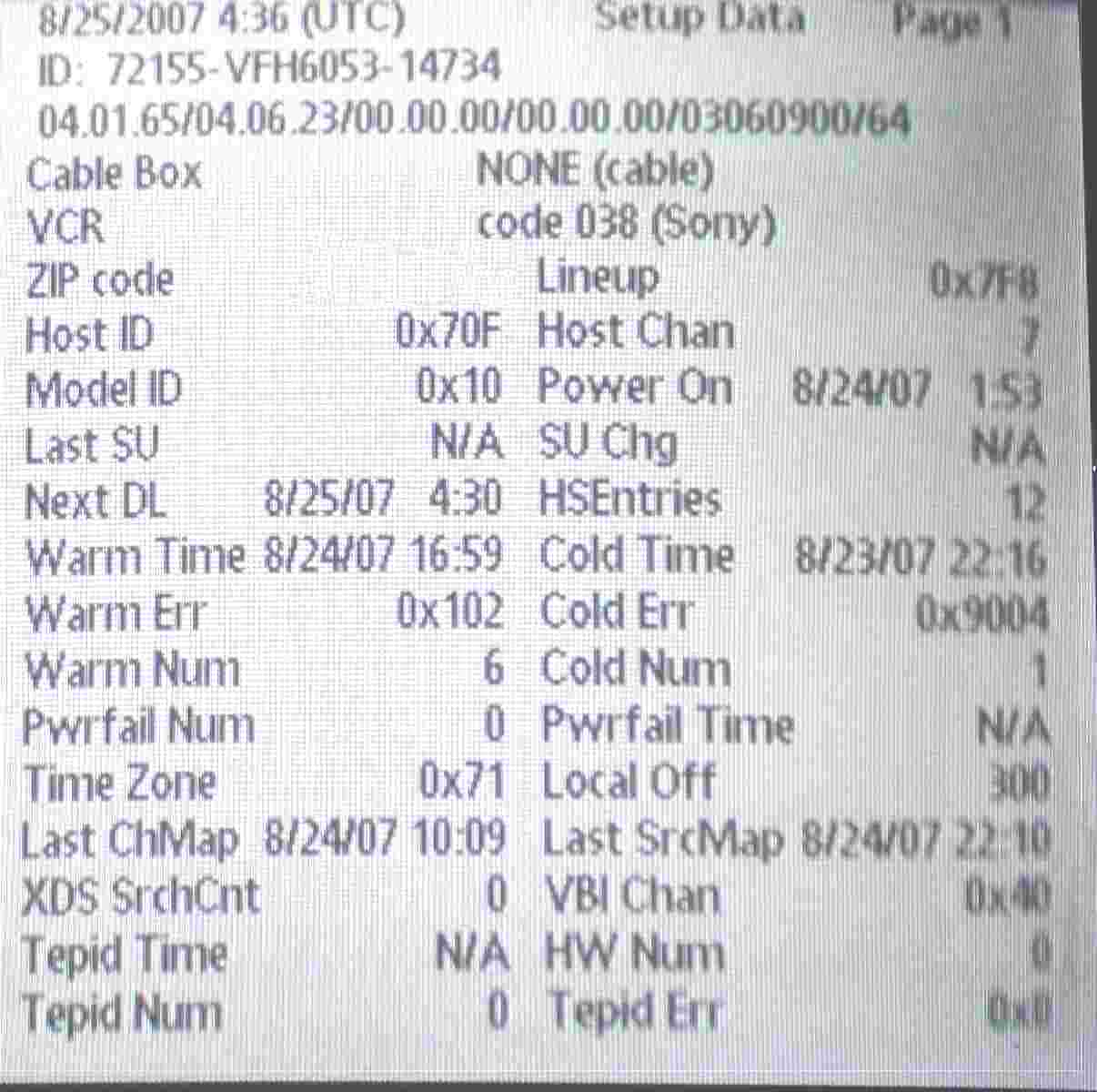
I have an RCA TV with a Program Listings feature called GuidePlus. The data for these listings are fed via the cable to the TV at night when it is switched OFF. I feel lost without a guide to what's on tonight. So I panicked when this feature stopped working about a week ago.
I called Thomson tech support (Thomson now own RCA and GE). The call centre turned out to be in the Philippines, so you might say the diagnosis is very long-distance. The regular support guy led me through the Reset process. This did not help.
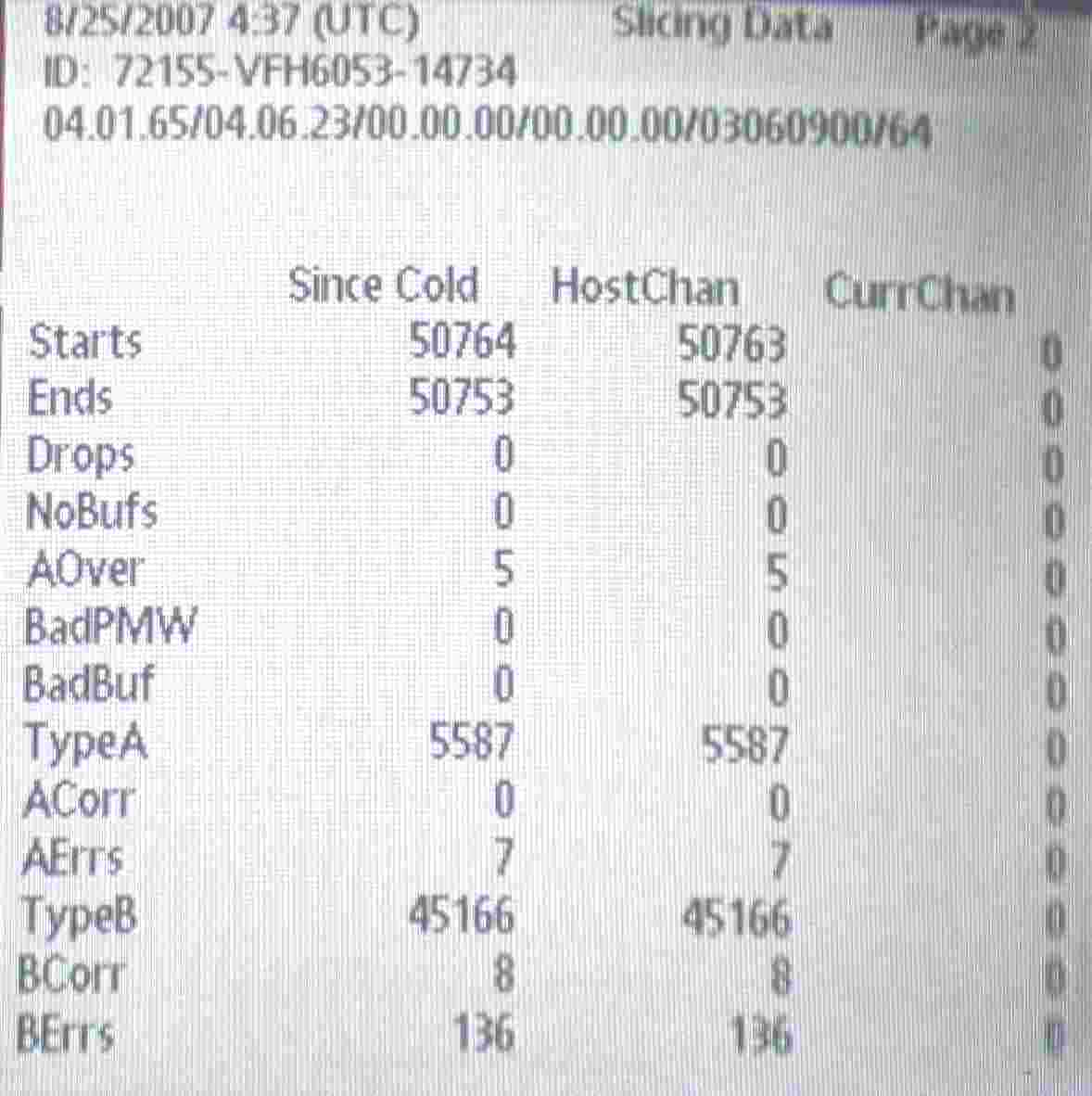
The next level up is a GuidePlus Specialist. She called me back several times, mostly when I was not at home. What happened next is an amazing long-distance diagnosis process whereby she had me display on the TV screen a series of History and Settings screens, 6 in all, full of abstruse parameters and their values, which she had me read to her over the phone. Access to these data screens was via the Message Mode, and a secret 10-digit access code (which I eventually memorized because I had to enter it so many times). After several of these sessions, she made the appropriate call to Rogers Cable in Ottawa, and one night later, my GuidePlus Program Listings came back.
The art of quality book-binding and restoration is fast disappearing. Years ago, I inherited a valuable family book, published in 1770, that was falling apart. It was then that I discovered a skilled book-binder named Fernando Martinez, trained by his father, and operating out of premises at 87 St Joseph, Hull. He did a superb job of repairing and rebinding my book. When Fernando retired and the store closed, it seemed that there were no re-binders of old books left. The last time I saw him, he gave me the address and phone number of his home in Kanata. Seeing the delivery van of Smiths Falls Bookbinding on Queen St in downtown Ottawa this week, made me wonder if the book-binding business had survived in this area.
A Canada411 search for Bookbinders in Ottawa, showed that indeed it had. The first business listed was Book Binding The Art, in Kanata, with the same phone number that Fernando had given me years ago. His wife Barbara told me that Fernando has a full time day job with the government, but he still does rare book restoration out of his home in the evening. They have no web site or email at home. Canada 411 also listed Canadiana Bookbinding in Ottawa, Kyla Ubbink in Orleans, and Smiths Falls Bookbinding. I was told that the latter mostly do book manufacturing, but they have one conservator on staff, but this turned out to be misleading.
I visited Kyla’s home. She was away on holiday, but I had a great chat with her assistant and husband Peter Turton. I did meet her on 2007-08-28. She has worked at Archives Canada under contract, in their stabilization and preservation departments, but they never offered her a full time job. So she set up her own conservation business. She knows all the experts at the Archives (where she worked). She has an excellent knowledge of the materials and types of glue used in bookbinding over the centuries. She knows how to repair old books and paper products such as very old documents and old maps that have fallen apart. She showed me three books that she had just restored, an old 19th century "Bargain and Sale" mortgage document that came to her in eight pieces (which she had restored to one), and a large wall map that she had remounted. I showed her the work that Fernando had previously done for me, and a rare 1846 edition of Bosworth's Hochelaga Depicta that she agreed to restore.
They keep their house temperature and humidity controlled in order to preserve the objects they are working on. To quote her web site, she “extend(s) the life of documents, letters, prints, drawings, books, maps, and architectural plans through the use of acid-free, archivally sound materials and established procedures that will stabilize, repair, renew and prevent future damage.” The web site includes her CV, a page on Conservation, and a detailed description of the services she offers.
When I visited Smiths Falls Bookbinding, I met Elsie Olmstead, who has been in the restoration business for 25 years. I was very impressed with a demonstration rebinding job she showed me. It was a large legal book published about 1730. The spine had been replaced with leather selected to match the original cover boards. She appears to have been trained by Alek Shevchenko, a former part owner, now semi retired, but still available should the demand warrant. He has 50 years experience in restoration of rare books. Elsie also mentioned Dennis Thompson, trained in England, who formerly worked with Smiths Falls Bookbinding, but set up shop in Madoc, Ontario. Dennis is now retired, and has sold his shop to Tonny Braden. Fernando did not match the leather he used on the spine rebinding he did for me, but I never thought to ask him to do that.
After posting this Blog, Alice Hughes (Argosy Books) mentioned another Book-binder/Restorer by the name of Pierre Thibaudeau, who works out of his home in Grantley, 10 km south of Chesterville, ON. Both he and Alice studied in classes conducted by Hubert Leurs, in Aylmer, QC. His business is called The Bookcraft Bindery. I visited Chesterville on Sun 2007-11-11, and was fortunate enough to find him at home. He showed me his workshop, some of his lettering tools, and samples of his work (on his web site).
Bookbinding store fronts are becoming a rarity, not only because restoration of rare books alone is not a viable living, but because the storage of valuable old books in a shop overnight is considered too much of a risk by the insurers. Insurance is less expensive for books in a home where there are people present overnight. Restorers are therefore more and more working out of their homes.
I would rate the remaining quality rare book restorers in the Ottawa-Gatineau area in the following order of excellence:
Smiths Falls Bookbinding, Elsie Olmstead, Alek Shevchenko
38 Union Street (Hwy 15 on the north side of town), Smiths Falls, ON, K7A 5C4
613-283-1981, http://www.smithsfallsbookbinding.com
Open Mon-Thur: 8.30-5pm; Fri: 8.30-1pm; closed Sat & Sun.
Kyla Ubbink, Book and Paper Conservator and Restorer.
Street address suppressed by request. Orleans, ON.
613-830-4968, http://www3.sympatico.ca/kyla.ubbink/
Book Binding The Art, Fernando Martinez,
Home street address suppressed, Kanata, ON
613-592-0189. No web or email.
The Bookcraft Bindery,Pierre Thibaudeau
Home street address suppressed, Grantley, ON
P.O. Box 356, Chesterville, ON, K0C 1H0
613-448-1350, http://www.bookcraftbindery.ca,
Tonny Braden, (business purchased from Dennis Thompson),
97 Livingstone Ave. W., Madoc, ON, K0K 2K0,
613-473-0369. No known web address.
Canadiana Bookbinding, Suzanne Lalonde, in the basement level at
250 Besserer St (at King Edward), Ottawa, ON, K1N 6B3.
613-238-6631, http://www.canadianabookbinding.com.
I received a hard copy of the Urbandale New LRT proposal (August 2007), which was presented to City Council a week ago, from Anne-Marie Leung (City of Ottawa Standing Committee Coordinator), this morning. When I got home, I found she had also emailed me the proposal in electronic form. The maps are in PDF format, which scale beautifully when you zoom in for detail. Colin Simpson (a city planner) also emailed me the city's Transportation Master Plan - Map 5, Rapid Transit Network (Sept 2003) in zoomable PDF format.
Street posters in Toronto, advertising a Kids Summer Camp teaching them how to throw grenades, how to build road-side bombs, fire an AK-47, and how to lay mines - all for children aged eight through 12, got many residents angry and ripping down as many posters as possible, until they discovered it was a stunt/hoax to bring attention to the fact that such camps do exist in Afghanistan. See
I found Carol Martin’s 1999 University of Ottawa thesis, In Memory of Chelsea's Historic Cemeteries, in hard copy format, in the university library archives today. I also found it online at the university, in their Dissertations and Theses database. I also found it online at the Theses Canada portal, at
http://www.nlc-bnc.ca/obj/s4/f2/dsk1/tape9/PQDD_0002/MQ45209.pdf
I was interested in section 2.1 (p.10) which deals with the origins of the village of Old Chelsea.
Met Carol Martin, a historian specializing in the Gatineau Valley, where she lives in a house with a beautiful terraced garden overlooking the Gatineau River, in Kirks Ferry, Chelsea. She is a descendant of Phelemon Wright's older brother, Thomas Wright (1759-1801). She is the editor of a historical magazine Up the Gatineau (published by the Gatineau Valley Historical Society), and author of
In Memory of Chelsea's Historic Cemeteries, stories of the Old Chelsea Protestant Burial Ground, Chelsea Pioneer Cemetery, St. Stephen's Cemetery, and Chelsea's Homestead Plots, Castenchel Editions, 2005.
She obtained her MA in history at the U of O in 1999.
CBC Radio One's The Current, Summer Edition talked about the amount of CO2 produced per person/year - about 2 tonnes due to the production of food that we eat. Production of beef is the worst. Feeding cows with grass produces more methane than feeding them grain. Running an SUV is about the same. Bill Mckibben was interviewed, see his books and the interview (second half of this RealAudio file). This was Episode # 9 - Ethical Eating and Your Foodprint - of the series Climate Currents, which said:
“The average North American meat-eater's love of burgers and steak adds as many greenhouse gases to the atmosphere as an SUV”
See
Oldest gravestone in the National Capital Area
Visited the “1891” Protestant Burial Ground in Old Chelsea. It actually dates from the 1830s. They have the head-stone of Thomas Wright (1759-1801), older brother of Philemon Wright who settled in Wrightville (later Hull and now Gatineau) also in 1801. Thomas was originally buried in a holmstead plot, before the existance of community burial grounds. When the land was provided by Thomas Brigham (of Chelsea, VT) in the 1830s for a Protestant burial ground, Thomas' remains and headstone were moved to this site. This is the oldest headstone in the National Capital Region. Protestants remained the majority in Chelsea until about 1820, when the Catholic Irish outnumbered them. Catholics were buried in St Stephen's Cemetery up the road.
Source:
Carol Martin.
In a conventional simple lens, the length of the lens is approximately equal to its focal length. In an Origami (or folded) lens, the front and back surfaces of the lens are mirrors, and the length is deceased by a factor equal to the number of reflections between the two mirrors.
Origami lenses are being developed for DARPA (at the Jacobs School, University of California) for airbourne surveillance from aircraft. Since it is a single lens, it is not presently suitable for point and shoot cameras or cell phone cameras that require zoom, but they have the potential for very small lenses for these camera applications that do not require zoom.
The prototype lens at the U of C is remarkable in that its length is only 5 mm, and with 7 or 8 folds (mirror reflections) produces a focal length of 38 mm. For a digital camera, this is a long focal length.
The Discovery TV channel showed an interview with the U of C developers. See the video.
For more details, see:
Daniel Kane, Origami Lens Slims High Resolution Cameras. UCSD, January 30, 2007
'Origami lens' slims high resolution cameras, PhysOrg.com, January 30, 2007
Origami Lens Slims High Resolution Cameras, Jacobs School, UCSD.
Met with Michael Murr* at City Hall to ask him about Urbandale's new LRT proposal. Micheal holds the LRT file. He gave me maps of Urbandale's proposed routes of the N-S line (to River Rd), the easterly extension (to Trim Rd), the westerly extension (to a Park and Ride at the 417/416 interchange), including the proposed twin tunnels.
I like the route of the these tunnels (under Sparks St, Confederation Sq and the canal, and under the park between Col By and the canal), the construction of which should produce the least amount of traffic obstruction since Sparks St is a pedestrian mall.
Sources include:
Jean-Franois Bertrand, Urbandale puts light rail back on the table, Proposal priced at $1.1 billion, including pair of tunnels running under Canal, Ottawa Citizen. Wednesday, August 15, 2007.
Susan Sherring, Light rail reappears on radar Developer proposes modified north-south plan, Ottawa Sun, Thu, August 16, 2007,
Urbandale north-south LRT plan sparks interest Ottawa Business Journal, Aug 16, 2007
Barrhaven and South Gloucester Transportation Study, prepared for the Barrhaven Business Improvement Area Transportation Focus Group, Trope Communications, April 30, 2007.
Today the NCC completed the resurfacing of part of the Rockcliffe Parkway, allowing bi-directional traffic to resume full-time. Today also marks the complete removal of bleechers and beer tents from the north end of Leamy Lake, after weeks of Casino fire works, returning the parking lot to the public and the park to nature.
New Bridge from Earl Armstrong to Strandherd in South Ottawa
The city of Ottawa approved funding, at a meeting on 2007-08-16, for a new 6 lane bridge over the Rideau River, connecting Earl Armstrong Rd (Urbandale Riverside South community) to Strandherd Drive (Barrhaven). This would cross the river at a narrow point just south of Claudette Cain Park. Maps show a reserved corridor of land on the west side of the river between Prince of Wales Drive and Strandherd.
River Rd and Prince of Wales Drive are within earshot of each other across the river, are at about the same elevation at this point, and both are many metres above the level of the fast moving river below. Earl Armstrong Rd is presently paved from River Rd to Limebank, and unpaved from Limebank to Bowmansville Rd.
Zheng He and the Chinese in Ethiopia
Met Maryam (Mary in Arabic, see Wikipedia) who is from southern Sudan. She has traveled in neighbouring countries such as Ethiopia and Somalia. I was talking about the Chinese Admiral Zheng He who during his naval expeditions during the period 1405-33 had explored her part of the world. Gavin Menzies even claimed he reached the Caribbean circa 1421, ie before Columbus. Wang Xiaoqiu (Professor of Chinese History at Beijing University) says
“Ma He was originally Muslim. Upon his conversion to Buddhism, he was given the surname Zheng and the religious name Sanbao. Zheng He's first fleet included 27,870 men on 317 ships, including sailors, clerks, interpreters, soldiers, artisans, medical men and meteorologists. In 1417, he sailed down the east coast of Africa, stopping at Mogadishu, Matindi, Mombassa and Zanzibar and may have reached Mozambique. [Some of his sailors settled in the ports that they visited.] Arab storytellers tell of the fantastic seven voyages of a Muslim sailor named Sinbad. Or was it Sanbao?”
Maryam told me, that during her travels, she noted that in Ethiopia, some of the people have Chinese features. She noted the similarity between the characters in Ethiopian writing and Chinese writing.
Sources include:
Wang Xiaoqiu, Zheng He: The World's first navigator, DalianNews.com, 2005-07-11
Elizabeth Grice, Explorer from China who 'beat Columbus to America', Telegraph.co.uk, 2002-04-03
Michael Higgins, Chinese beat Columbus: researcher, Who discovered America?: Chinese eunuch may have arrived here in 1420, National Post, 2002-02-05, formerly, but this link broken.
The first of five bridge pairs on route 417 to be replaced, the pair at Island Park Drive were replaced overnight today. Presentations on this project are at:
including a 4 MB animated video of the lifting and replacement process at:
The MOT web cam showed close-up action at the bridge. Rogers Cable (channel 22) showed the whole process live overnight. The YouTube video shows the old bridge being moved away. The company provided bleachers for the public to watch first hand.
Bridges are obviously very heavy to lift. You would need an enormous crane to lift 650 tonnes. Fortunately, they are already elevated, so that you can get under them and push upwards. The heavy lifting equipment was a series of four huge flat-bed vehicles (with 216 steerable wheels) with hydraulic rams on the wheels, and additional rams on top of the vehicles, that push the bridge up, supplied by Mammoet, Cambridge, ON.
“The new bridges each weigh 650 tonnes, and are significantly better than their predecessors:
The lifting equipments are called self-propelled modular transports (SPMTs), which are assemblies of tractor-trailer sized flatbed vehicles that are combined for each specific job. The approximate size of each of the Island Park transporters were:
42 metres long
12 metres wide
5 metres tall
and they weighed 134 tonnes
The two SPMTs at Island Park each had
6 trailer modules — 3 on each side of the bridge.
216 rubber wheels on 36 axles. Each is highly manoeuvrable and can turn 360̊ and lift the trailer bed up to 60 cm.”
The above quote is from the Ottawa Citizen, Saturday, August 11, 2007.
By conventional methods, the replacement of these bridges would have taken two years. With these heavy lift equipments, the two bridges were replaced overnight in just 16 hours. They had the foresight to build 4-lanes in the new bridges, to allow for future expansion in the width of the Queensway. Presently, the outside lanes are not in use.
Here are some webcam photos of the old bridges being moved out of the way, in chronological sequence (hold your mouse over a photo to see the time it was taken). Click on a thumbnail to see a larger picture.
One may ask why one needs 12 MP in a digital camera, when 2 or 3 MP produces excellent pictures. The sensor chip size has been increased. They use a "type 1/1.72" size chip, which is code for a 7.6 x 5.7 mm. sensor area (see Vincent Bockaert, Sensor Sizes, © 1998-2007). The previous generation of cameras used a "type 1/2.5" chip which is about 5.76 x 4.29 mm in active size. The basic aspect ratio for the new cameras is 7.6/5.7 = 4/3.= 1.33333. 12 MP allows 4000 x 3000 pixels in this aspect ratio. The area of silicon per pixel is
7.6mm/4000 x 5.7mm/3000 = about 1.9 x 1.9 μm per pixel.
For a previous generation camera with 6MP (2816 x 2112 pixel) with the old "type 1/2.5" size sensor (5.76 x 4.29 mm) the chip area per pixel is about 2.0 x 2.0 μm. - much the same.
In fact there are many advantages to these new 12 MP cameras:
The Sony DSC-W200 achieves an ISO of 6400 at 3 MP by this technique. 12 MP cameras are available from
FujiFilm (FinePix S5 Pro, S8000fd, F50fd), Nikon (D2X), Canon (EOS 5D and PowerShot G9), Kodak (Z1275), Sony (W-200), Panasonic (FX-100).
I was intrigued by the new larger sensors (physically and in number of pixels) in the new generation of
digital cameras
In the ISO 6400 mode, the Sony W200 trades pixels for ISO, placing groups of four of the high-res pixels
as one high-sensitivity pixel, resulting in a 3MP resolution, each effective pixel being about 3.8 x 3.8
μm, resulting in 4 X the sensitivity.
To quote Sony, in the DSC-W200 Ultra-High-Sensitivity (ISO 6400) mode, "you can shoot effectively without flash even in very low light to preserve the mood and capture fast action at high shutter speeds — with the Sony Clear RAW Noise Reduction system to take care of the picture noise that can ruin low-light shots." See Cyber-shot® Digital Camera DSC-W200, sonystyle.com
I went to the Bayshore Sony Store, and was given a demonstration of this feature. The demo target was a black speaker in a deeply recessed shelf in a dimly lit room (the lights were off, the only light was from a TV). With the naked eye, I could not see the speaker.
With the DSC-W200 in Ultra-High-Sensitivity (ISO 6400) mode, the result was amazing. Not only could we see the black speaker, but we could see the texture of the cloth on its front. You could see the inside of the recessed shelf clearly, particularly the colour of the wood, and the glue joining the sides to the back. The camera said the exposure was 125 ms at 6400 ISO.
Next, a business card was placed in front of the speaker in the darkness of the recessed shelf, and another shot was taken from about 2 m away using maximum zoom. In the resulting image, we could read what was printed on the card for all but the finest print. The noise on the white part of the image was practically non-existent.
“Digital zoom is a method of decreasing (narrowing) the apparent angle of view of a digital photographic or video image. Digital zoom is accomplished by cropping an image down to a centered area with the same aspect ratio as the original, and usually also interpolating the result back up to the pixel dimensions of the original.” Regular digital zoom is continuous, and interpolates, causing degradation of image. Precision Zoom interpolates, but in a sophisticated way. “The [Sony] Precision Digital Zoom function enlarges photos while leaving details faithfully intact by applying sophisticated image compensation based on Sony’s proprietary SRC signal processing technology.”
Smart Zoom zooms without interpolation, by reducing the number of pixels used, hence retaining a sharp image, albeit with lower resolution. Sony’s 7 MP DSC-S650 offers Smart Zoom® Technology: Up to 3.6X (5MP), 4.5X (3MP), 5.6X (2MP), 14X (VGA resolution) 4.7x Smart Zoom refers to say only using 1MP of a total of 8MP. See
Digital Zoom, (describes interpolation required), Wikipedia
Smart Zoom, digitalsecrets.net, Sony Zone,
Optical vs. Digital Zoom,
(includes section on Smart Zoom), photoxels.com
What is Smart Zoom?, cameras.co.uk,
Powerful Zooming Brings Subjects Closer - Smart Zoom and Precision Digital Zoom, sonystyle.ca
I obtained a MasterCard “PayPass” proximity card from the Bank of Montreal. The only other banks offering these types of cards in Canada seem to be CitiBank and PC Financial (Loblaws). “The PayPass mini-card is a fast, easy and convenient way to pay for smaller cash purchases”. No opening your purse and looking for your wallet or credit card (the PayPass card is small enough to attach to your car key ring). No fumbling for change. No swiping the conventional magnetic strip credit card. No signature is required for purchases under $25. You simply hold the card in front of the RFID (Radio Frequency Identification) reader at the store that transmits an RF signal and detects signals radiated back by the card. The system works in near-field mode, so has a very short range. The card uses embedded microprocessor and memory chips and a magnetic loop antenna that operates at 13.56 MHz. One security feature is that the card never leaves your hand (or key ring), so you have control over multiple or surreptitious uses. There is zero liability should there be unauthorized purchase using the card number. The PayPass account has a separate access number linked to my regular Mosaik MasterCard account, which I pay monthly online. There is no Annual Fee. I originally got it to pay for gasoline at my regular Pioneer gas station, but this particular owner will not yet accept the risk of no signature. No signature is required at the PetroCan gas pump, at some Loblaws and at Tim Hortons. The $25 no signature limit is obviously going to have to increase as filling your car with gas costs more than this. The Loblaws PC Financial proximity card has, I believe, a $100 no signature limit. The highest transaction limit allowed is $300.
The feature that appealed to me was the small size of the card, which is designed to be a "Key-ring fob" which you attach to your key-ring and put in your pocket. On 2007-11-09, my key ring tore the card, from the hole to the edge, and in the process apparently broke the loop antenna which seems to have been placed round the edge (inside) of the card, outside the key-ring hole - a bad feature bearing in mind that this hole may tear. From that time on the card would not work. I checked out the card on 3 different Pay-Pass card readers. I phoned the bank's Mastercard division, and was told that they have discontinued the "fob" sized card. BMO (Bank of Montreal) and Presidents Choice now only offer regular credit card size proximity cards. To my mind, this eliminates the security feature of having the card attached to your keys, and the convenience of having the card in your pocket.
See
MasterCard PayPass, MasterCard
MasterCard PayPass, Wikipedia
ISO 14443, proximity card , Wikipedia
Radio-frequency identification, Wikipedia
The NAC Orchestra’s Summer Music Institute consists of the:
The National Youth Orchestra of Canada (NYOC) and the Orchestre de la francophonie canadienne (OFC) take part in this training program, and then give free concerts at the NAC which I always enjoy. This year these concerts were on Fri 2007-07-27 and Sat 2007-07-28. The NYOC, under its conductor Yoav Talmi , played WAGNER: Die Meistersinger: Prelude; KELLY-MARIE MURPHY: From the Drum Comes a Thundering Beat; SIBELIUS: Karelia Suite; BARBER: Medea's Meditation and Dance of Vengeance; and RAVEL: Daphnis et Chloé: Suites No. 1 and 2. After the playing of her new composition, Kelley Murphy appeared on stage and described her composing experience (living in an apartment under construction) and answered questions from the audience. The OFC under its conductor Jean-Philippe Tremblay played Tchaikovsky’s soul-stirring Sixth Symphony as well as Beethoven’s powerful Third Concerto, SCOTT GOOD: Cry (world premiere of OFC commission) and BRUCKNER: Symphony No. 6. Founding conductor Jean-Philippe Tremblay is a staff member and former participant of the NAC Summer Music Institute.
Line-up of Summer Music at the NAC
Computers and the Decline of Handwriting
Today, at the bistro where I usually eat breakfast, being Father's Day, they had 500 customers for breakfast. And at 8am, their computer ordering system went down. (Where do you find a computer tech to fix such a problem at that time of day on a Sunday?) They were expecting high volume, so they had extra staff on duty.
Well, for two hours, all these different servers, who knew how to use a computer but had never written an order by hand before, were hand-writing hundreds of orders, all in different hand-writing. The kitchen staff were going nuts trying to decipher the hand-writing. Orders were backing up and taking about an hour to fill.
The clarity and uniformity of computer printouts in the kitchen do have an advantage over hand-writing. Young people today, used to using computers, are losing the skill of writing by hand.
"What if laws of physics were not written in stone? This could be the case if it were possible to prove that the speed of light is not a constant as Einstein suggested."
This was the thesis of a very interesting lecture on TVO's Big Ideas on Saturday, 2007-06-16-4pm. It was presented by Joao Magueijo, and appeared to have been presented at the Perimeter Institute.
He talked about quantum gravity and quantum space, but he concluded with Cosmological experiments that show that the speed of light has not always been the same as it is today.
If I remember correctly, this involves the measurement of α (alpha) from a very distant star. α is known to be related to Planks constant and the velocity of light (c), hence c can be measured indirectly as a function of how distant the star is, and hence how far back in time it was measured. A plot of c vs time in the past, shows c reducing as time approaches the Big Bang.
Check out
Big Ideas. There is no video, but there is an audio file of the program (45 minutes, 22MB).
Is the speed of light constant? "Varying constants" (Beyond Relativity 2), Univ. New South Wales, Sydney, Australia.
I saw eight beautiful large acrylic paintings (over $1000 each), by artist Jocelyne Milks, on display at the bistro at Leamy Lake. Her speciality is gardens - flowers and trees with sunlight in the distance, stone walls and arches, ornamental gateways etc. She works out of her home at Peter's Point in Chelsea, QC. The images she paints make you wish you were there. I wanted to know where these beautiful images came from - real life, from photographs or magazines, or from her imagination. I visited her home, but she was out. Her garden is nothing like the paintings. Eventually I did meet her. She told me she paints from her imagination. It would be nice to own such a painting, but I do not have walls big enough on which to hang them.
If you have no need for a land-line telephone, for instance if you use a cell phone or VoIP instead, then if you rent a dry copper line from Bell for your DSL modem, it can cost you quite a bit less than a line with a dial-tone and full telephone service. For example, where I live, a 'Dry' copper line (band C) costs $10.22 per month. For 5 Mbps DSL service via Freenet, you add to that $29.95 per month. The price of the dry copper line depends on the band, as follows
Band A $7.25/month
Band B $9.10/month
Band C $10.22/month
Band D $10.98/month
Band E $15.91/month
Band F $16.20/month
Band G $25.10/month
A "dry copper line" is a twisted copper pair line with no dial-tone and is not connected to the Central Office battery. A "wet copper line" has no dial-tone, but is connected to the Central Office battery.
See
'Dry Copper' DSL from NCF, National Capital Freenet
Dry DSL, Montreal DSL.
Here are some of the High Speed cable specifications and the speeds attainable with twisted copper pair, as used in POTS, ie ADSL and its successors:
In telecommunications, ITU G.992.1 (better known as G.DMT) is an ITU standard for ADSL using discrete multitone modulation. G.DMT full-rate ADSL expands the usable bandwidth of existing copper telephone lines, delivering high-speed data communications at rates up to 8 Mbit/s downstream and 1 Mbit/s upstream.
In telecommunications, ITU G.992.2 (better known as G.Lite) is an ITU standard for ADSL using discrete multitone modulation. G.Lite offers a maximum of 1.5 Mbit/s downstream and 512 kbit/s upstream and does not require the use of phone line splitters.
ITU G.992.3/4 is an ITU (International Telecommunication Union) standard, also referred to as ADSL2. It extends the capability of basic ADSL in data rates. The data rates can, in the best situation, be as high as 12 Mbit/s downstream and 3.5 Mbit/s upstream depending on line quality. The distance from the DSLAM to the customer's equipment is usually the most significant factor in line quality.
ITU G.992.5 is an ITU (International Telecommunication Union) standard, also referred to as ADSL2+ or ADSL2Plus.
Commercially it is notable for its maximum theoretical speed of 24 Mbit/s. ADSL2+ extends the capability of basic ADSL by doubling the number of downstream bits. The data rates can be as high as 24 Mbit/s downstream and 1 Mbit/s upstream depending on the distance from the DSLAM to the customer's home.
ADSL2+ is capable of doubling the frequency band of typical ADSL connections from 1.1 MHz to 2.2 MHz. This doubles the downstream data rates of the previous ADSL2 standard of up to 12 Mbit/s, but like the previous standards will degrade from its peak bitrate after a certain distance.
Also ADSL2+ allows port bonding. This is where multiple ports are physically provisioned to the end user and the total bandwidth is equal to the sum of all provisioned ports. So if 2 lines capable of 24 Mbit/s were bonded the end result would be a connection capable of 48 Mbit/s. Bell Canada Service is expected to commence in Q2-2007 in selected areas of Ontario and Quebec. TELUS in Alberta and British Columbia, Canada; have began the process of activating their networks (03/2007)
ITU G.993.1, AKA VDSL or VHDSL (Very High Speed DSL) is an xDSL technology providing faster data transmission over a single twisted pair of wires. Compare HDSL (High data rate Digital Subscriber Line).
The maximum available bit rates are achieved at a range of about 300 meters (1000 ft), which allows for 26 Mbit/s symmetric access or up to 52 Mbit/s down - 12 Mbit/s up asymmetric access.
Currently, the standard VDSL uses up to 4 different frequency bands, two for upstream (from the client to the telco) and two for downstream. The standard modulation technique is either QAM (Quadrature amplitude modulation) or DMT (Discrete multitone modulation) which are not compatible, but have similar performance. The current mostly used technology is DMT.
These fast speeds mean that VDSL is capable of supporting new high bandwidth applications such as HDTV, as well as telephone services (Voice over IP) and general Internet access, over a single connection.
VDSL is offered in urban areas by SaskTel in Saskatchewan, MTS in Manitoba, and Bell Sympatico in Ontario and Quebec.
ITU G.993.2 is an ITU standard for DSL that defines VDSL2. VDSL2 (Very High Speed Digital Subscriber Line 2) is an access technology that exploits the existing infrastructure of copper wires that were originally deployed for POTS services. It can be deployed from central offices, from fibre-fed cabinets located near the customer premises, or within buildings.
VDSL2 is the newest and most advanced standard of DSL broadband wireline communications. Designed to support the wide deployment of Triple Play services such as voice, video, data, high definition television (HDTV) and interactive gaming, VDSL2 enables operators and carriers to gradually, flexibly, and cost efficiently upgrade existing xDSL-infrastructure.
ITU-T G.993.2 (VDSL2) is an enhancement to G.993.1 (VDSL) that permits the transmission of asymmetric and symmetric (Full-Duplex) aggregate data rates up to 200 Mbit/s on twisted pairs using a bandwidth up to 30 MHz.VDSL2 deteriorates quickly from a theoretical maximum of 250 Mbit/s at 'source' to 100 Mbit/s at 0.5 km (1640 ft) and 50 Mbit/s at 1 km (3280 ft), but degrades at a much slower rate from there, and still outperforms VDSL. Starting from 1.6 km (1 mile) its performance is equal to ADSL2+.
ADSL-like long reach performance is one of the key advantages of VDSL2. LR-VDSL2 enabled systems are capable of supporting speeds of around 1-4 Mbit/s (downstream) over distances of 4 to 5 km (2 ½ to 3 miles), gradually increasing the bit rate up to symmetric 100 Mbit/s as loop-length shortens.
This means that VDSL2-based systems, unlike VDSL1 systems, are not limited to short loops or MTU/MDUs only, but can also be used for medium range applications.
Sasktel, a crown corporation of the province of Saskatchewan, Canada, has officially announced the deployment of VDSL2. Sasktel is currently testing this technology among 100+ users on a trial basis and hopes to bring it to the masses by the end of 2007.
The Videotron pilot test seems to offer up to 100Mbps (not the 1Gbps backbone service offered by Cisco).
"Videotron's offering is based on the proposed DOCSIS 3.0 specification for high speed data over cable. Most cable providers are using running on the DOCSIS 2.0 standard, although a number, such as Shaw Communications, are investigating the possibilities of adopting the new standard when it is finalized.
DOCSIS is a standard set by CableLabs in conjunction with a number of major IT vendors including Intel, Motorola, Broadcom, Netgear and Texas Instruments, many of whom make equipment for cable companies, corporate buyers and consumers.
DOCSIS 3.0 won't be be finalized until the end of the year. Most Canadian cable companies, such as Shaw, Rogers, Aurora, Eastlink and Mountain Cable, will wait until then before upgrading their infrastructure, Vittore said. What's noteworthy, said Grant, is that Cisco's solution doesn't need an expensive investment by a cable company, mostly a swap of circuit boards."
DOCSIS is Data-Over-Cable Service Interface Specifications. According to Wikipedia
| DOCSIS | Downstream | Upstream |
| 1.x | 42.88 (38) Mbit/s | 10.24 (9) Mbit/s |
| Euro | 57.20 (51) Mbit/s | 10.24 (9) Mbit/s |
| 2.0 | 42.88 (38) Mbit/s | 30.72 (27) Mbit/s |
| 3.0 | +160 Mbit/s | +120 Mbit/s |
The numbers in brakets are the usable speeds.
a. Channel Width: DOCSIS 1.0/1.1 specified channel widths between 200 kHz and 3.2 MHz. DOCSIS 2.0 specifies 6.4 MHz, but is backward compatible to the earlier, narrower channel widths.
b. Modulation: DOCSIS 1.0/1.1/2.0 specifies that 64-level or 256-level QAM (64-QAM or 256-QAM) be used for modulation of downstream data, and QPSK or 16-level QAM (16-QAM) be used for upstream modulation. DOCSIS 2.0 specifies 32-QAM, 64-QAM and 128-QAM also be available for upstream use. The new specifications call for downstream data rates of 160 Mbps (20 MBps) or higher, and upstream rates of 120 Mbps (15 MBps) or higher. They also include support for the new Internet Protocol version 6 (IPv6) which allows a significant increase in the number of possible IP addresses. In comparison, the current standard (DOCSIS 2.0) delivers up to 40 Mbps downstream and 30 Mbps upstream. see ArsTechnica
The Cisco 1-Gbps Wideband SPA for Cisco uBR10012 Universal Broadband Router appears to support speeds up to DOCSIS 2.0
2007-05-09
The Canadian Copy-Fight; Copyright, Culture and the Internet
Michael Geist.spoke on this topic at a meeting of the Ottawa PC User Group (OPCUG) today. He has written a book on this topic:
Michael Geist (editor), In The Public Interest, The Future of Canadian Copyright Law, Publisher: Irwin Law (Canada), 2005, Paperback/602pp, ISBN 9781552211137, Australian RRP $66.00, Direct Price $60.00.
I found many of the web sites he referred to so interesting that I generated a text (machine-readable) version from his PowerPoint presentation, by searching for the original web sites (the sources of his screen shots), including their URLs and the original text together with additional information of interest. What I have excluded is most of the graphics (in order that the file should not be too large), and the introductory part (mostly graphical) about Sam Bulte; and of course the verbal explanations given at the meeting by Michael Geist. The OPCUG kindly posted my version which you can see in PDF or HTML formats. The content of both is identical. Their web master described the posting:
“Micheline has created a comprehensive article about [Geist's] presentation. Her article also contains the many URLs Dr. Geist showed us.”.
Dr Michael Geist gave written permission for this posting, but not for posting his original PPT:
"I would be more comfortable if you limited the posting to your very nicely done PDF".
I frequently walk along the northern side of Lac Leamy for exercise, year round when there is no ice and snow. On this side of the lake there is a large wooded area which is home to thousands of small birds. At one period in the spring, the sounds of their mating songs can become deafening. In the winter, when they are hungry, finches wil fly up to you and eat food out of your hand. When the snow disappears and the clover starts to grow in the spring, the Canada geese come to feed on the grassy areas at the side of the lake. You usually see two or three pairs, each with 6-8 young ones. Once a large flock of geese came in low over the trees, from the direction of the Gatineau River, to land all at the same time on the lake, a spectacular site. Fortunately I could hear them coming (honk, honk), so I was able to see the whole thing. Another time, I saw a heron, about 1m tall, fishing at the edge of the lake. These are rare at Lac Leamy, but I am told they are more common on the Ottawa River near Cumberland.
Electric bicycles are becoming more popular. This summer, I have seen three different types of electric bicycles in the park at Leamy Lake, mostly ridden by older folk.
The electric motor in the Toyota Prius is 50KW (67 hp). That in the Honda Civic Hybrid is only 15KW (20hp). Motors on electric bikes are currently in the range 250 to 450 W.
You can go with the old heavy lead-acid technology sold at Canadian Tire (Schwinn and Strong), or you can go with the light weight Li-ion batteries used by Bion-X, found at bycycle specialist stores.
The Bion X electric bike systems offer 250W or 350W motors with NiMH (60-80 Wh/kg) or Li-ion (100-200 Wh/kg) batteries, and regenerative braking.. The motor is in the hub of the rear wheel, and uses stationary coils and rotating magnets, so that there are no brushes.
A local authorized dealer, Bicyclettes de Hull, sell these bike electric accessory versions:
250W motor with a 24V, 8Ah, 4Kg NiMH battery for $1095 + bike + throttle ($50).
250W motor with a 24V, 9.6Ah, 2.5Kg Li-ion battery, 80Km range, for $1395 + bike + throttle ($50).
350W motor with a 36V, 8Ah, 6Kg NiMH battery for $1295 (incl throttle) + bike
350W motor with a 36V, 9.6Ah, 3.5Kg Li-ion battery, 100Km range, for $1695 (incl throttle) + bike
which are also available at Pecco's in the market area in Ottawa, at about the same prices as in Hull ($1150, $1500, $1300, $1600, to which you have to add about $750 for a suitable bike).
The electric motor/controller can provide 4 levels of assist (25%, 50%, 100% or 200%) The range with Li-ion batteries is 80Km (250W) or 100Km (350W) on the flat with 25% assist.
With the Bion-X system, there is a strain guage to measure the rider's effort, and the controller uses this measurement to boost the thrusting power by 35, 75, 150 or 300%, in the case of the 350W motor. The high-end system uses a 3.1kg, 36v, 9.6Ah Li-ion battery with a 4kg, 350W electric motor which has a torque of 10N.m, nominal (32N.m max), and which can generte a peak power of 700W. For technical details, see BionX
Canadian Tire sell three types of Electric Bicycles:
Schwinn CTC # 71-1519-2, from $600 (includes the bike)
Schwinn AL1020 folding bike, CTC # 71-1521-4, for $700, and the
Strong GT-S210, CTC # 71-1510-0 for $1000.
The Strong GT-S210 weighs a total of 41kg, which includes a 15kg 36v lead-acid battery, and a 500W hub motor. A 2.5kg Li battery will be available in June 2007 for $450. Range is up to 100km at 28km/h. Nice features include LED headlight and lockable (anti-theft) disk brakes.
Both the Schwinn bicycles use lead-acid batteries. The 71-1519-2 has an external 450W motor (which gets very hot) with a chain drive to the hub, and a 24v lead-acid battery (which weighs a "ton"). The frame of the bike is specially designed (split) to accomodate the shape of the battery. I could not find these on the Schwinn web site (.ca or .com).
I had been writing an article on Digital Radio. It started off describing the American satellite systems of Sirius and XM Radio, but as I learned more, it was expanded to include the terrestrial systems in Europe, and the Multimedia satellite systems in Asia. On impulse, I decided to visit the Communications Research Centre (CRC) at Shirley's Bay near Ottawa, and see what more I could learn. They put me in touch with their top man in this field:
René Voyer, Manager, Radio Broadcast Systems and Transmission, CRC, Ottawa,
(613) 998 4407, rene.voyer@crc.ca
and he arranged a meeting the following day. Having seen my draft article, he realized that I had uncovered quite a bit about his favorite topic, and he spoke enthusiastically about what CRC had done in this field. He showed me a book on Digital Audio Broadcasting (DAB) in Europe, edited by Wolfgang Hoeg and Thomas Lauterbach that included CRC contributions:
1. Measurements and modeling of service availability vs bandwidth; and field strength vs distance at 1.5 GHz (Montreal) - see chapter 7 (pp221-263) in Hoeg and Lauterbach.
2. Early music quality testing vs audio coding method and degree of compression.
He described to me digital audio broadcasting in Canada, that I was not aware of - few Canadians are. There are no receivers available commercially that can receive these transmissions.
He gave me copies of some of his recent presentations:
DAB/DMB Worldwide Deployment Status, to the DRRI, Ottawa, 20 March, 2007. The Digital Radio Research Inc. was established in 1992 to manage the introduction of L Band digital radio or a replacement technology for current AM/FM technologies.
An Overview of the Digital Radio Mondiale System, to the Central Canada Broadcast Engineers (CCBE), 2006, Barrie, Ont., September 2006.
An Experimental MMB System in Canada, 3rd International Symposium on DMB, Seoul, April 12th, 2006
Overview of the “IBOC” system (In-Band On-Channel), to the Canadian Radio-television and Telecommunications Commission (CRTC), March 2, 2006.
Overview of Emerging Radio Broadcasting Technologies, firstly to WABE 2005, Calgary, October, 2005; and then to CORUS Engineering Conference, Toronto, November 21, 2005.
WABE is the Western Association of Broadcast Engineers. CORUS may be Corus Entertainment, a Canadian media and entertainment company that owns many radio stations. He also gave me the following pamphlets:
René Voyer, Success Story: Digital Radio Broadcasting, 2002.
WorldDMB, Eureka!, issue 2, Feb 2007.
Marcus Prosch*, DAB+, the additional audio codec in DAB, 2007
I was given the VIP treatment with a tour of one the digital broadcasting labs down the corridor. There I saw equipment simulating a digital audio broadcasting transmitter, and various digital audio radio receivers used around the world. See his departmental web page and
Digital Radio Broadcasting and CRC, Silicon Valley North, 1997
Papers by Voyer include:
Voyer, Camiré and Rime, Relevance of empirical propagation models for interference coordination in mountainous areas, Proc. International Broadcast Convention, Amsterdam, 2000
Voyer and Breton, Coverage Prediction for distributed emission of DAB, 3rd Internl. Symposium on Digital Audio Broadcasting, Montreux, 1996.
F Conway, R Voyer, Digital Audio Broadcasting experimentation and planning in Canada, EBU Technical Review, 1991.
R Paiement, R Voyer, D Prendergast (CRC), Digital Radio Broadcasting using the mixed satellite/terrestrial approach: An application study, Proceedings of the Fourth International Mobile Satellite Conference (IMSC 1995) p 439-444 (See N96-25406 09-32); US; 1995.
In the latter, Voyer says:
“Digital radio broadcasting (DRB) is a new service that offers CD quality stereo programs to fixed, portable and mobile receivers. Terrestrial DRB in Canada is considered as a replacement technology for existing AM and FM services, and it is expected to start up in 1996. Canada currently favors Eureka 147 technology operating in the L-band, in the 1452-1492 MHz frequency band allocated during WARC'92 for DRB. Terrestrial DRB delivery is appropriate for small to medium sized service areas, such as cities and their associated suburbs. For larger areas such as provinces, as well as for sparsely populated areas such as the regions in northern Canada, satellite delivery is more appropriate. The mixed approach is based on both satellite and terrestrial broadcasting services using a common frequency band. Spectrum efficiency is achieved through close coordination of both service types, to achieve proper frequency sharing and spectrum re- use. As well, use of a common transmission format by both types of services allows for a common receiver. This mixed satellite/terrestrial approach to DRB is being seriously considered in Canada and in other countries. This paper studies the feasibility of such a mixed satellite/terrestrial DRB system. It looks at possible coverage scenarios for Canada, and at the satellite and receiver technology requirements.”
Digital Audio Broadcasting in Canada
According to World DAB Forum, networks in Toronto, Montreal and Vancouver have been operating since early 1999 and in Windsor since early 2000. Some 10 Million potential listeners can receive DAB, about 35% of the population.
15 private and 4 public CBC services are broadcasting in Toronto. In Montreal there are 5 private and 4 CBC stations (4 more commercial stations have applied for licenses) and in Vancouver 7 services are on air with another 6 that have been approved. Planning for DAB (known as DRB in Canada) is well advanced and well documented. In contrast to other countries that have adopted and implemented DAB. 23 channels are allocated to DRB in the range 1452 - 1492 MHz, c.f. 225 MHz in the UK. See details.
The CRC-Ensemble in Ottawa, has been on-air since February 2005 and operates at 224 kbps per program. It uses the Transmission Mode I, optimized for Band III, rather than either the usual L-band Modes II or IV. Sirius and XM Radio use only 64 Kbps/program due to their more advanced codecs, and they transmit in the S-band.
No subscription or reception licence is required. These broadcasts are free.
Digital Audio Broadcasting in Europe
DAB has been broadcast in Europe, notably in the UK, Sweden and Germany, since 1997 using an open international standard. The audio coding available in the DAB standard is MPEG-1/Audio Layers I, II and III, which was standardised in the ISO/IEC standard IS 11172-3 in 1993. In the same year, the basic DAB standard, ETS 300 401, was adopted by the ETSI.
International standards followed in 1994 with the ITU-R Recommendation BS.1114 (satellite digital audio broadcasting) and BO.1130 (terrestrial digital audio broadcasting)., recommending the use of Eureka 147 DAB (referred to as "Digital System A").
At WARC'88, 40 MHz of the L-band was allocated to satellite sound broadcasting with terrestrial augmentation. However WARC'92 conceded primary terrestrial use of a portion of this spectrum. L-band is well suited for satellite delivery of DAB, but is very costly for terrestrial implementation compared with VHF and UHF.
So in 1995, the Conference Européenne des Administrations des Postes et des Télécommunications (CEPT) at a Terrestrial DAB conference in Wiesbaden, alloted DAB frequencies in the VHF Band III (mostly TV channel 12) and in the L-band from 1452 to 1467MHz. This allowed the start of regular DAB services in 1997 in Sweden and the UK. In a later step, new frequencies have since been opened for DAB.
DAB v1 is described in the European Telecommunications Standards Institute.
ETSI EN 300 401 V1.4.1 (2006-01), Digital Audio Broadcasting (DAB) to mobile, portable and fixed receivers.
and is documented in great detail in the book
Wolfgang Hoeg and Thomas Lauterbach (eds), Digital Audio Broadcasting: Principles and Applications of Digital Radio, Chichester, England: Wiley Ltd, 2nd edn, 2003-10-01, ISBN 0470850132, hardcover, 360pp, includes 14pp bibliographical references; available only by Print-on-Demand (orders to: cs-books@wiley.co.uk) ; $181.99Can; copies at BVAS, NSHT, OORPL (CRC library, 2 copies), OOU, call #: TK6562.D54.D574, 2003.
DAB was developed by a Eureka project (147). Eureka is an intergovernmental European Network of countries and market o riented R&D organizations, formed at the Ministerial Conference in Hanover on November 6, 1985 (the Hanover Declaration), to support European technological innovation. Todate (July 2006), there are 700 running Eureka projects with a total budget of 1.7 billion Euros. There are 2760 organizations involved, including 583 large companies, 1187 SMEs (Small and Medium Enterprises), 491 research institutes, 435 universities, and 64 governmental/national administrations.
At a meeting in December 1986 in Stockholm, a consortium of 19 organizations and states (France, Germany, UK, Netherlands*) applied for the "Digital Audio Broadcasting, DAB" project to be notified as Eureka 147 project [Hoeg and Lauterbach, §1.4.1, p5]. 17 organization participated (including BBC R&D, CCETT, etc.). Eureka 147 officially started on 1987-01-01. It was due to end on 2000-01-01, but actually finished on 2001-04-09. Phase 1 was to develop a European Technical Standard for Digital Audio Broadcasting. Phase 2 was to provide "Final System Standardizaiont and Design, System Verification and Investigation of Implementation Aspects". [*Finland was originally included, but withdrew].
The goals were
For item 1, bitrates of 1.4 Mbps per stereo channel had to be compressed to less than 200 kbps. Item 2 required overcoming the effects of multi-path, frequency selective fading and doppler. The first approach considered 16 CD quality stereo programs in the 7 MHz bandwidth of a TV channel.
Audio compression and transmission methods became the most important part of the research. Four audio coding approaches were investigated:
two sub-band coding systems
two transform coding systems.
Four different transmission schemes were proposed and investigated:
one narrow band system
one single carrier spread-spectrum system
one multicarrier OFDM system
and one frequency hopping system.
[Hoeg and Lauterbach, §1.4.1, p6].
Audio compression tests were conducted by the MPEG Audio Group, supported by Swedish Radio, the BBC and CRC. The results showed that MPEG-1, layers I, II and II were best. The Eureka 147 consortium selected Layer II, AKA Musicam for the DAB specification.
For the best transmission method, tests showed that broadband solutions worked better than narrow band. Of the broadband methods, spread-spectrum was slightly better than OFDM, while frequency hopping was too difficult to implement (? synchronization). Of the first two, OFDM was already developed in COFDM form, while spread-spectrum was not developed and was considered complex. COFDM was chosen.
Canadian (CRC) experiments with the COFDM system with reduced bandwidth, revealed substantial degradation with bandwidths below 1.3MHz. So a DAB channel or block was defined as 1.5 MHz wide [see also Hoeg and Lauterbach, §7.2.2.3, pp226-8, "Effects of Channel Bandwidth", and figure 7.6 (this work was done by René Voyer's department at CRC)]. A 7 MHz TV channel can then be divided into four blocks, each carrying an ensemble of 5 to 7 programmes [Hoeg and Lauterbach, §1.4.1, p7]".
Hoeg and Lauterbach do discuss the use of AAC plus SBR (§3.3.5), now standardized in MPEG-4 version 2, which is used to good effect by XM Radio.
This morning, on my bi-daily exercise walk at Lac Leamy, it was raining and there were few people around. I was the first to find a dead man hanging from a tree at the lake’s edge. I reported it by cell phone to the Gatineau police. Several ambulances came. They cut him down and carted him away. It bothered me for many days. I kept worrying about what he must have been thinking before he made that fatal jump. The police told me that the man was known to them, and that he had made several previous attempts to commit suicide.
In their article:
Alex Usher and Andrew Potter, "We don't need more education, The belief that what everyone needs is more schooling might be doing little more than fuelling a wasteful educational arms race", Ottawa Citizen, Monday 2006-08-14
Usher and Potter wrote that
" People go to school to acquire knowledge, skills and abilities, which they are then able to sell on the open market to employers.
"The problem is that we don't know what the knowledge economy of the next quarter century will require in the way of education. We have a poor grasp on the relative value of having people spend four, six or even 10 years at university studying philosophy, physics or accounting. Furthermore, even if we did have such a grasp, the more-is-better approach runs square into the problem of credentialism.
"Degrees are valuable not just for the knowledge and skills they impart, but also for the credential one receives at the end. Employers like credentials because of what they signal about a student's motivation, character and contacts, and — especially — his or her ability to persevere in a task."
The implication that university is only for acquiring job skills, and that not everyone requires this level of education, got my friend Joan upset, and she fired off a letter to the editor of the Citizen:
Joan McKay, Job training is not education, The Ottawa Citizen, 2006-08-18
"Alex Usher and Andrew Potter appear to believe education is all about numbers and the ability to "produce" for a market economy, that it is a measure of worth, and that we need to push our children quickly through this financially inefficient system so we do not put an additional drain on the education dollar.
"We attempt to prepare our young people for jobs and this is an essential aspect of any schooling system. But it is not education. Education is part of that collection of intangible assets we find difficult to measure and therefore tend to discount. Education can go a long way towards curing socio-economic ills, even the challenge posed by the accelerating economies of China and the rest of Asia. Education provides the tools one needs to think, to assess, and to make decisions based not on prejudice, hearsay, or media-predigested "facts," but on knowledge. Education, not vocational training, is the "asset" we take with us into the world. If we do not possess the intellectual tools, university degrees will not help us. A degree is evidence of discipline and dedication to learning. As a quantifier of worth, however, the danger exists that those with degrees will be deferred to as possessors of wisdom, one of the non-quantifiable intangibles.
"The evolution of education in Ontario has tended to deny students access to the thinking tools essential to their development and even to their success in the Usher-Potter marketplace. Responses to questions on school tests are frequently "yes" or "no" or multiple choices demanding only a tick of the pen. If we do not require our students to learn to form structured and relevant sentences in reply to questions, they will never learn to form substantive concepts in their heads.
"Education has intrinsic value far beyond training for a good or better job. We have devolved into teaching "literacy," which is something one can quantify and with which we are comfortable, seemingly high priorities for Mr. Usher and Mr. Potter. A literate person can read any article. But the need to read critically, read between the lines for the point of view, for underlying assumptions, for the full implications of a text, is what is involved in education.
"It matters not if we compress schooling into fewer years or fewer hours when our plebeian perception of education is unrelentingly shallow. Policy-makers who contrive to impose their own impoverished styles and wills on our students and our children do the whole of society a disservice.
"In a small book published in 1905 called Things of the Mind, author J.L. Spalding wrote: "Our interest in education is the measure of our interest in the world and in humanity." If we want to "teach smarter" we need a better grasp of this tenet and we need to view education as something to be revered. We must approach it with the piety disdained by Messrs. Usher and Potter.
Her letter got me fired up as well. This is a topic that I had always felt strongly about. So on Saturday, August 19, 2006 I wrote her the following:
"I like the University of California definition of education:
The purpose of the General Education Program at UCA is
In fulfilling these general purposes, the program seeks to prepare students to be lifelong learners with the intellectual and emotional skills - the adaptability - to tackle the great changes they will undoubtedly experience during their adult lives; and to recognize the connectedness of human life and develop a sense of how humanity's diverse pursuits relate to one another.
Robert Harris wrote an excellent article,
On the Purpose of a Liberal Arts Education, March 14, 1991
Eleanor Roosevelt wrote on
The Purpose of Education, Pictorial Review, April 1930: 4, 94, 97.
Martin L. King Jr wrote on the purpose of education, in 1948, while at Morehouse College
"As I engage in the so-called "bull sessions" around and about the school, I too often find that most college men have a misconception of the purpose of education. Most of the "brethren" think that education should equip them with the proper instruments of exploitation so that they can forever trample over the masses. Still others think that education should furnish them with noble ends rather than means to an end.
"It seems to me that education has a two-fold function to perform in the life of man and in society: the one is utility and the other is culture. Education must enable a man to become more efficient, to achieve with increasing facility the legitimate goals of his life.
"Education must also train one for quick, resolute and effective thinking. To think incisively and to think for one's self is very difficult. We are prone to let our mental life become invaded by legions of half truths, prejudices, and propaganda. At this point, I often wonder whether or not education is fulfilling its purpose. A great majority of the so-called educated people do not think logically and scientifically. Even the press, the classroom, the platform, and the pulpit in many instances do not give us objective and unbiased truths. To save man from the morass of propaganda, in my opinion, is one of the chief aims of education. Education must enable one to sift and weigh evidence, to discern the true from the false, the real from the unreal, and the facts from the fiction.
"The function of education, therefore, is to teach one to think intensively and to think critically. But education which stops with efficiency may prove the greatest menace to society. The most dangerous criminal may be the man gifted with reason, but with no morals.
"The late Eugene Talmadge, in my opinion, possessed one of the better minds of Georgia, or even America. Moreover, he wore the Phi Beta Kappa key. By all measuring rods, Mr. Talmadge could think critically and intensively; yet he contends that I am an inferior being. Are those the types of men we call educated?
"We must remember that intelligence is not enough. Intelligence plus character — that is the goal of true education. The complete education gives one not only power of concentration, but worthy objectives upon which to concentrate. The broad education will, therefore, transmit to one not only the accumulated knowledge of the race but also the accumulated experience of social living.
"If we are not careful, our colleges will produce a group of close-minded, unscientific, illogical propagandists, consumed with immoral acts. Be careful, "brethren!" Be careful, teachers!"
Some famous quotes on Education follow:
"Education's purpose is to replace an empty mind with an open one." — Malcolm Forbes, in Forbes Magazine, US art collector, author, & publisher (1919 - 1990), also at Brainy Quote, and many other places.
"You don't need fancy highbrow traditions or money to really learn. You just need people with the desire to better themselves." — Adam Cooper and Bill Collage, Accepted, 2006
"It is possible to store the mind with a million facts and still be entirely uneducated." — Alec Bourne
"An education isn't how much you have committed to memory, or even how much you know. It's being able to differentiate between what you do know and what you don't." — Anatole France (1844 - 1924)
"Education is the best provision for the journey to old age." — Aristotle (384 BC - 322 BC), from Diogenes Laertius, Lives of Eminent Philosophers
"It is the mark of an educated mind to be able to entertain a thought without accepting it." — Aristotle (384 BC - 322 BC)
"Education is what survives when what has been learned has been forgotten." — B. F. Skinner (1904 - 1990), New Scientist, May 21, 1964
"The strength of the United States is not the gold at Fort Knox or the weapons of mass destruction that we have, but the sum total of the education and the character of our people." — Claiborne Pell (1918 - )
"Everyone has a right to a university degree in America, even if it's in Hamburger Technology." — Clive James.
"The number of books will grow continually, and one can predict that a time will come when it will be almost as difficult to learn anything from books as from the direct study of the whole universe. It will be almost as convenient to search for some bit of truth concealed in nature as it will be to find it hidden away in an immense multitude of bound volumes." — Denis Diderot (1713 - 1784)
"The foundation of every state is the education of its youth." — Diogenes Laertius.
"Education begins a gentleman, conversation completes him." — Dr. Thomas Fuller (1654 - 1734), Gnomologia, 1732
"Only the educated are free." — Epictetus (55 AD - 135 AD), Discourses
"America believes in education: the average professor earns more money in a year than a professional athlete earns in a whole week." — Evan Esar (1899 - 1995)
"Education... has produced a vast population able to read but unable to distinguish what is worth reading." — G. M. Trevelyan (1876 - 1962), English Social History (1942)
"Good teaching is one-fourth preparation and three-fourths theater." — Gail Godwin.
"A fool's brain digests philosophy into folly, science into superstition, and art into pedantry. Hence University education." — George Bernard Shaw (1856 - 1950).
"Human history becomes more and more a race between education and catastrophe." — H. G. Wells (1866 - 1946), Outline of History (1920).
"College isn't the place to go for ideas." — Helen Keller (1880 - 1968).
"Education has for its object the formation of character." — Herbert Spencer (1820 - 1903).
"The great aim of education is not knowledge but action." — Herbert Spencer (1820 - 1903).
"Next in importance to freedom and justice is popular education, without which neither freedom nor justice can be permanently maintained." — James A. Garfield (1831 - 1881), July 12, 1880.
"A university is what a college becomes when the faculty loses interest in students." — John Ciardi (1916 - 1986).
"She knows what is the best purpose of education: not to be frightened by the best but to treat it as part of daily life." — John Mason Brown (1900 - 1969).
"Fathers send their sons to college either because they went to college or because they didn't." — L. L. Henderson.
"Education is a method whereby one acquires a higher grade of prejudices." — Laurence J. Peter (1919 - 1988).
"I have never let my schooling interfere with my education." — Mark Twain (1835 - 1910).
"Training is everything. The peach was once a bitter almond; cauliflower is nothing but cabbage with a college education." — Mark Twain (1835 - 1910), Pudd'nhead Wilson (1894).
"To repeat what others have said, requires education; to challenge it, requires brains." — Mary Pettibone Poole, A Glass Eye at a Keyhole, 1938.
"I prefer the company of peasants because they have not been educated sufficiently to reason incorrectly." — Michel de Montaigne (1533 - 1592)
"Education is when you read the fine print. Experience is what you get if you don't." — Pete Seeger.
"The direction in which education starts a man will determine his future life." — Plato (427 BC - 347 BC), The Republic.
"It is only the ignorant who despise education." — Publilius Syrus (~100 BC), Maxims.
"A college degree is not a sign that one is a finished product but an indication a person is prepared for life." — Reverend Edward A. Malloy, Monk's Reflections.
"The advantage of a classical education is that it enables you to despise the wealth that it prevents you from achieving." — Russell Green.
"Education is a progressive discovery of our own ignorance." — Will Durant (1885 - 1981).
"I respect faith, but doubt is what gets you an education." — Wilson Mizner (1876 - 1933).
"A space elevator is a proposed megastructure designed to transport material from a celestial body's surface into space, first conceived by Konstantin Tsiolkovsky *. Many different types of space elevators have been suggested. They all share the goal of replacing rocket propulsion with the traversal of a fixed structure via a mechanism not unlike an elevator in order to move material into or beyond orbit. Space elevators have also sometimes been referred to as beanstalks, space bridges, space lifts, space ladders, skyhooks or orbital towers." * *
"The most common proposal is a tether, usually in the form of a cable or ribbon, spanning from the surface to a point beyond geosynchronous orbit. As the planet rotates, the inertia at the end of the tether counteracts gravity, and also keeps the cable taut. Vehicles can then climb the tether and get in orbit without the use of rocket propulsion. Such a structure could theoretically permit delivery of cargo and people to orbit with transportation costs a fraction of those of more traditional methods of launching a payload into orbit.
"Recent proposals for a space elevator are notable in their plans to incorporate carbon nanotubes into the tether design, thus providing a link between space exploration and nanotechnology."
"One early plan involved lifting the entire mass of the elevator into geosynchronous orbit, and simultaneously lowering one cable downwards towards the Earth's surface while another cable is deployed upwards directly away from the Earth's surface."
Annual Space Elevator Games - NASA's Centennial Challenges promotes technical innovation through a novel program of prize competitions. It is designed to tap the nation's ingenuity to make revolutionary advances to support the Vision for Space Exploration and NASA goals. The first two competitions will focus on the development of lightweight yet strong tether materials (Tether Challenge) a nd wireless power transmission technologies (Beam Power Challenge).
The Tether Challenge centers on the creation of a material that combines light weight and incredible strength. Under this challenge, teams will develop high strength materials that will be stretched in a head-to-head competition to see which tether is strongest.
The Beam Power challenge focuses on the development of wireless power technologies for a wide range of exploration purposes, such as human lunar exploration and long-duration Mars reconnaissance. In this challenge, teams will develop wireless power transmission systems, including transmitters and receivers, to power robotic climbers to lift the greatest weight possible to the top of a 50-meter cable in under three minutes.
The 2005 competition was held at NASA's Ames Research Center in Mountain View, CA on October 21-23. The 2006 competition was held at the X-PRIZE Cup in Las Cruces, NM on October 20-21. The 2007 Space Elevator Games will be held at the Davis County Event Center, Greater Salt Lake City Area, Utah from October 19 - October 21, 2007. It will include a Space Elevator Power Beaming Competition, and a Space Elevator Tether Strength Competition.
The concept of the space elevator appeared in 1895 when Russian scientist Konstantin Tsiolkovsky was inspired by the Eiffel Tower in Paris to consider a tower that reached all the way into space. He imagined placing a "celestial castle" at the end of a spindle-shaped cable, with the "castle" orbiting Earth in a geosynchronous orbit (i.e. the castle would remain over the same spot on Earth's surface). The tower would be built from the ground up to an altitude of 35,790 kilometers above mean sea level (geostationary orbit). Comments from Nikola Tesla suggest that he may have also conceived such a tower. Tsiolkovsky's notes were sent behind the Iron Curtain after his death.
Tsiolkovsky's tower would be able to launch objects into orbit without a rocket. Since the elevator would attain orbital velocity as it rode up the cable, an object released at the tower's top would also have the orbital velocity necessary to remain in geosynchronous orbit.
In 1977, Hans Moravec published an article called A Non-Synchronous Orbital Skyhook, in which he proposed a modification of the space elevator idea into a more feasible tether propulsion system. (Journal of the Astronautical Sciences, Vol. 25, Oct.-December 1977)
Arthur C. Clarke introduced the concept of a space elevator to a broader audience in his 1979 novel, The Fountains of Paradise, in which engineers construct a space elevator on top of a mountain peak in the fictional island country of Taprobane (which is actually an early name for Sri Lanka).
Some of the many sources of information on this popular topic include:
Space Elevator, Wikipedia,
Space Elevator Games. On the official Web site of the Annual Space Elevator Games, find information on participating teams, view a photo gallery of past competitions, visit a blog written by the event's organizers, and more.
Elevator 2010's Annual Space Elevator Games,
First Centennial Tether and Beam Power Challenge, NASA News, March 23, 2005.
Space Elevator, Institute for Scientific Research. On this Web site, learn how the proposed space elevator might work and watch a computer animation of it in motion.
LiftWatch.org. On this blog, find news, events, articles, essays, and discussion of all things related to the space elevator concept.
The Nanotube site. Explore the science of carbon nanotubes and find other nanotechnology resources on this Web site from Mississippi State University.
Nanotechnology Gallery. Browse a gallery of nanotechnology images on this NASA Web site.
Sidenotes replace Footnotes on Web Pages
Footnotes are convenient on the printed page, because you can see the footnote at the bottom of the page you are reading. This does not work very well on a web page, since there is only one page, so all footnotes will become end- notes, and will not be visible without continually scrolling from the paragraph you are reading to the end of the article and back again. That last action - looking for the paragraph you were reading - is the hardest. I was looking for an effective method of automatically making the footnote, corresponding to the paragraph you are reading, visible while you are reading the paragraph, on a web page.
I tried a method using frames, where the article is in the top frame, and the footnotes are in the bottom frame, see for example my web page Llandaff House, but in order to see the relevent footnote in the bottom frame, you have to click on the footnote number within the main text.
Many authors use a system of reference numbers in the main text which contain links to the actual reference in the End Notes, and after the endnote reference, a link back to the para you were reading. This I find cumbersome.
For this reason, I now favour one of the following:
a) EndNotes which ARE visible at the same time as the main text, eg with notes in a bottom frame,
b) SideNotes in a left or right margin, at the same vertical level as the referring text, or
c) SideNotes in a side-bar or box around which the main text flows.
Option b), using a margin wide enough for sidenotes, is not very efficient. Up to 10% of the page is un-used. Additionally, the sidenote margin is of fixed width, and does not allow for sidenotes of different lengths. Option c) has the advantage this space is not wasted when there are no sidenotes, and can accommodate a larger range of note lengths. For a demo of the third method - option c) - see: Sidenote Demo (updated 2005-10-07), or the sidenotes on this web page.
I received much help in my search for a solution from Pat Drummond and Bronwyn Boltwood. Bronwyn wrote on 2005-09-30:
"Notes can be a tough problem, but there are other methods than frames and javascript.
"John Gruber detailed a good cross-browser implementation, see Footnotes. and Notes on Notes. It's nothing new or exciting, just simple, well-done, and not done enough.
"For another more complex footnote implementation, see Footnote Format
"Some sidenote implementations (where the notes are in the margin beside their referring text):
Some of the then recent postings on this topic were summarized on my web page SideNotes and Footnotes posted on 2005-10-02.
I currently favour the JavaScript approach, since all the code can be put in the style-sheet in the Head section, details of which were learned from the Corel WP HTML generator. The only code in the main text section consists of a span-tag pair around the sidenote, with a class reference to the complex code in the style-sheet. Sidenote box widths depend on the amount of text being put in them. The former problem of setting the sidenote box width was solved when I discovered the "width: auto" attribute.
Background:
It was around this time that I discovered Google Maps, a great improvement over the competing map sites that downloaded a complete new web page and graphic when you clicked on the pan arrows. Google Maps allowed you to drag the map around, and filled in the resulting blank spaces, by requesting just the missing map segments from the server.
Google Maps panning was much faster than its competitors
a) because the map was built up from small square tiles, only a few of which needed to be added during a pan, and
b) because Google used an existing little used feature of web browsers, the XMLHttpRequest that allowed it to request the server for additional data, and add these to the existing browser display.
It turned out that this technology was not new. It had been used previously in Google Suggest, by Amazon in its A9 search engine, and before that by Microsoft in its Outlook Web Access.
This apparently new technique is not a technology in itself, but is a term that describes a "new" approach to using a number of existing technologies. When these are combined in what has become known as the AJAX model, web applications are able to make quick, incremental updates to the user interface without reloading the entire browser page. This makes the application faster and more responsive to user actions. *
Asynchronous JavaScript and XML (AJAX) uses a combination of:
The first use of the term in public was by Jesse James Garrett in February 2005. Garrett thought of the term when he realized the need for a shorthand term to represent the suite of technologies he was proposing to a client.
Techniques for the asynchronous loading of content on an existing Web page without requiring a full reload date back as far as the IFRAME element type (introduced in Internet Explorer 3 in 1996). Microsoft created the XMLHttpRequest object in Internet Explorer version 5 and first took advantage of these techniques using XMLHttpRequest in Outlook Web Access supplied with the Microsoft Exchange Server 2000 release.
Seeing the popularity of this new trend, Microsoft brought out a "new tool, code-named Atlas. Essentially, this tool will just be a package of JavaScript functions, probably not tremendously different than Michael Schwarz's ASP.NET AJAX library," another toolkit, which seems to have predated Atlas, see: *
Michael Schwarz, Ajax.NET - A free library for the Microsoft .NET Framework, a demonstration page of the Ajax.NET library I have build in my free time.
For a review, see
Shan-Tech, Michael Schwarz's Ajax.NET Free Library - Experience, August 22, 2005
In an article:
Sanket Terdal, Working with AJAX using ATLAS, 2006-04-11
Sanket demonstrates a basic overview about the workings of AJAX with the Atlas framework.
Sources include:
Jim Wagner, The Return of AJAX?, August 12, 2005
Matteo Casati. JavaScript SOAP Client, Posted: 24 Jan 2006
Jonathan Fenocchi, How to Develop Web Applications with Ajax
Ajax (programming), Wikipedia
AJAX Tutorial, Introduction, W3schools.com
AJAX, Getting Started, Mozilla Development Center
AJAX Control Toolkit, ASP.NET, Release Friday, September 21, 2007
Having discovered the location of Bosworth's farm in Trafalgar, see below, I wanted to make a map of the region around the farm, if not as it looked in 1835, then at least as it looks today. There were few roads at that time, so a satellite image map seemed appropriate. Google Maps displayed good images at high resolution. They allow you to print the display, but perhaps because the display consists of multiple tile files, they do not offer a save image feature.
If you know the URLs of individual adjacent tiles, you can download these manually, save them, and then join them together into one large high resolution map. But how do you determine these URLs, and the logic in naming these files? The tile URLs are only displayed briefly on the browser status bar, during downloading of the tiles. I managed to capture one or two of these URLs using screen capture, pasting this image into my graphics editor, and reading the status bar there.
Google maps typically consist of 49 tiles (cells) each 256x256 pixels. In the case of a satellite image map, the URL of a single tile has varied over the years, and may be of the form:
http://kh.google.com/kh?v=1&t=tqstqqrrsqrqtqrstr
http://kh1.google.com/kh?n=404&v=20&t=tqstqqrrsqrqtqrstr or
http://kh2.google.com/kh?n=404&v=20&t=tqstqqrrsqrqtqrstr
Note that the server address may change, as do the n and v parameters, but the form and value of the t parameter has remained the same and consists of a series of letters which can only be q, r, s or t. By experimenting with these URLs, I discovered that:
q refers to the top left hand quadrant (TLHQ) of the previous level map,
r refers to the top right hand quadrant (TRHQ) of the previous level map,
s refers to the bottom right hand quadrant (BRHQ) of the previous level map,
t refers to the bottom left hand quadrant (BLHQ) of the previous level map,
ie clockwise rotating.
If you start with just t=t, ie a single letter for the t parameter, then you are fully zoomed out and you get the whole world:
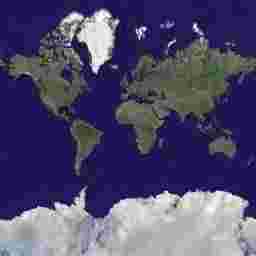
If you add a letter to the t parameter, then you zoom in by a factor of 2, and the maps will consist of the TLHQ, TRHQ, BRHQ or the BLHQ of the previous level of zoom, depending on which letter is added.
http://kh2.google.com/kh?n=404&v=20&t=tq |
http://kh2.google.com/kh?n=404&v=20&t=tr |
http://kh2.google.com/kh?n=404&v=20&t=tt |
http://kh2.google.com/kh?n=404&v=20&t=ts |
Note that these are single tile displays.
Now let's find our way to Ottawa by successively zooming in by factors of 2x. Note again that these are single tile displays. Actual detail maps are made up of multiple tiles placed close together.
| North America, the TLHQ of the world is http://kh2.google.com/kh?n=404&v=20&t=tq |
the BRHQ of which is http://kh2.google.com/ kh?n=404&v=20&t=tqs  |
the TLHQ of which is http://kh2.google.com/ kh?n=404&v=20&t=tqsq  |
| the BLHQ of which is http://kh2.google.com/ kh?n=404&v=20&t=tqsqt  |
the BRHQ of which is http://kh2.google.com/ kh?n=404&v=20&t=tqsqts  |
the TLHQ of which is http://kh2.google.com/ kh?n=404&v=20&t=tqsqtsq  |
| the BRHQ of which is http://kh2.google.com/ kh?n=404&v=20&t=tqsqtsqs  |
the BLHQ of which is http://kh2.google.com/ kh?n=404&v=20&t=tqsqtsqst  |
the BLHQ of which is http://kh2.google.com/ kh?n=404&v=20&t=tqsqtsqstt  |
| the TLHQ of which is http://kh2.google.com/ kh?n=404&v=20&t=tqsqtsqsttq  |
the BRHQ of which is http://kh2.google.com/ kh?n=404&v=20&t=tqsqtsqsttqs  |
the TLHQ of which is http://kh2.google.com/ kh?n=404&v=20&t=tqsqtsqsttqsq  This is downtown GATINEAU-OTTAWA |
Note that with just 12 zooms of 2x, the tile has zoomed in from covering the world to just covering downtown Ottawa. Thus the size of the world is just 212 = 4096 times the size of downtown Ottawa. By this I mean that the width of the territory represented by the base tile (t=t, a Mercator projection of the world, the width of which represents the equatorial circumference of the earth) is 4096 times larger than the width of the territory represented by the tile coded t=tqsqtsqsttqsq (downtown Ottawa-Hull).
I did this for Bosworth's farm, see entry dated 2005-05-13 below. Having discovered the lot and concession number, and identified these from Ontario Base Maps, I identified the same features on a Google Maps satellite view of the area. I then discovered the URLs of the tiles making that view, downloaded them, and stiched them together into a 3072 x 2048 pixel JPG. This final image consists of 12 x 8 = 96 tiles. The zoom level is the highest available (level 18). The image shown is reduced in size to fit this window. To see the full size image, click on the picture.
In 2005, I never thought to Google for map tiling information, I just figured it out on my own. Two years later (2007) I did search for further details on Google Map tiling, and discovered that much had been written on this topic. Some of these articles are listed below under "Sources".
Sources
Mapping Google, February 09, 2005
JeremyDunck, Simple Analysis of Google Map and Satellite Tiles, last edited 2005-05-21.
Noah Vawter (Computing Culture, MIT Media Lab), Google Map Hack for Large Maps, second half of "Looking for something?".
Fetch Google Maps tiles via latitude/longitude . Enter lattitude, longitude and zoom level, and a 3 x 3 tile map is generated. Further down the page, are maps of Australia. If you place your mouse over highlighted airea, the tooltip gives you the "keyhole address" eg ts for Australia, tsrr for SW Australia.
Michal Guerquin and Zach Frazier, How big is the world? (of Google Maps), February 2005 (updated in April, June and July 2005). "If we add up all the areas, we find that 171,798,691,680,000 (171 trillion) pixels are needed to store all the bitmap information. Since all maps are made up of small 128x128 tiles, one can venture to guess that there are 171,798,691,680,000/(128*128) = 10,485,759,990 (10.5 billion) potential tile files."
Guerquin and Frazier refer to 128x128 pixel tiles. Today the tile size is 256x256 pixels.
Discover Bosworth's Farm at Trafalgar
A breakthrough in my research on Newton Bosworth (1778-1848), I discover the exact location of his farm at Trafalgar, and the land registry documents that prove that he owned it from Feb 1835 until Nov 1842. But there were red herrings and some detective work was required.
Bosworth was a school teacher, a Baptist minister and a farmer, who emigrated to Canada in May 1834. He and his family first lived on a rented farm in York Mills, 8 miles north of Toronto. But he wanted to own a farm.
Bosworth describes a long conversation he had with Governor Sir John Colborne (Lt-Governor of Upper Canada,1828-36) in the summer of 1834, a map lying before them, on the most eligible spots for settlement. He went with his son Thomas to explore some parts of the country that Colborne had pointed out to them. In a letter to England, he writes:
" . . As land in the vicinity of the capital is too dear for us to purchase a sufficient quantity with our scanty means, we have long been looking about for a more eligible scite [as he spells it], and have at length purchased two farms contiguous to each other, on Dundas Street, about 35 miles from this [his York Mills farm] — and to which we shall probably remove in the course of the year. . . . . Our new farms are partly cleared and already sown for the next crop. . . . Our new situation will be much nearer to two good markets for the sale of produce, than we are now to one. The first of these is the rising village of Oakville on the shore of Lake Ontario, between York and Hamilton; and where a great deal of business is already doing. The other is, the mouth of the river Credit [Port Credit] on the same Lake, where a fine harbour is in preparation. . ."
No sooner had Newton Bosworth settled on his new farm in 1835, than he was called to Montreal to lead the Baptist church there. F.H. Armstrong, writing about Bosworth, concluded that the new farm purchase was abandoned:
" . . instead of moving to the Port Credit area as planned, he accepted a charge in Montreal."
- the first red herring.
But there were two clues that indicated that he had not abandoned the new farm. Firstly, the church register in Montreal showed Bosworth a member, but not his son Thomas, the farmer. Secondly, after Bosworth left Montreal in April 1839, he wrote a letter dated “Trafalgar, 16 December 1841” to the widow of his old friend Olinthus Gregory (1774-1841) who had asked him for details about her husband’s early life.
At first I thought that Trafalgar was a village at the intersection of Dundas Street and Trafalgar Road (the road from Oakville). But later it turned out that the reference to Trafalgar was to a township by that name in Halton County. So while in Toronto, on Wed and Thur 2005-05-11 and -12, I searched the land registry records at the Archives of Ontario. These are microfilm copies of the Mormon filming of the original documents. In the 1830s there were three types of record books kept:
The name index was not as helpful as expected, because it was an index of "first-named" persons in the registration instruments. In these documents, the first named is the seller, not the buyer. I had no idea who was selling the farm to Bosworth. Bosworth's name did not appear in this name index until he was first-named. As it turned out, this document referred to the same farm he bought in 1835, so this was my first clue as to its location.
I searched each lot in each concession in the Abstract Index Books for entries dated about 1835 until I found the name Bosworth. Since the books of Instrument details (the Copy Books) are rarely looked at, these entries were still easy to read when filmed. However the Abstract Index is frequently searched, so that the ink in the originals of these books has been exposed to more sunlight. The early entries in these are now so faint (were faint when filmed), that identifying the names is extremely difficult without prior knowledge of where to look - I had found a clue in the Alphabetical Name Index. Eventually I did identify the Abstract Index entries for Bosworth. The cross-references to the legal documents in the Copy Books confirmed that these were for Newton Bosworth, and that his farm was located in the northern half of Lot 20, Concession 2N, Trafalgar Township in Halton County, which is in the second concession north of Dundas Street.
Sixteen Mile Creek (so named because its mouth is 16 miles from the Head of the Lake) passes through the middle of lot 20 through a deep ravine. Sixteen Mile Creek and Dundas Street figured prominently in the escape of William Lyon Mackenzie, following the defeat of his rebels at Montgomery's Tavern, during the Upper Canada Rebellion of December 1837. Today the new 407 electronic toll highway passes through lot 20, and the 407 interchange with Neyagawa Blvd is right in the middle of the southern half of lot 20 (see map at the end of the previous blog entry - on Google Map Tiling)..
For further details and background, see Trafalgar Farm.
Sources:
The “Trafalgar” letter, the church registers of 1st Baptist church in Montreal, and a diary of Bosworth, are in the Baptist Archives at McMaster University, Hamilton, ON.
F.H. Armstrong, The Rev Newton Bosworth: pioneer settler on Yonge St., Ontario History, v.58, #3 (Sept 1966), pp.163-171.
The letter Bosworth wrote in Jan-Feb 1835 to his friends Beldam and Matthews in England, is in the Baldwin Room of the Toronto Public Libraries [Armstrong, p163, footnote 1].
Archives of Ontario, 77 Granville Street, Toronto, ON, between Bay and University.
Michel Prévost, Archivist at University of Ottawa
I met Michel Prévost, University of Ottawa Chief Archivist, today. He showed me many pictures of the origins of the University of Ottawa. He is also President of the Outaouais Historical Society, and in summer does historical walking tours of that region. He can be found at
Room 012, 100 Marie-Curie, Ottawa, ON, K1N 6N5
613-562-5825, Michel.Prevost@uottawa.ca
Based on the sources he provided, I was able to write the following summary histories of the Universities of Ottawa and St Paul’s.
In September 1848, the Oblate Fathers led by Adrien Telmon (first Oblate pastor of Ottawa) and Joseph-Eugène-Bruno Guigues (first Bishop of Bytown) established the College of Bytown. It was truly bilingual, teaching in French in the morning, and in English in the afternoon. The first college building was a small wooden structure built in 1848 on Guigue Street behind the cathedral (see plaque at 58 Guigue). It was initially called St Joseph's College. In 1849, it was civilly incorporated as the College of Bytown. But it became too small, so in 1852 a stone building was built on Sussex at the corner of Guigue, and the college moved into it in 1853. When the college moved to Wilbrod in 1856, this building became the Auberge Champagne, a military barracks in 1866, the Notre Dame parish school in 1870, and the Académie-de-la-Salle in 1899. The smaller building attached to it, built in 1844 by Thomas Donnelly, was Mgr. Guigue's "palace" (residence) from 1847 to 1850. Both buildings still stand, though the facades have changed many times over the years. A third building was built in Sandy Hill on Wilbrod (in the block between Cumberland and Waller, where the Tabaret parking lot is now) on land donated in 1846 by L-T Besserer. (Willbrod was named after his son). The first classes were held there in 1856. By 1887, it had expanded to cover the entire block. (In 1987, the University purchased this block, and today it is known as Séraphin Marion). In 1861, the college was renamed College of Ottawa, when the town became Ottawa. In 1893-4, the Juniorat du Sacré-Coeur was built on Laurier at Cumberland. Until 1968, the Juniorat was a high school for young men intending to join the OMI. In 1970, it was bought by the University of Ottawa. It is the oldest building on campus. In 1901, a new Science building (now called Academic Hall) was opened on Wilbrod opposite the main 1856 college building. The latter was destroyed by fire on Dec 2, 1903, and Academic Hall became the temporary main college building. On May 24, 1904, the corner stone was laid for Tabaret Hall and the central portion opened in 1905 (the entire building was not completed until 1931). In 1866, the Parliament of Canada gave the College of Ottawa a civil charter permitting it to grant degrees in literature, science, law and medicine. In 1889, Pope Leo XIII, granted the college a pontifical charter permitting it to confer ecclesiastical degrees in theology, philosophy and canon law, and the college started calling itself the University of Ottawa (see '88 and '89 calendars). The university has been conferring undergraduate degrees since 1872, master's degrees since 1875, and PhDs since 1888. It is the oldest and largest bilingual university in North America.
The University of Ottawa and St Paul's University have common roots, and on this basis, St Paul's is considered to also have been founded in 1848. The pontifical charter of 1889 allowed the College of Ottawa to confer ecclesiastical degrees in theology, philosophy and canon law. Philosophy and Theology were taught in Latin. Unable to accept the "French fact" at the university, the "Irish" Oblates, and a large number of anglophone students, left in 1915 to form St Patrick's College on Echo Drive (now Immaculata). In May 1937, the new University Seminary, dedicated to Saint Paul, was officially opened on 249 Main Street, and the faculties of Theology and Canon Law moved into it in the same year. The faculty of Philosophy followed in 1943. In 1958, construction began of a new building between the Seminary and the St Joseph Scholasticate, and was opened two years later. Denominational establishments were ineligible for provincial funding. By July 1965, the Oblates were no longer able to bear the load alone. An agreement was reached with Ontario. The old University of Ottawa disappeared. It was replaced by two new ones, St Paul's University and the new University of Ottawa. Both were now incorporated, permitting provincial funding, thus ending the exclusive control of the Oblates. The two universities formed a federation. Under the terms of the agreement, St Paul's University kept the civil and pontifical charters, and the Faculties of Theology and Canon Law under the aegis of the Oblates. The new University of Ottawa kept the civil Faculties and Schools and most of the physical assets.
Sources
Saint Paul University, Calendar, 1996-1998, published by the university.
Cum apostolica sedes, Centenary of the Pontifical Charter, 1889-1989, Saint Paul University; published by the university in 1989.
Michel Prévost, University of Ottawa, 150 years, 1848-1998, Ottawa: University of Ottawa Archives, 1998.
L'Académie De-La-Salle, 1844-1973, Le Droit, (63e anne, No. 171), Sam 18 Oct 1975, pp.13-14 (4 photos).
Walking Tour of the University of Ottawa's historical sector, Ottawa: University of Ottawa Archives, n.d.
It was during my research on Loop Quantum Gravity that I discovered a great source of full text documents online for theoretical physics, known as arXiv (the "X" represents the Greek letter ? (Chi), so the word is pronounced "archive").
ArXiv is an e-print service in the fields of physics, mathematics, non-linear science, computer science, and quantitative biology. The contents of arXiv conform to Cornell University academic standards. arXiv is owned, operated and funded by Cornell University, a private not-for-profit educational institution. ArXiv is also partially funded by the National Science Foundation. Most researchers in these fields now publish their papers in this open depositary rather than in paper based journals which charge high subscription rates. Another advantage of digital publishing is that errors can be corrected, and papers can be updated - which they often are in arXiv. Almost all of the papers referenced below in the entry on LQG may be found in and downloaded from this archive.
To retrieve the abstract of a High Energy Physics Theory paper with the reference hep-th/0310224, say, go to
http://arxiv.org/abs/hep-th/0310224
To retrieve the full text of this paper in PDF, go to http://arxiv.org/pdf/hep-th/0310224. To search ArXiv by author, title, abstract, source journal etc., go to http://arxiv.org/find. For further info, go to http://arxiv.org/help.
I became interested in Lee Smolin’s article in Scientific American, January 2004, about this time (June 2004). In the search for a theory of quantum gravity, to combine the theories of gravity with those of quantum mechanics, an interesting theory, known as Loop Quantum Gravity (LQG) has evolved. For a fuller more detailed review of LQG, and the dualities involved, see my web page Duality of Spacetime and Matter.
Development of the various String Theories of Everything have stalled. LQG seems to solve many of the String Theory problems. Many papers on this topic have been published this year by researchers at the Perimeter Institute for Theoretical Physics, Waterloo, ON, which was founded in the fall of 1999 by Mike Lazaridis, President and Co-CEO of Research In Motion (RIM). Lee Smolin was a founding member.
The Gamma-ray Large Area Space Telescope (GLAST), will be able to confirm some of LQG predictions. The launch has been delayed to December 14, 2007, see
GLAST User's Group (GUG), Telecon, April 20, 2007
To paraphrase Matthew Chalmers [PW-1]:
"There are two routes to quantum gravity. The first is to formulate general realtivity into a quantum field theory in which the gravitational force is carried by the exchange of gravitons. The problem is that gravtons carry mass and energy, which are the source of the gravitational field in the first place. This leads to infinities that render calculations meaningless.
"One way round this problem is to replace the idea of point-like particles with infinitesimal 1D strings (eg see Susskind [PW-3]). However, there are too many string theories, and too many dimensions (see Quevedo [PW-2]) . Since 1995, M-theory is helping theorists understand what it all means. (M-theory encompasses all the string theories, adds extended objects called p-branes and D-branes, and adds an 11th dimension [PW-6][PW-7][Berg-1][Berg-2][DAMTP-2]).
"String theory is based on conventional quantum mechanics and assumes that spacetime is a fixed background on which particles move and interact. The second route to quantum gravity, however, starts with general relativity and involves completely rewriting quantum theory. In loop quantum gravity, there is no such thing as space, only fields. Carlo Rovelli ([PW-4] and elsewhere) arrived at a background-independent quantum field theory by treating the gravitational field in terms of closed lines or loops."
In his 1997 paper [Rov-17], Rovelli concludes:
"The most remarkable physical result obtained from loop quantum gravity is, in my opinion, evidence for a physical (quantum) discreteness of space at the Planck scale. This is manifested in the fact that certain operators corresponding to the measurement of geometrical quantities, in particular area and volume, have discrete spectrum. According to the standard interpretation of quantum mechanics (which we adopt), this means that the theory predicts that a physical measurement of an area or a volume will necessarily yield quantized results. Since the smallest eigenvalues are of Planck scale, this implies that there is no way of observing areas or volumes smaller than Planck scale. Space comes in "quanta'' in the same manner as the energy of an oscillator. The spectra of the area and volume operators have been computed with much detail in loop quantum gravity. These spectra have a complicated structure, and they constitute detailed quantitative physical predictions of loop quantum gravity on Planck scale physics. If we had experimental access to Planck scale physics, they would allow the theory to be empirically tested in great detail.
"A few comments are in order.
In the conclusions to his 2004 book Quantum Gravity [Rov-1, sec 10.2] Carlo Rovelli says:
Rovelli, in Appendix B of his 2004 book Quantum Gravity [Rov-1], gives a detailed 17 page history of the evolution of LQG. A shorter history (2.5pp) is contained in section 3 of his 1997 paper on Loop Quantum Gravity [Rov-17]. An even shorter history (1 page) appears at the end of section 6 (p197) of [Rov-1]. Carlo Rovelli is well qualified to write such histories, since as well as being one of the originators of the theory, he is both a professor at the Centre de Physique Théorique, CNRS-Luminy, Marseille, and a Professor of History and Philosophy of Science at the University of Pittsburg, in Pittsburg, PA.
A reconstruction of the early history of all the explorations of the quantum properties of spacetime, including the three main approaches, from Einstein (1916 ) and Klein (1927) to the present day, may be found in:
John Stachel, Early history of quantum gravity (1916-1940), presented at the HGR5, Notre Dame, July 1999; and in Black Holes, Gravitational radiation and the Universe, edited by BR Iyer and B Bhawal, Kluwer Academic, Netherlands 1999.
Carlo Rovelli, Notes for a brief history of quantum gravity, presented at the 9th Marcel Grossmann Meeting in Roma, July 2000, (arXiv:gr-qc/0006061 v3, 23Jan2001), updated: May 17, 2006; 32pp, 120 refs.
In the latter, Rovelli describes in detail the three main lines of research:
and the five main periods of evolution of quantum gravity research.
The Perimeter Institute for Theoretical Physics was founded with the help of RIM's Lazaridis' personal donation of $100 M , together with additional donations of $10 M each by fellow RIM executives Doug Fregin and Jim Balsillie. The Scientific Advisory Committee includes Sir Roger Penrose.
Sources include:
(See arXiv above for details on access to papers from this source.)
Lee Smolin, How far are we from the quantum theory of gravity?, arXiv:hep-th/0303185v2 11 Apr 2003, updated 2003-03-19.
Lee Smolin, Atoms of Space and Time, Scientific American, January 2004, pp66-75.
Lee Smolin, Three Roads to Quantum Gravity, Perseus Books Group, published 1957, ISBN 0465071406
Three Roads to Quantum Gravity is moving in and out of some best seller lists including the science bestseller lists at Blackwells and at Amazon.com. The Guardian published Mark Buchanan 's review of Three Roads to Quantum Gravity in an article titled “Quantum leap.” 17 February 2001. New Scientist published Robert Matthew's review of Three Roads to Quantum Gravity. 3 February 2001. The Independent published John Gribbin's review of Three Roads to Quantum Gravity in an article titled “Explaining the universe - it's child's play.” 25 January 2001.Scientific American published Chet Raymo's review of Three Roads to Quantum Gravity in an article titled “A Spin on Spin Foam.” August 2001. Nature published David Lindley's review of Three Roads to Quantum Gravity in an article titled “Falling to Earth in a quantum way.”. 8 March 2001.
Lee Smolin, Wikipedia.
Loop Quantum Gravity, Wikipedia.
The Perimeter Institute. For details of the founding donations to the institute, see.
Melvyn Bragg discussed Quantum Gravity with John Gribbin, Janna Levin, and Lee Smolin on the BBC Radio 4 program In Our Time. 22 February 2001
[PW-1] Matthew Chalmers (Features ed, Phys World), Welcome to quantum gravity, Physics World, v16, #11, Nov 2003.
[PW-2] Fernando Quevedo (DAMTP), The string-theory landscape, Physics World, v16, #11, Nov 2003, same as [DAMTP-4].
[PW-3] Leonard Susskind, Superstrings, Physics World, v16, #11, Nov 2003.
[PW-4] Carlo Rovelli, Loop Quantum Gravity, Physics World, v16, #11, Nov 2003.
[PW-5] Amelino Camelia-Giovanni, Quantum-gravity phenomenology, Physics World, v16, #11, Nov 2003, same as [ACG-3].
[PW-6] Steven Abel and John March-Russell, The search for extra dimensionis, Physics World, Nov 2000.
[PW-7] Brian Green, The Elegant Universe: superstrings, hidden dimensions and the quest for the Ultimate theory, 1999, Jonathan Cape/W W Norton, 448pp
[PW-8] John Charap (Univ London), String Theory: simple yet elegant, a review of [PW-6], Physics World, July 1999.
[Ash-21] Abhay Ashtekar, Carlo Rovelli, Lee Smolin, Weaving a classical geometry with quantum threads, Mar 1992, 9pp, Phys.Rev.Lett. 69 (1992) 237-240, same as [Rov-24], [Smo-17]
[Berg-1] E Berghoeff, p-Branes, D-Branes and M-Branes, Nov 1996.
[Berg-2] E Berghoeff, p-Branes and D-Branes actions, July 1996.
[DAMTP-2] Carlos Herdeiro, M-Theory, the theory formerly known as Strings, ?1996,
Carlo Rovelli, Luminy, Case 907, F 13288 Marseille, France. rovelli@cpt.univ-mrs.fr . Professeur (Ire classe), Université de la Méditerranée et Centre de Physique Théorique, CNRS-Luminy, Marseille, France
[Rov-1] Carlo Rovelli, Quantum Gravity, to be published by Cambridge University Press, 347pp, 359 refs, draft
dated 2003-12-30 available from Centre de Physique Theorique
(Luminy, Marseille, France). or from
backup, (both 4.7 MB).
Carlo Rovelli, Quantum Gravity, Cambridge Monographs on Mathematical Physics, 480pp, Cambridge: Cambridge University Press, 2004
[Rov-17] Carlo Rovelli, Loop Quantum Gravity, arXiv, Oct 1997; Loop Quantum Gravity, Living Rev.Rel. 1 (1998) 1 [http://www.livingreviews.org/lrr-1998-1 redirects to the same], or at Loop Quantum Gravity, The European Mathematical Information Service (EMIS), journals, Living Reviews in Relativity (Published by the Max Planck Institute for Gravitational Physics), Volume 1 - 1998.
[Rov-18] Simonetta Fritelli, Luis Lehner, Carlo Rovelli, The complete spectrum of the area from recoupling theory in loop quantum gravity, Class.Quantum.Grav. 13 (1996) 2921-2932, Aug 1996, 12pp.
[Rov-23] Roberto De Pietri, Carlo Rovelli, Geometry Eigenvalues and Scalar Product from Recoupling Theory in Loop Quantum Gravity, Phys.Rev D54 (1996) 2664-2690, Feb 1996, 37pp.
[Rov-28] Carlo Rovelli, Lee Smolin, Discreteness of area and volume in quantum gravity, Nucl Phys B442 (1995) 593; Erratum Nucl Phys B456 (1995) 734, Nov 1994, 36pp, same as [RQG6-174].
Thomas Thiemann, Albert-Einstein-Institut, Golm near Potsdam, Germany
His 24 most recent papers (2003-1994) may be found at http://arxiv.org/find/gr-qc,hep-th/1/au:+Thiemann_Thomas/0/1/0/all/0/1. Note Thiemann uses the term "Canonical Quantum General Relativity" rather than "Loop Quantum Gravity"
[Thi-22] Thomas Thiemann, A Length Operator for Canonical Quantum Gravity , J Math Phys 39 (1998) 3372- 3392, gr-qc/9606092
[Thi-23] Thomas Thiemann, Closed Formula for the Matrix Elements of the Volume Operator in Canonical Quantum Gravity, J Math Phys 39 (1998) 3347-3371, gr-qc/9606091
Discover Location of Montreal Baptist College
I discovered some old maps this week in the Canadian National Map Collection at what was then the Public Archives of Canada. The James Cane map of Montreal dated 1846 was the only one I found that identified the building on the SW corner of Dorchester and Guy as the Baptist College, so confirming the location of the new (and final) Canada Baptist College building. The college went under in 1849 and had to be sold to the Catholics. The Boxer map dated 1859 identified the same building as St Patrick’s Hospital, as did the 1861 edition of Boxer’s map. The 1872 Johnston’s map identified the same building as “Mont Ste Marie”. The Walling 1875 map showed the same building with the same name and an easterly extension. The Fudge map of 1881 called it Mount St Mary Convent with by this time a wing extending north. Charles Goads maps of 1890 and 1903 showed the building still in the shape of an L, and still bearing the title Mount St Mary Convent.
For a more detailed description of the Canada Baptist College see my web page on this topic.
Bosworth Research in Toronto, Paris and Hamilton.
As part of my research on the Bosworth family, I drove from Aurora to downtown Toronto (2 hours) to Knox College library on St George Street, arriving there 5 minutes before closing. Librarian Chris Tucker made me a library member, which allowed me to borrow George Campbell's thesis on Canada Baptist College. Drove on to Hamilton, where I stayed overnight.
Next morning, Thursday, I drove to Paris, and spent the day exploring and photographing 22 Church Street, former residence of Newton Bosworth's older brother, the old cemetery at the top of the hill on Church street, the new (1876) cemetery and the Bosworth grave stone, the site of the Baptist Chapel on West Street, the house opposite which was probably the Parsonage, and the land on the banks of the Nith River north of Governors Road West where Thomas Bosworth had his farm. I met Marg Deans (a local historian) at 1pm at the Library. Donated $100 to the Historical Society, as a thank-you for her help. Stayed overnight in Paris at a motel for $45.
Left Paris Friday morning, heading East along original Governors Road. Stopped by at Brantford Land Registry Office (80 Wellington) where they gave me a copy of the Mortgage for Thomas Bosworth's property on Lot 10, Concession 1, Brantford Township. Visited Brant County Museum in Market Mall to look for registration of Thomas' farm property - unsuccessful.
Drove into west end of Hamilton to visit McMaster Baptist Archives. Met Ken Morgan, who was then in charge of the archives, and he found pamphlets on First Baptist Church in Montreal, which he photocopied for me. Newton Bosworth was the second pastor of this early Montreal church.
The DARPA Grand Challenge is a prize competition for driverless cars, sponsored by the Defense Advanced Research Projects Agency (DARPA). There is a good description of the DARPA robot vehicle races, at
The first Grand Challenge, with a prize of $1M, was in Mar 13, 2004. The second in 2005, had a prize of $2M.
In November 2007, DARPA had an Urban Challenge (also $2M prize money), which was much harder in that they had to obey all traffic laws while they detecting and avoiding other robots on the course, including merging into traffic.
More details of the 2005 race may be found at 2005 DARPA Grand Challenge
The Stanford Vehicle (nicknamed "Stanley") is based on a stock, Diesel-powered Volkswagen Touareg R5, modified with full body skid plates and a reinforced front bumper. Stanley is actuated via a drive-by-wire system developed by Volkswagen of America's Electronic Research Lab.
All processing takes place on seven Pentium M computers, powered by a battery-backed, electronically-controlled power system. The vehicle incorporates measurements from GPS, a 6DOF inertial measurement unit, and wheel speed for pose estimation.
While the vehicle is in motion, the environment is perceived through four laser range finders, a radar system, a stereo camera pair, and a monocular vision system. All sensors acquire environment data at rates between 10 and 100 Hertz. Map and pose information are incorporated at 10 Hz, enabling Stanley to avoid collisions with obstacles in real-time while advancing along the 2005 DARPA Grand Challenge route.
I never thought about the fact that a video camera, even a stereo video camera, cannot easily determine how far ahead objects in the picture are. Combining a camera with a laser range finder makes sense, in that it provides the third dimension.
Stanley was characterized by a machine learning based approach to obstacle detection. Data from the LIDARs was fused with images from the vision system to perform more distant look-ahead. If a path of drivable terrain could not be detected for at least 40 meters in front of the vehicle, speed was decreased and the LIDARs used to locate a safe passage.
To correct a common error made by Stanley early in development, the Stanford Racing Team created a log of "human reactions and decisions" and fed the data into a learning algorithm tied to the vehicles controls; this action served to greatly reduce Stanley's errors. The computer log of humans driving also made Stanley more accurate in detecting shadows, a problem that had caused many of the vehicle failures in the 2004 DARPA Grand Challenge.
For descriptions of and reports on the 2005 winning vehicle "Stanley", see
Stanley, Wikipedia,
Roadrunner, Stanford
Stanford Racing, Stanford
Hanna Hickey, Move over, Herbie, Stanford Report, May 18, 2005
Old Technology. Stanford
I attended a very interesting recital in Freiman Hall at the University of Ottawa at noon today. David Stewart and Karen Homes were demonstrating early and modern tuning experiments.
The system for tuning keyboard instruments was not standardized until the early twentieth century. Nowadays, pianos are almost always tuned in equal temperament, and there is the tendency to think that this is the "right" tuning, and that earlier musicians would have used it, if only they could have figured out how! In fact, even in the nineteenth century, pianos were tuned to favour certain keys, and in earlier times, musicians delighted in using a variety of tunings. Today's presentation will demonstrate some tuning experiments, old and new.
Various so-called "meantone" tunings were common in the pre-Baroque period. Instruments tuned this way sound well in common keys, but cannot be used in more "remote" keys such as F# or C# major.
Composers of music for stringed instruments also experimented with tunings different from the conventional tuning in fifths. This use of "scordatura", in which, for example, the usual "e string" might be tuned to "d", permitted special effects such as greater simultaneous use of open strings. Composers such as Pachelbel, Schmelzer, and especially Heinrich Biber, wrote music calling for different "scordaturas".
An Increasing interest in world music has led contemporary composers to borrow ideas from various ethnic music styles, including the use of quarter-tones, or other micro-tones. Experimenting with tuning on a modern piano is totally impractical, but on a harpsichord with two keyboards it is easy. For the last two pieces on today's programme, the lower manual is tuned one quarter-tone lower than the upper.
Karen Homes had two harpsichords on stage, one tuned in a "mean-tone" manner, and the other tuned with the lower manual is tuned one quarter-tone lower than the upper. David Stewart had his violin tuned in a "scordatura" manner. This involved tightening one of the strings to a much higher pitch than it was designed for. He therefore carried a spare string in his pocket, in case the string broke.
Karen Holmes played pieces by Sweenlinck (1561-1621) and Ligeti (b.1923) in mean-tone tuning. David Stewart played two pieces by Biber (1644-1704) on his "scordatura" violin. Finally, Holmes played pieces by Mather (b.1939) and Tiensuu (b.1948) on the "quarter-tone" tuned harpsichord.
Traction drives are continuously variable transmissions without gears or belts that counter-intuitively use oil rather than friction to couple the input and output shafts. Under extremely high pressure, the oil, rather than acting as a lubricant, provides a "solid-like" connection between the coupling surfaces. These were used in stationary and mobile (vehicular) machinery as early as the 19th century.
“Traction drives have been around for a long time but have not made a major impact on the power-transmission industry. The main obstacle to their increased use has been a lack of confidence in the fact that two smooth rollers can transmit force through a fluid. However, the block to using traction drives appears to be dissipating, aided by design changes that have improved capabilities. These advances, combined with ease of maintenance are making traction drives formidable competitors to conventional adjustable-speed drives. *
“Presently, the ball variator accounts for the majority of traction drives sold; however, Beier disc and ring cone drives also are widely used. In addition, planetary, toroidal, and ring roller devices have carved out niches as commercially proven traction drives. The friction drive (which some experts would not classify as a traction drive) rounds out the field of traction drives.
“In general, traction drives are finding applications where compactness, ruggedness, and speed-control accuracy are primary concerns. The micrometer speed-setting dial on most traction drives attests to their inherent accuracy in maintaining a specific output speed. In addition, most conventional adjustable-speed drives require additional components to start smoothly. Traction drives, in contrast, automatically provide the extra torque needed at reduced speeds.”
I read Heinlich and Shube’s book
Frederick W. Heinlich III and Eugene E. Shube, Traction Drives, selection and application, New York: Marcel Dekker, 1983; OOU: TJ1095.H44, 1983.
and got interested in the history of Traction Drives in automobiles. This led to researching the history of automobiles, resulting in a short article on both subjects, now on this web page. A list of current manufacturers of such drives may be found at Traction Drives.
Dating Old Photographs by their Content
,harbrim2.jpg) |
My father died when I was young (1956). My mother did not die until 1996, but neither she nor anyone else in our family ever mentioned this album to us (my brother or me). So it was an interesting discovery when he found the album in 2002.
There were no date or name annotations on any of the photos or the pages of the album. The two oldest photos, those of WHF Johnson and of Harriet Brimley, are sepia coloured on thick card stock bearing the tiny mark "Marion, Tmp. Paris" on the back, together with an engraved stamp showing that they were taken by Hills & Saunders, Cambridge.
The only way to date these earliest photos was by their content. The National Archives of Canada have a Costume Collection, a collection of photos of people which are sorted by date. The fashion style of the clothes worn by Harriet Brimley, the furniture style, the table cloths etc., in our album photo of her is consistent with those photos in the Costume Collection all having been taken in the period 1865-67. Photos in this collection before and after this period are quite different.
In Sources for English Photographic History. Ian Leith gives the following sources for dating photographs by fashion:
If these photos were taken about 1865, then WHF Johnson would have been 40 years old, and Harriet Brimley would have been 36 years old.
I was interested in determining the context of these photos, whether they were taken early on in the history of print photography, and whether the photo studio was one of the first in Cambridge.
"The earliest photographic process was the Daguerreotype, first invented in 1831. Portraits made using this process were expensive and it was not until 1851 that a cheaper process came along. This was the collodian positive invented by F. Scott Archer of Bishop's Stortford which captured images on glass." *
Henry Fox Talbot was the first to create permanent (negative) images using paper soaked in silver chloride and fixed with a salt solution in 1834. But he did not patent his process until 1841 using the name "calotype". His positive images were created by contact printing onto another sheet of paper. Louis Daguerre created his images on silver-plated copper, coated with silver iodide and "developed" with warmed mercury in 1837.
Albumen prints are photographs secured on albumen paper. Iron traces were removed from raw paper. The paper was then treated with egg white (albumen). These photographs are sepia (brown) in color and have a glossy appearance with depth.
Hills & Saunders were established at “Harrow-on-the-Hill in 1852, just 13 years after William Henry Fox Talbot almost burnt down the famous school whilst experimenting on his way to discovering photography as we know it today.” A display advert for Hills & Saunders, 15 Kings Parade (which is in Soham, Ely, 20 km NE of Cambridge), appearing on Oct 10, 1868, is noted by Petty. Today, there is only one office of Hills & Saunders left, that at Eton. The present owner bought it in 1989. He says that "the Cambridgeshire studio was listed in the 1881 Census at the 15 Kings Parade address being run by Robert Hills, the son of one of the founders".
Robert Leggat, in his “A History of Photography from its beginnings till the 1920s says that
Richard Beard was Britain's first portrait photographer in 1841. “A coal merchant for a number of years, Beard became interested in photography from the moment it was announced. An entrepreneur rather than a photographer, he hired the right people, and having concluded that there might be considerable potential in daguerreotypes, he purchased the patent from Daguerre for £150 a year in 1841, and on 23 March that year the first professional portrait studio in England was officially opened. This studio was on the roof of the Polytechnic Institution in Regent Street, London, (now the University of Westminster) and John Goddard, a science lecturer, was his operator.”
Mike Petty, in his Cambridgeshire Photographers 1844-1990, an article attempting to identify the first person to have set up a professional studio in Cambridge, says that
"The earliest photographic process was the Daguerreotype, first invented in 1831 and recounted how portrait studios were established in London in 1840. Such portraits were expensive and it was not until 1851 that a cheaper process came along. This was the collodian positive invented by F. Scott Archer of Bishop's Stortford which captured images on glass. It had the important bonus in that the process was portable and itinerant photographers became great attractions at village feasts along with other stalls and shooting galleries. They were not always welcome apparently. In 1864 Henry Pendle of Soham, photographic artist, accused two Lt Downham men of causing wilful damage to his booth at Downham Feast - perhaps they did not like their likeness and at Ely the booths were described as eyesores and taking away trade from the established photographers. An early practitioner was Dick Hutchinson who lived somewhere on East Road and "worked" Yarmouth beach each Summer, though he apparently had no Cambridge studio.
"Other early contenders for the honour were considered to Edward Gage of Sidney Street, William Pugh of James Street and George Sheldon of Melbourn Passage who were amongst those trading in 1863 together with several others already covered by these present articles. But it now appears that these were not in fact the first.
"The earliest record of a Cambridge photographer seems to have been in August 1844 when the "Cambridge Chronicle" carried an advertisement for "Beard's Patent Daguerreotype or photographic portraits". They sent their reporter to St Mary's Passage where he expressed "surprise ... that the beautiful and marvellous art of Photographic portrait-painting has not long since been introduced into the town of Cambridge since other places of far less note have been favoured by enterprising individuals with opportunities of profiting by the Exercise of this Science". The reporter commented: "People fancy that everything which is got in London is better than the same thing in the country; but prima facie a photographic portrait taken by the action of light will be more perfect when the plate is acknowledged up in the clear atmosphere of Cambridge than in the pea soup affair which Londoners breath".
"The enterprising exponent who opened this studio in St Mary's Passage was William Nichols and his business flourished despite the newspaper's caution that: "Photography is no flatterer, it paints us as we are, with every wrinkle and every stray hair plainly marked" people responded to the challenge of having "their true lineaments indelibly stamped on metal". It would appear that he had been practising his profession elsewhere for in 1864 he acknowledges the patronage he had enjoyed for the previous 25 years - taking him back to 1839."
Sources include:
Mike Petty, Cambridgeshire Photographers 1844-1990, November 2006
Ian Leith (National Monuments Record, English Heritage) Sources for English Photographic History.
William Henry Fox Talbot, 11 February 1800 to 17 September 1877
Early Photographic Processes, Photogenic Drawing
Thanks to Andrew Rodger, Archivist, Photography Acquisitions and Research at Library and Archives Canada, for the last three sources.
Discover Location of Llandaff House
It was known that our family had lived in Llandaff House, Cambridge (UK), and we had a painting of the house and garden, but no living family member knew where the house was located. There is a description of inside the house in a book by Alice Johnson, but no address. During a visit to England in the spring of 1992, I took the opportunity to spend some time in Cambridge, where my family had lived in the 19th century, and attempt to find Llandaff House.
I visited the Public Library there, and they directed me to the The Cambridgeshire Collection, then located in Lion Yard Library, Cambridge. I asked about the house. To my surprise, Mike Petty the librarian in charge of the collection (also a local historian) was familiar with the history of the house. He produced a Post Office Directory of Cambridgeshire dated 1875, which included the listing:
“Johnson, Wm. Hy. Farthing, school for gentlemen, 2 Regent st”
William Henry Farthing Johnson (1825-1901) was my great-grand-father, owner of the school at Llandaff House, and deacon at the local Baptist Church just down the road. The librarian showed me a local map dated 1886 showing exactly where Llandaff House was located. He also produced old photographs of the street, including the front of the house. He produced a pamphlet, "Thoughts on Education", written by William Johnson (WHFJ’s father and the previous owner of the school), promoting it. But most useful, he produced an article about Llandaff House written by Kenneth Parsons, archivist at the Baptist church and an amateur local historian, titled
“A Nonconformist School, The Story of Llandaff House and its Academy, Regent Street, Cambridge”,
first published in the Cambridge Local History Society Bulletin No. 39, 1984. An updated version of this article appears on my web page Llandaff House
Parsons showed that the Johnsons had lived in this house from 1823 to 1903. WHFJ’s children, including Alice and George William, were born there. The house was knocked down in 1933 to make way for an expansion of Robinson's Bicycle Shop next door.
See also
W. Johnson, "Thoughts on Education, an address delivered to the friends and supporters of Llandaff-House Academy, Regent Street, Cambridge", London: Simpkin and Marshall; Cambridge: Stevenson, 1830.
Alice Johnson, "George William Johnson, Civil Servant and Social Worker by his sister Alice Johnson", Cambridge, 1927.
Kenneth Parsons
I went to visit Kenneth Parsons. He was then living at 1 Lees Way, Girton, Cambridge. He was a very old gentleman then, and has since expired. He invited me in to tea. He seemed thrilled to be meeting a descendant of one of the Cambridge families he had studied. He showed me family trees he had compiled of many of the interesting families in Cambridge, some of whom I was familiar with, because they had inter-married with my family. One tree included my grandmother, Lucy Nutter. I told him how interested I was in his article on Llandaff House and why.
Parsons also studied the life of Newton Bosworth (1778-1848), who had owned the school at Llandaff House before passing it on to his assistant, William Johnson, and who had emigrated to Canada in 1834. Parsons even visited Canada, in particular the Baptist Archives at McMaster University, in order to learn what happened to Bosworth in Canada.
WHF Johnson and his Baptist Church
I went to visit the Baptist church (St Andrew’s) and found many mementos of WHFJ. I found an oil painting of him hanging in a hallway at the back of the church - a nice surprise.
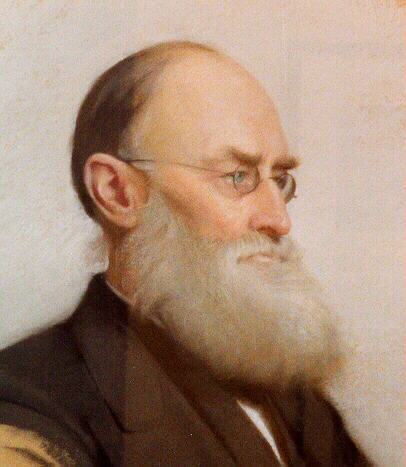
I found a pulpit built in memory of him by a group of former students at his school. There was a file on him in the church office. I found the grave-stone of his father.
